
We read your photo as:
A tractor (4 tonnes, 4000 cm² tyre contact area) and a car (1 tonne, 150 cm² tyre contact area) are on soft ground. Explain the physical features enabling the tractor to move easily and the car to sin
ScanSolve AI Answer
Answer
Step-by-step solution
3 stepsHere are the solutions to your tasks:
Part a
The physical features on the two vehicles leading to the observation in the scenario.
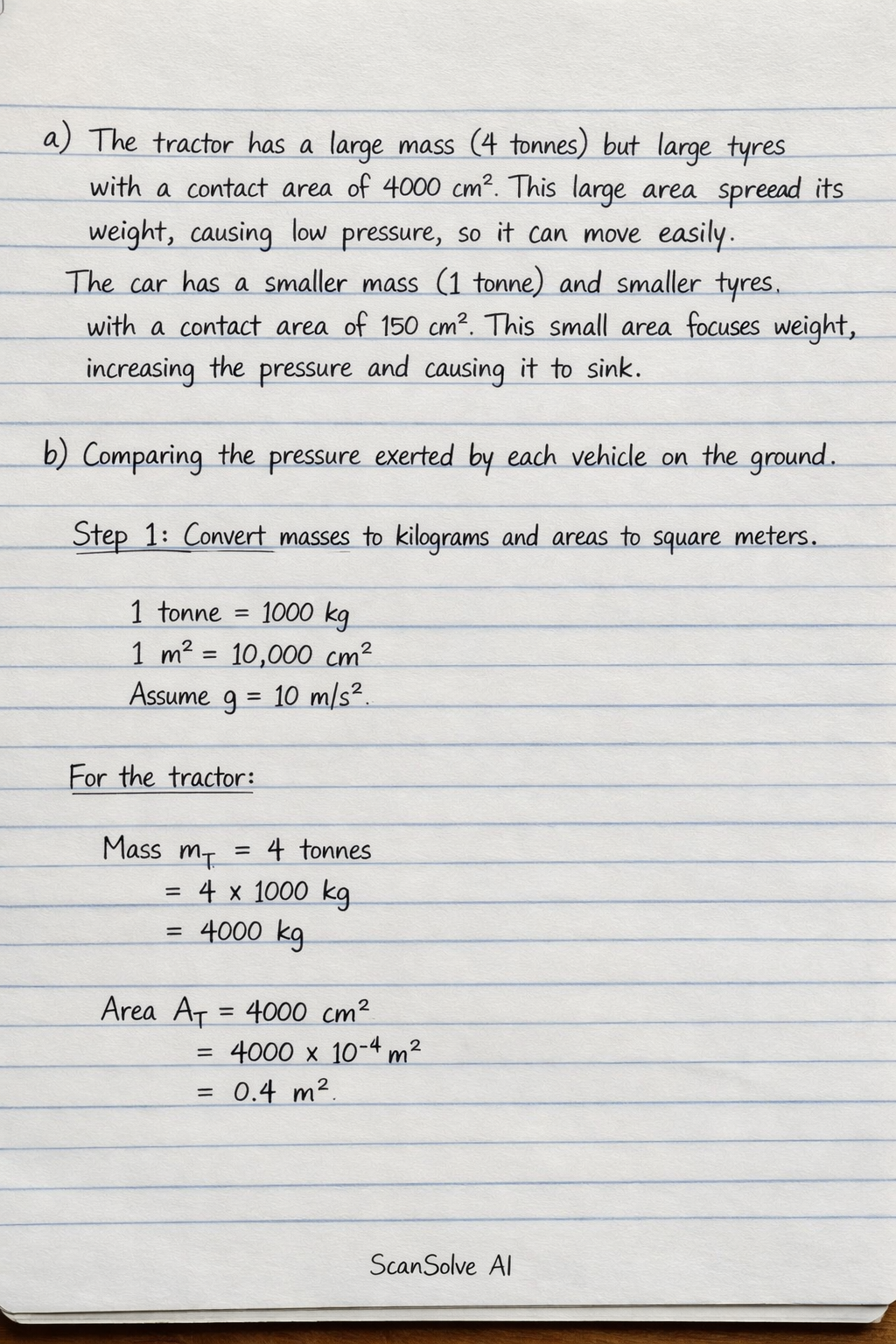
The tractor has a large mass (4 tonnes) but is equipped with large tyres that provide a significant contact area (4000 cm²). This large area distributes its weight, resulting in low pressure on the soft ground, allowing it to move easily. In contrast, the car has a smaller mass (1 tonne) but smaller tyres with a much smaller contact area (150 cm²). This concentrates its weight, leading to higher pressure and causing it to sink.
Part b
The comparison of the pressure exerted by each of the two vehicles on the ground.
Convert masses to kilograms and areas to square meters.
Given: , .
Assume acceleration due to gravity .For the tractor:
Mass
AreaFor the car:
Mass
AreaCalculate the force (weight) exerted by each vehicle.
Force .
For the tractor:For the car:
Calculate the pressure exerted by each vehicle.
Pressure .
For the tractor:For the car:
Comparison:
The pressure exerted by the tractor is .
The pressure exerted by the car is approximately .
The car exerts significantly more pressure on the ground than the tractor.
The pressure exerted by the tractor is and by the car is approximately .
Part c
The modifications that should be made to the father's car to enable it to move on soft ground with ease.
To enable the car to move on soft ground easily, the pressure it exerts on the ground must be reduced. This is achieved by increasing the contact area between the car and the ground. Modifications could include:
- Fitting wider tyres to the car.
- Using more tyres (e.g., dual wheels) or tracks (like a tank) to spread the weight over a larger area.
Part d
One application in real life where knowledge on pressure is applied.
Snowshoes are designed with a large surface area to distribute a person's weight over a wider area, reducing the pressure on the snow and preventing them from sinking.
Try one yourself
A new problem that tests the same skill.
Still stuck on this one?
Ask a follow-up, and the answer starts from this question.
More Physics Questions
Handwritten Step-by-Step Solution
Get this as a handwritten image on WhatsApp — like a tutor wrote it for you.
Try on WhatsApp