
We read your photo as:
The sketch below shows a tow-truck of mass 2500 kg pulling a car of mass 800 kg up a rough inclined surface which makes an angle of 30° with the horizontal.
ScanSolve AI Answer
Step-by-step solution
8 stepsHere are the solutions to the questions.
4.1.1 State Newton's Second Law of motion in words.
Newton's Second Law of motion states that the net force acting on an object is directly proportional to the object's mass and its acceleration, and acts in the same direction as the acceleration.
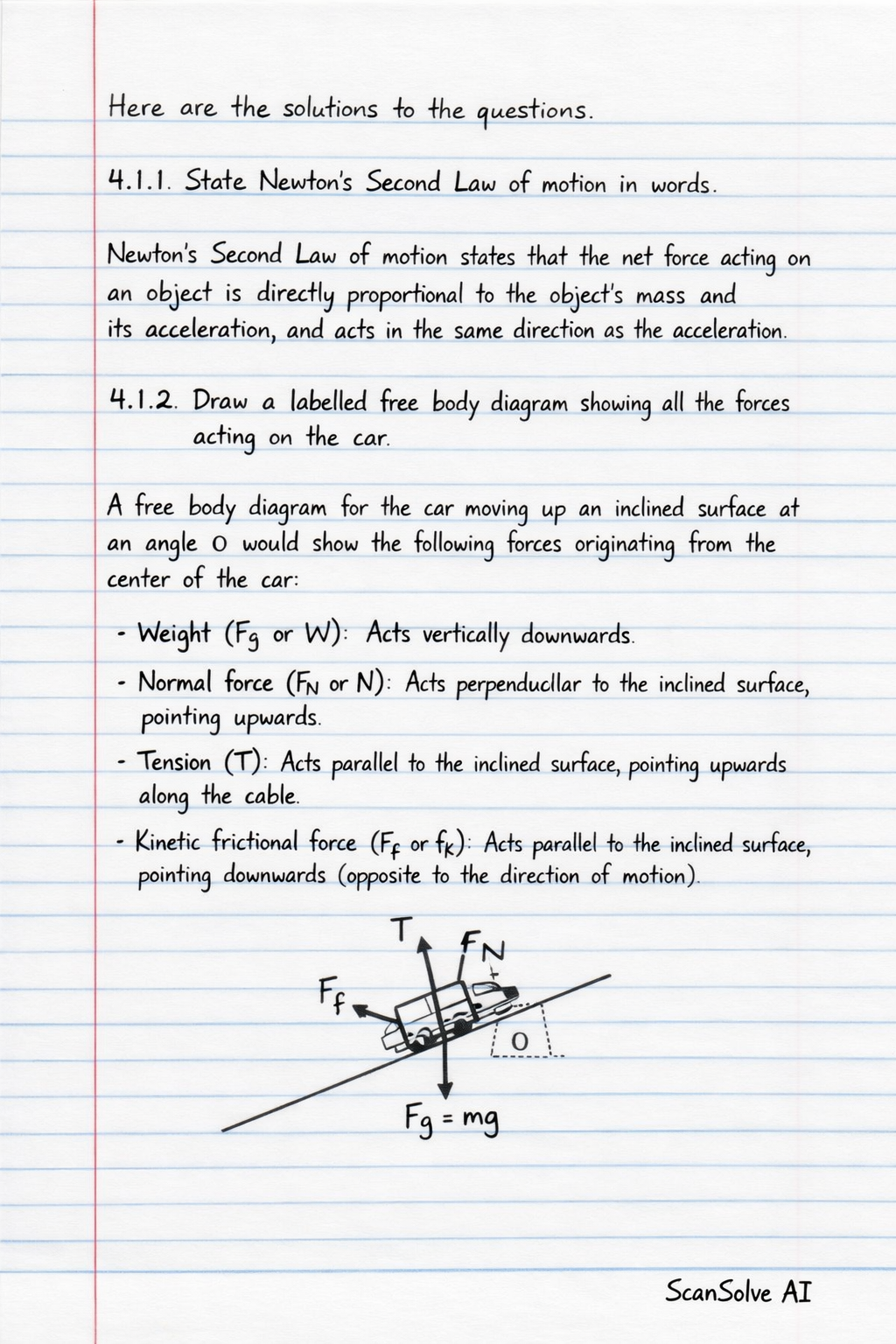
4.1.2 Draw a labelled free body diagram showing all the forces acting on the car.
A free body diagram for the car moving up an inclined surface at an angle would show the following forces originating from the center of the car:
- Weight ( or ): Acts vertically downwards.
- Normal force ( or ): Acts perpendicular to the inclined surface, pointing upwards.
- Tension (): Acts parallel to the inclined surface, pointing upwards along the cable.
- Kinetic frictional force ( or ): Acts parallel to the inclined surface, pointing downwards (opposite to the direction of motion).
4.1.3 Calculate the kinetic frictional force that the car experiences as it moves up the surface.
Given:
Mass of car () =
Coefficient of kinetic friction () = 0.25
Angle of incline () =
Acceleration due to gravity () =
Calculate the normal force ().
The normal force on an inclined plane is the component of the gravitational force perpendicular to the surface.
Calculate the kinetic frictional force ().
The kinetic frictional force is given by the product of the coefficient of kinetic friction and the normal force.
The kinetic frictional force is .
4.1.4 Calculate the tension T in the cable.
Given:
Mass of car () =
Mass of truck () =
Net force on truck () =
Angle of incline () =
Acceleration due to gravity () =
Kinetic frictional force () = (from 4.1.3)Calculate the acceleration of the system.
Since the truck is pulling the car with a cable, they both experience the same acceleration.
Apply Newton's Second Law to the car along the incline.
The net force on the car along the incline is the sum of the forces acting parallel to the incline.
According to Newton's Second Law, .
Solve for tension ().
The tension in the cable is .
4.2.1 State Newton's Law of universal gravitation in words.
Newton's Law of Universal Gravitation states that every particle in the universe attracts every other particle with a force that is directly proportional to the product of their masses and inversely proportional to the square of the distance between their centers.
4.2.2 Calculate the distance between the spaceship and the centre of Earth when Earth exerts a force of 2458 N on the spaceship.
Given:
Force () =
Mass of spaceship () =
Gravitational constant () =
Mass of Earth () =Write down the formula for universal gravitation.
Rearrange the formula to solve for the distance ().
Substitute the given values and calculate .
The distance between the spaceship and the center of Earth is
\boxed{\text{1.42 \times 10^7 m}}.
Still stuck on this one?
Ask a follow-up, and the answer starts from this question.
More Physics Questions
Handwritten Step-by-Step Solution
Get this as a handwritten image on WhatsApp — like a tutor wrote it for you.
Try on WhatsApp