
We read your photo as:
A train travels 2.97 km in 3 minutes. It accelerates uniformly, then travels at a constant speed, and finally retards uniformly to stop. The ratio of acceleration to retardation is 2:3. Find the maxim
Physics
ScanSolve AI Answer
Step-by-step solution
2 stepsConvert given values to standard units.
Total time .
Total distance .
Maximum speed .
Let be the acceleration and be the retardation.
The ratio of acceleration to retardation is , so .Analyze the motion in three phases using a velocity-time graph.
The motion consists of three parts:
- Uniform acceleration from 0 to .
- Constant velocity at .
- Uniform retardation from to 0.
Let , , be the times for acceleration, constant velocity, and retardation, respectively.
Let , , be the distances covered in these phases.For acceleration phase:
Initial velocity , final velocity .The distance covered is the area of the triangle:
For retardation phase:
Initial velocity , final velocity $
Was this helpful?
Still stuck on this one?
Ask a follow-up, and the answer starts from this question.
Got a different question?Ask your own question
More Physics Questions
QA train starts from rest with uniform acceleration for 20 seconds. It travels with uniform velocity…QA train starts from rest and accelerates for 150s, travels at a constant speed for 300s, and then…QA train travels 240 km in 3 hours, then 180 km in 2 hours. What is its average speed for the entire…QA train travels 240 km in 3 hours. Average speed?QA train travels 240 km in 3 hours. What is its average speed? Show the steps.
Browse by topic:Mechanics
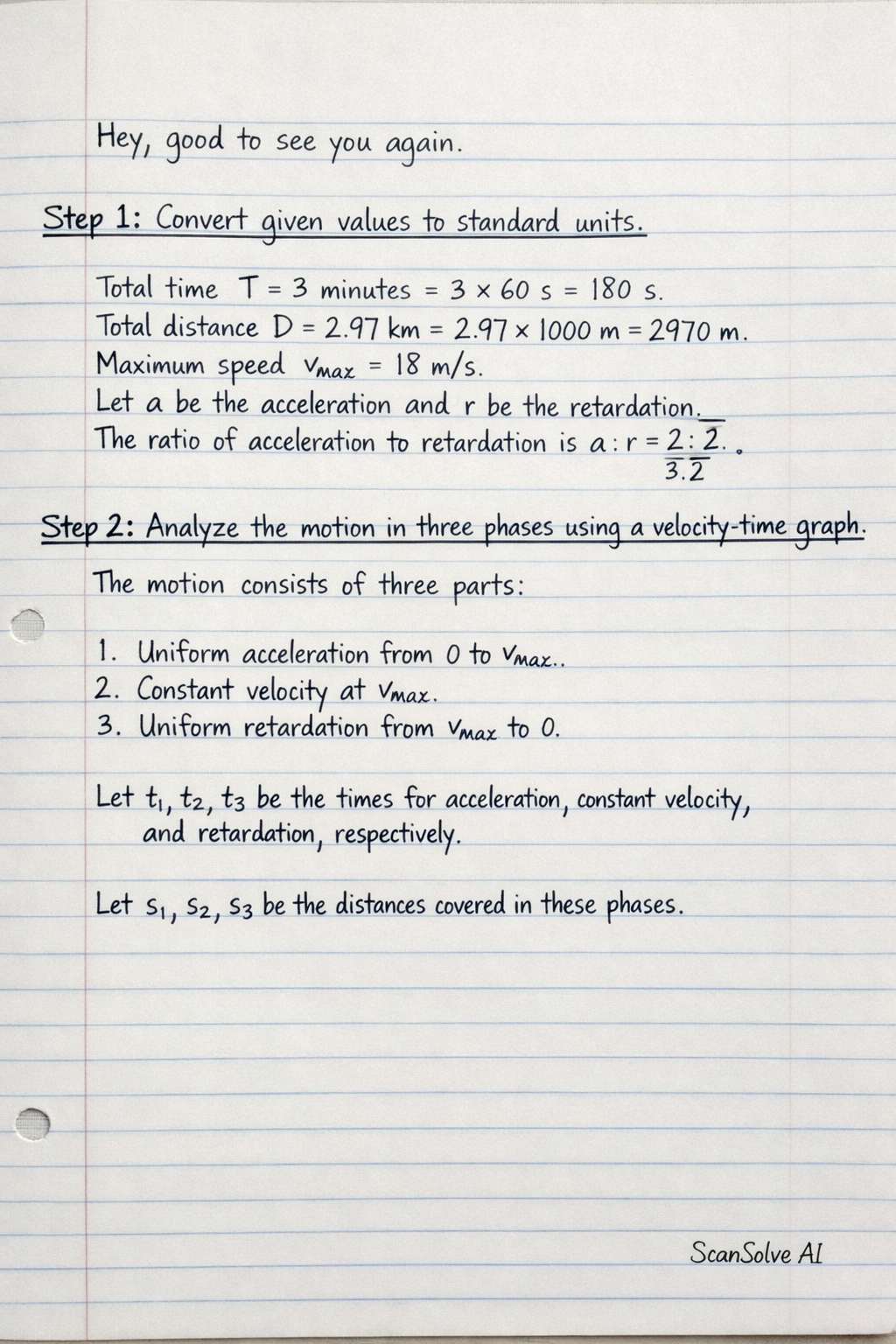
Handwritten Step-by-Step Solution
Get this as a handwritten image on WhatsApp — like a tutor wrote it for you.
Try on WhatsApp