
We read your photo as:
A uniform plank of negligible mass and length 2 m is on a support at its midpoint. Two weights, 60 N and 80 N, are attached. State the conditions for equilibrium and calculate the distance x of the 80
ScanSolve AI Answer
Step-by-step solution
4 stepsHere are the solutions for the questions from the image:
2.
Figure 2 shows a uniform plank of negligible mass and of length 2 m, on a support, A, at its midpoint. Two weights of 60 N and 80 N are attached to it.
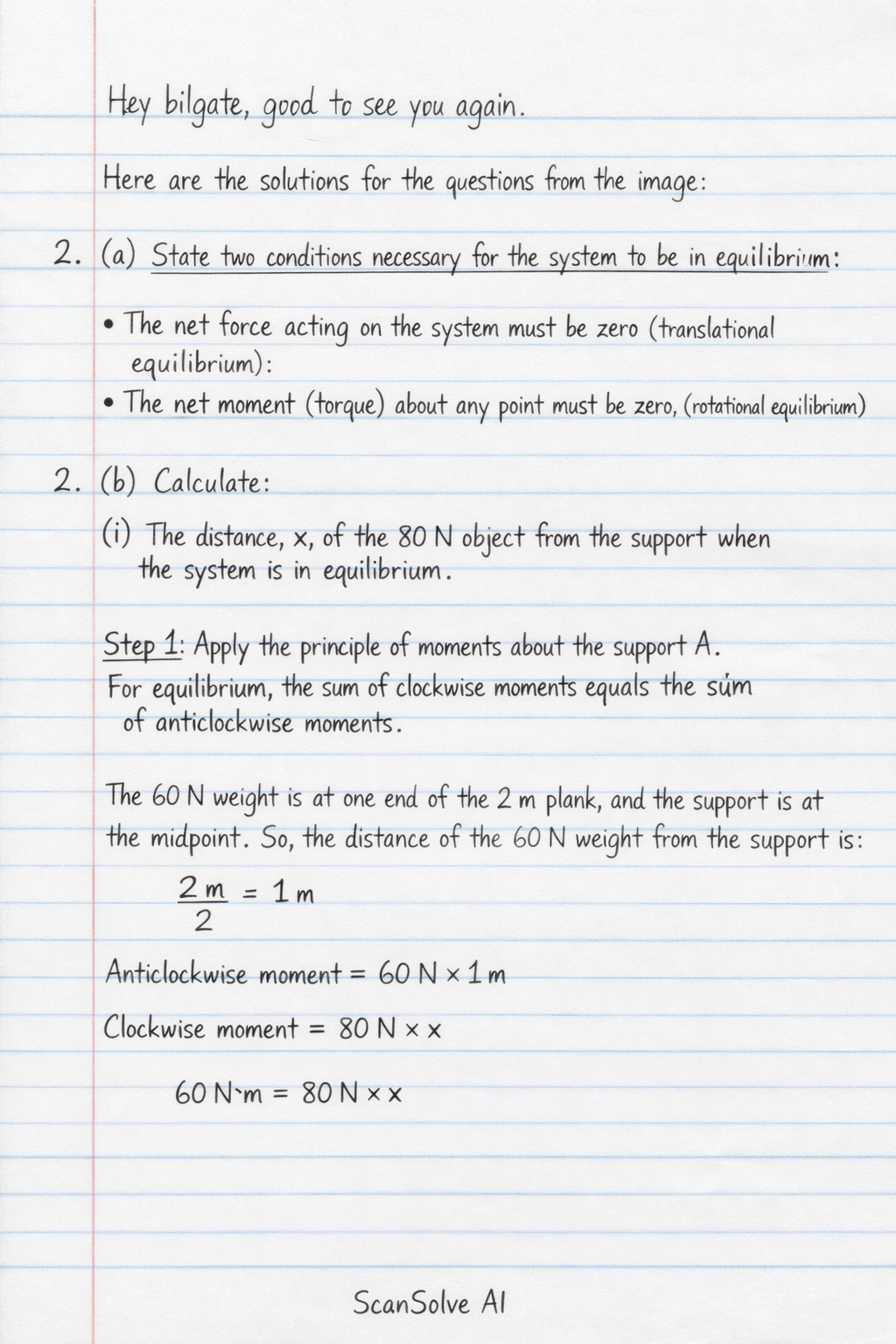
2. (a) State two conditions necessary for the system to be in equilibrium.
- The net force acting on the system must be zero (translational equilibrium).
- The net moment (torque) about any point must be zero (rotational equilibrium).
2. (b) Calculate:
(i) The distance, x, of the 80 N object from the support when the system is in equilibrium.
Apply the principle of moments about the support A.
For equilibrium, the sum of clockwise moments equals the sum of anticlockwise moments.
The 60 N weight is at one end of the 2 m plank, and the support is at the midpoint. So, the distance of the 60 N weight from the support is .
Anticlockwise moment =
Clockwise moment =Set moments equal and solve for x.
The distance, x, is .
(ii) The force, R, on the plank by the support.
Apply the condition for translational equilibrium.
For equilibrium, the sum of upward forces equals the sum of downward forces.
Upward force = R
Downward forces =Set forces equal and solve for R.
The force, R, on the plank by the support is .
3. (a)
(i) Define interference.
Interference is the superposition of two or more waves that results in a new wave pattern, where the amplitudes of the waves either add up or cancel out.(ii) Name the two types of interference.
- Constructive interference
- Destructive interference
(iii) Explain what happens to the resultant amplitude of each type named in (ii) above.
- In constructive interference, the waves are in phase, and their amplitudes add up, resulting in a larger resultant amplitude.
- In destructive interference, the waves are out of phase (180 degrees), and their amplitudes subtract, resulting in a smaller or zero resultant amplitude.
Still stuck on this one?
Ask a follow-up, and the answer starts from this question.
More Physics Questions
Handwritten Step-by-Step Solution
Get this as a handwritten image on WhatsApp — like a tutor wrote it for you.
Try on WhatsApp