
We read your photo as:
Calculate the acceleration of a system with a 10 kg mass on a 30-degree incline and a 15 kg hanging mass, assuming a frictionless system and pulley.
ScanSolve AI Answer
Answer
Step-by-step solution
4 stepsHere's the solution for the acceleration of the system:
Identify the given values and set up the forces.
Mass on the inclined plane, .
Angle of inclination, .
Hanging mass, .
Acceleration due to gravity, .
The plane is smooth, so there is no friction. The pulley is also smooth.Apply Newton's Second Law to each mass.
Assume the system accelerates such that moves downwards and moves up the incline. Let be the tension in the string and be the acceleration of the system.
For mass (on the inclined plane):
The forces acting along the incline are the tension (up the incline) and the component of gravity (down the incline).For mass (hanging vertically):
The forces acting are gravity (downwards) and tension (upwards).Solve the system of equations for acceleration .
From equation (2), we can express :
Substitute this expression for into equation (1):
Rearrange the terms to solve for :
Substitute the numerical values and calculate .
We know .
The acceleration of the system is .
Try one yourself
A new problem that tests the same skill.
Still stuck on this one?
Ask a follow-up, and the answer starts from this question.
More Physics Questions
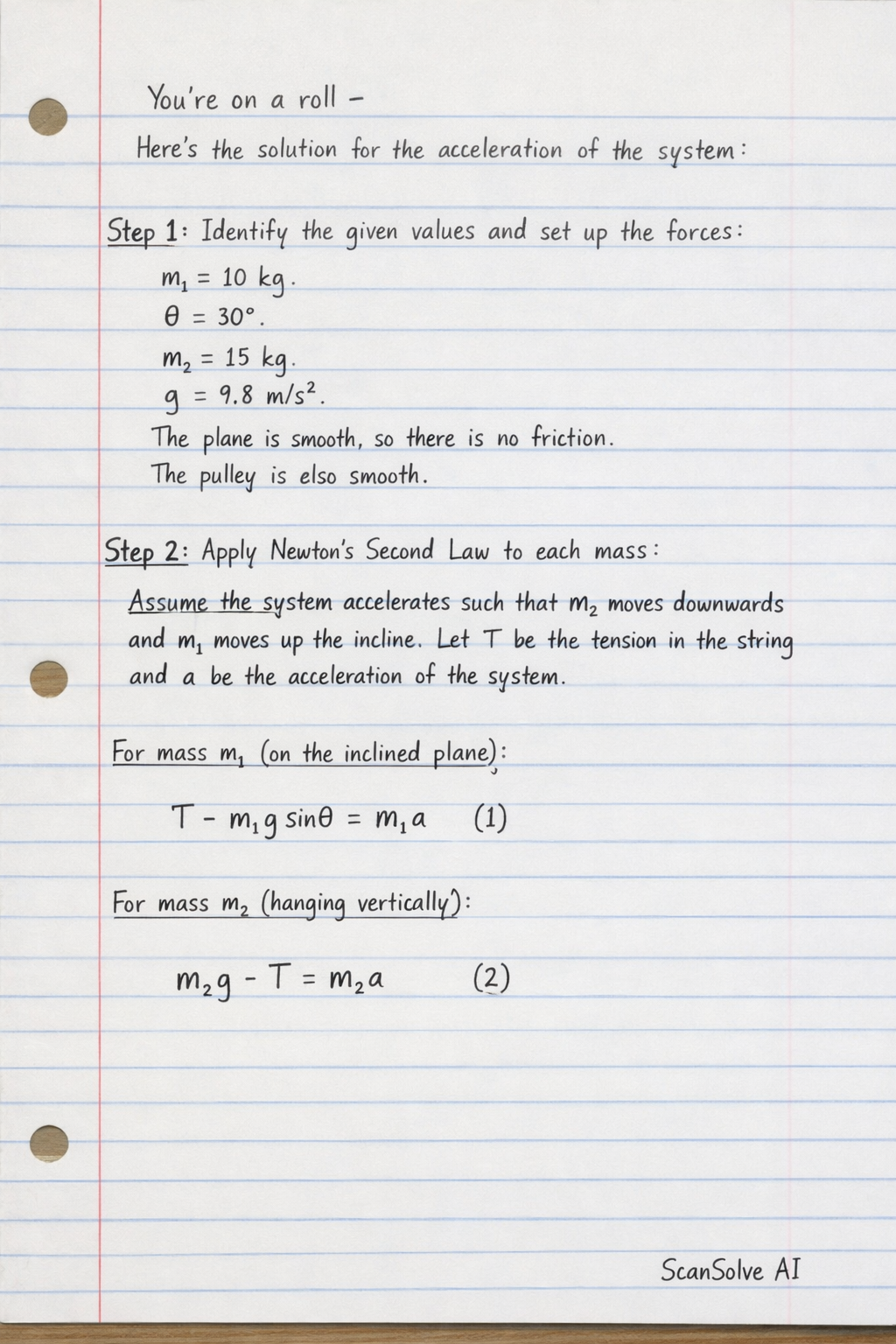
Handwritten Step-by-Step Solution
Get this as a handwritten image on WhatsApp — like a tutor wrote it for you.
Try on WhatsApp