
We read your photo as:
An airplane flies at a constant height h and constant speed j. A gun is at the origin (0,0). A shell is fired from the gun with an initial muzzle velocity v at an angle theta with the horizontal. What
ScanSolve AI Answer
This answer stops before the end.
It was cut off when it was first written. Ask ScanSolve this question again for the full working.
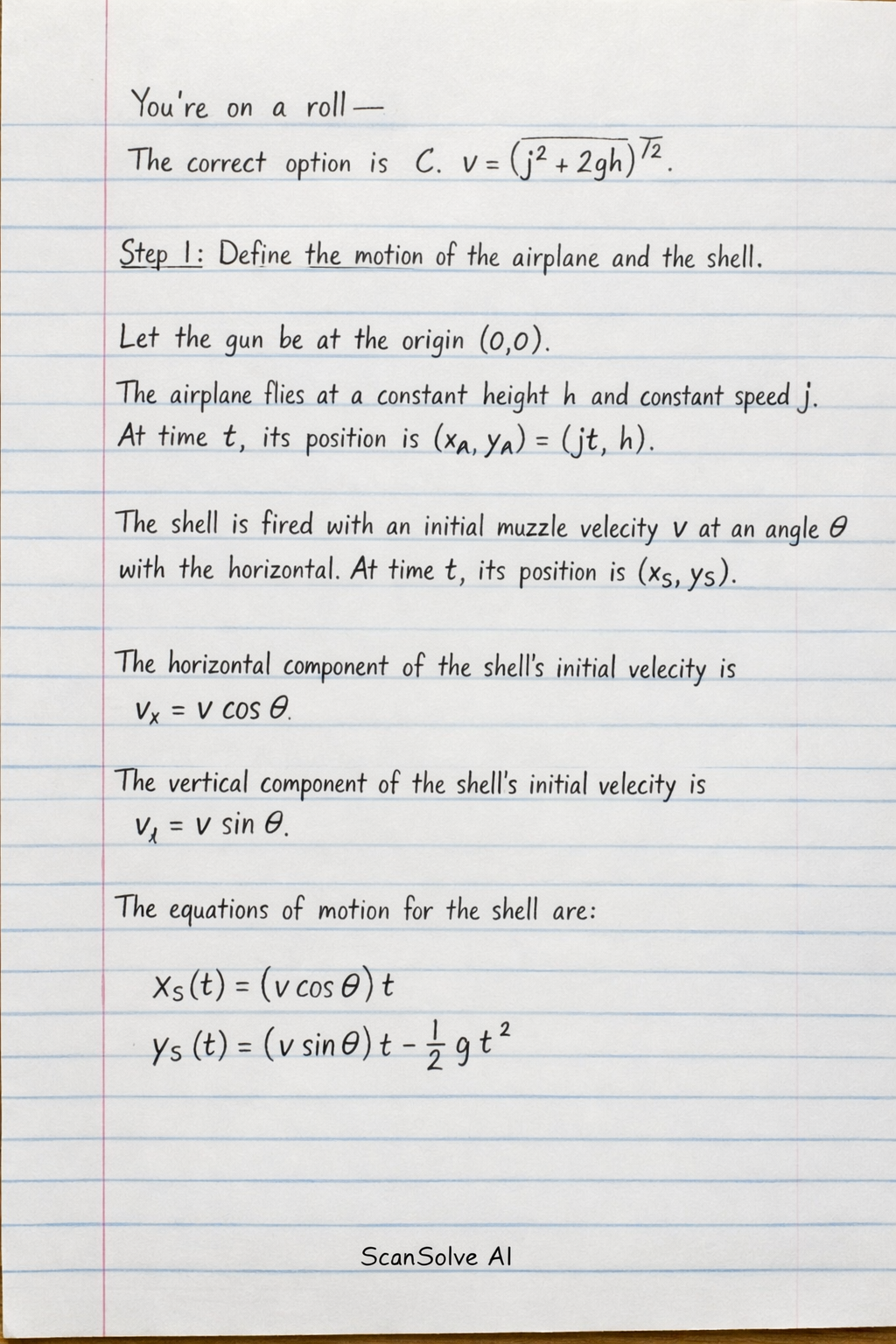
The correct option is C. .
Step 1: Define the motion of the airplane and the shell.
Let the gun be at the origin .
The airplane flies at a constant height and constant speed . At time , its position is .
The shell is fired with an initial muzzle velocity at an angle with the horizontal. At time , its position is .
The horizontal component of the shell's initial velocity is .
The vertical component of the shell's initial velocity is .
The equations of motion for the shell are:
Step 2: Set the conditions for the shell to hit the airplane.
For the shell to hit the airplane at time , their positions must be equal:
Since (the shell takes time to reach the airplane), we can divide by :
Step 3: Express in terms of and .
From , .
Using the identity :
Step 4: Substitute into equation and solve for .
Substitute into :
Still stuck on this one?
Ask a follow-up, and the answer starts from this question.
More Physics Questions
Handwritten Step-by-Step Solution
Get this as a handwritten image on WhatsApp — like a tutor wrote it for you.
Try on WhatsApp