
We read your photo as:
An airplane is flying south at 100 km/hr. A wind is blowing west at 25 km/hr. What is the resultant velocity of the airplane?
ScanSolve AI Answer
Answer
Step-by-step solution
3 stepsIdentify the given velocities as vectors.
The airplane's velocity is . We can represent this as a vector pointing downwards.
The wind's velocity is . We can represent this as a vector pointing to the left.
Since these velocities are perpendicular, we can use the Pythagorean theorem to find the magnitude of the net velocity.Calculate the magnitude of the net velocity.
Let be the airplane's speed and be the wind's speed.
The net velocity is the hypotenuse of a right-angled triangle formed by and .Substitute the given values:
Round the result and select the correct option.
Rounding to one decimal place, the net velocity is approximately .
Comparing this with the given options:
A.
B.
C.
D.The correct option is A.
The final answer is .
Try one yourself
A new problem that tests the same skill.
Still stuck on this one?
Ask a follow-up, and the answer starts from this question.
More Physics Questions
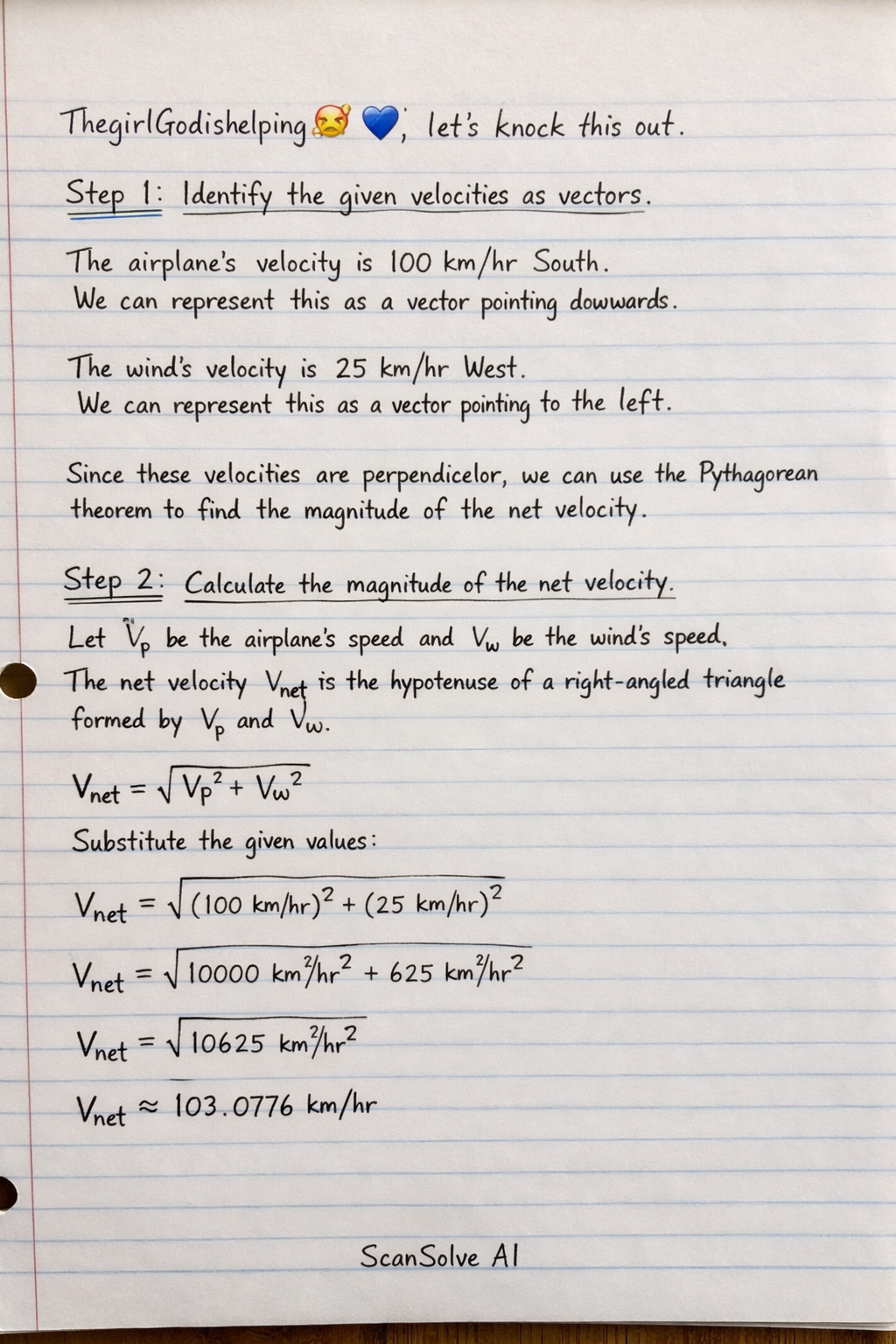
Handwritten Step-by-Step Solution
Get this as a handwritten image on WhatsApp — like a tutor wrote it for you.
Try on WhatsApp