
We read your photo as:
An element loses 31/32 of its original atoms in a certain time. If its half-life is 7 years, how long did it take for this amount of decay?
ScanSolve AI Answer
Answer
Step-by-step solution
4 stepsDetermine the fraction of the original atoms remaining.
The problem states that the element will lose of its original atoms.
The fraction of atoms remaining is:Relate the fraction remaining to the number of half-lives.
The formula for the fraction of a radioactive substance remaining after half-lives is:
Where is the fraction remaining, and is the number of half-lives.
Calculate the number of half-lives ().
Substitute the fraction remaining into the formula:
We know that . So, .
Therefore, .
This means 5 half-lives have passed.Calculate the total time taken.
The half-life () of the element is given as 7 years.
The total time () is the number of half-lives multiplied by the half-life period:The final answer is .
Try one yourself
A new problem that tests the same skill.
Still stuck on this one?
Ask a follow-up, and the answer starts from this question.
More Physics Questions
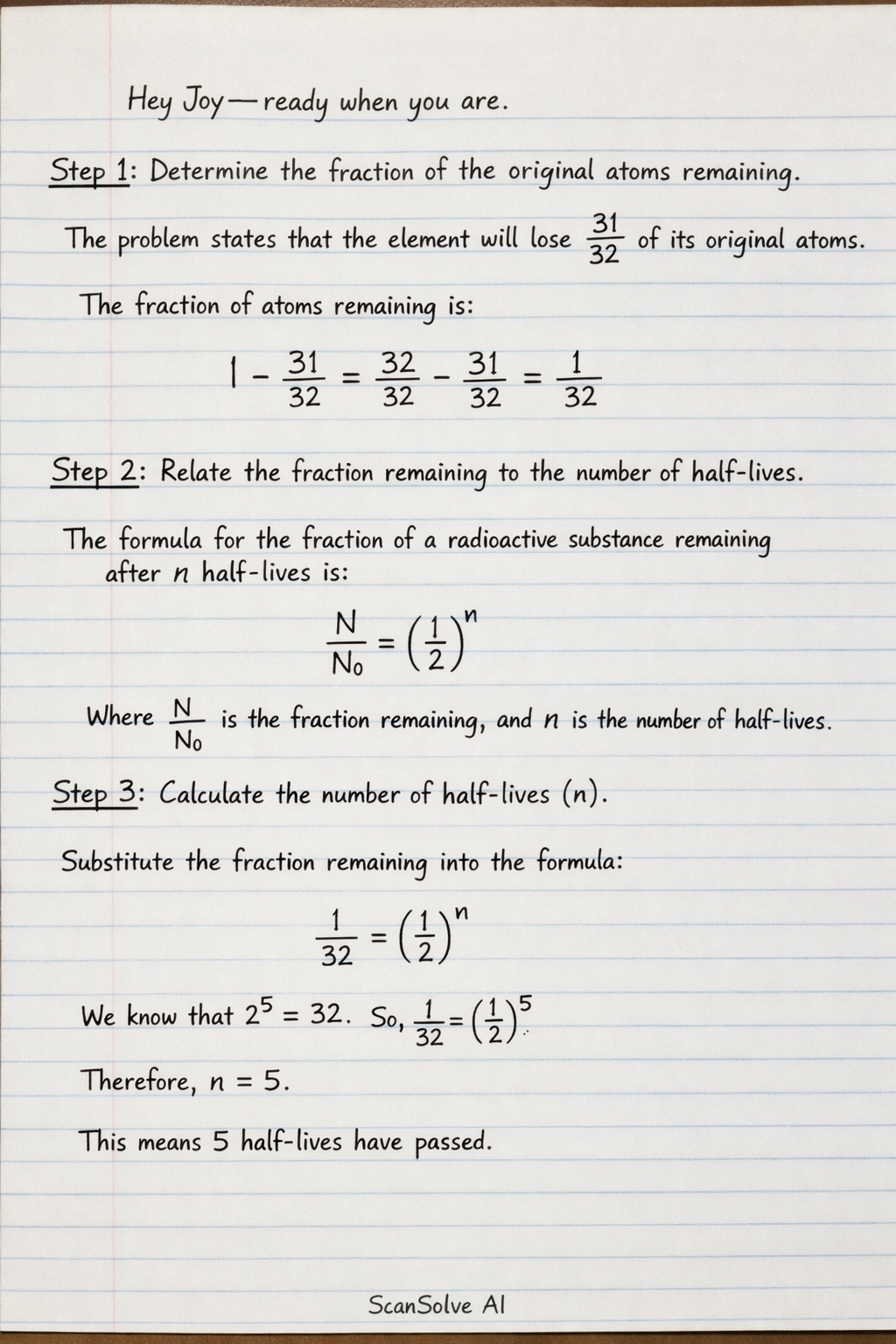
Handwritten Step-by-Step Solution
Get this as a handwritten image on WhatsApp — like a tutor wrote it for you.
Try on WhatsApp