
An empty relative density bottle has a mass of 30g. When filled with paraffin, its mass is 70g. Calculate the mass of the bottle when it is filled with water. (relative density of papaffin =0.8)? 5 Answers Available Asked by Olayemi on 11th February, 2019
ScanSolve AI Answer
Answer
Step-by-step solution
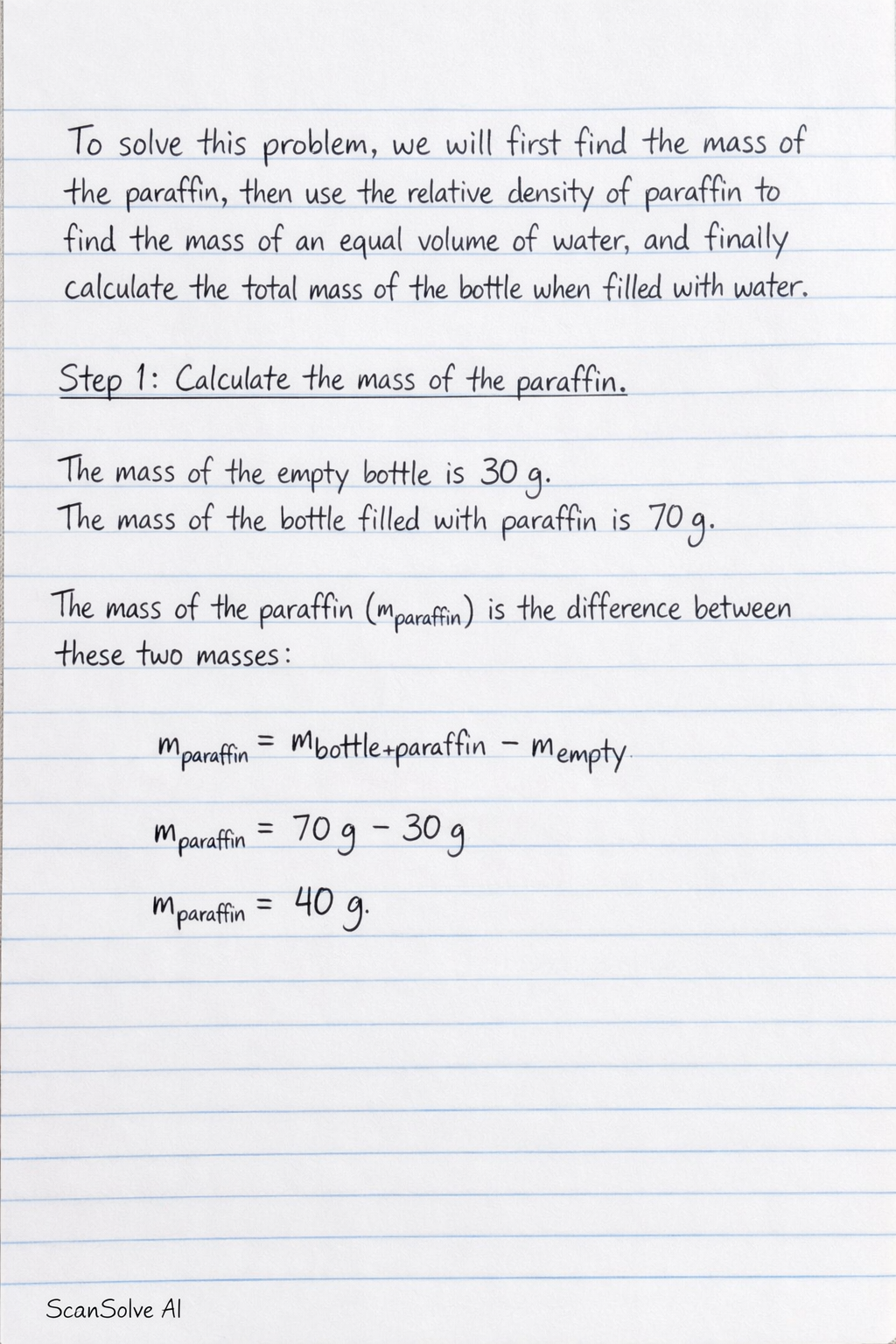
3 stepsTo solve this problem, we will first find the mass of the paraffin, then use the relative density of paraffin to find the mass of an equal volume of water, and finally calculate the total mass of the bottle when filled with water.
Calculate the mass of the paraffin.
The mass of the empty bottle is .
The mass of the bottle filled with paraffin is .
The mass of the paraffin () is the difference between these two masses:Use the relative density of paraffin to find the mass of an equal volume of water.
Relative density (RD) is defined as the ratio of the density of a substance to the density of water. For equal volumes, it is also the ratio of the mass of the substance to the mass of water.
We are given and we found . We need to find .
Rearrange the formula to solve for :
Calculate the mass of the bottle when filled with water.
The mass of the bottle filled with water () is the sum of the mass of the empty bottle and the mass of the water that fills it:
The final answer is .
Try one yourself
A new problem that tests the same skill.
Still stuck on this one?
Ask a follow-up, and the answer starts from this question.
More Physics Questions
Handwritten Step-by-Step Solution
Get this as a handwritten image on WhatsApp — like a tutor wrote it for you.
Try on WhatsApp