

This physics problem tests your understanding of fundamental physical laws and their applications. The step-by-step solution below breaks down the problem using relevant equations and physical reasoning.
ScanSolve AI Answer
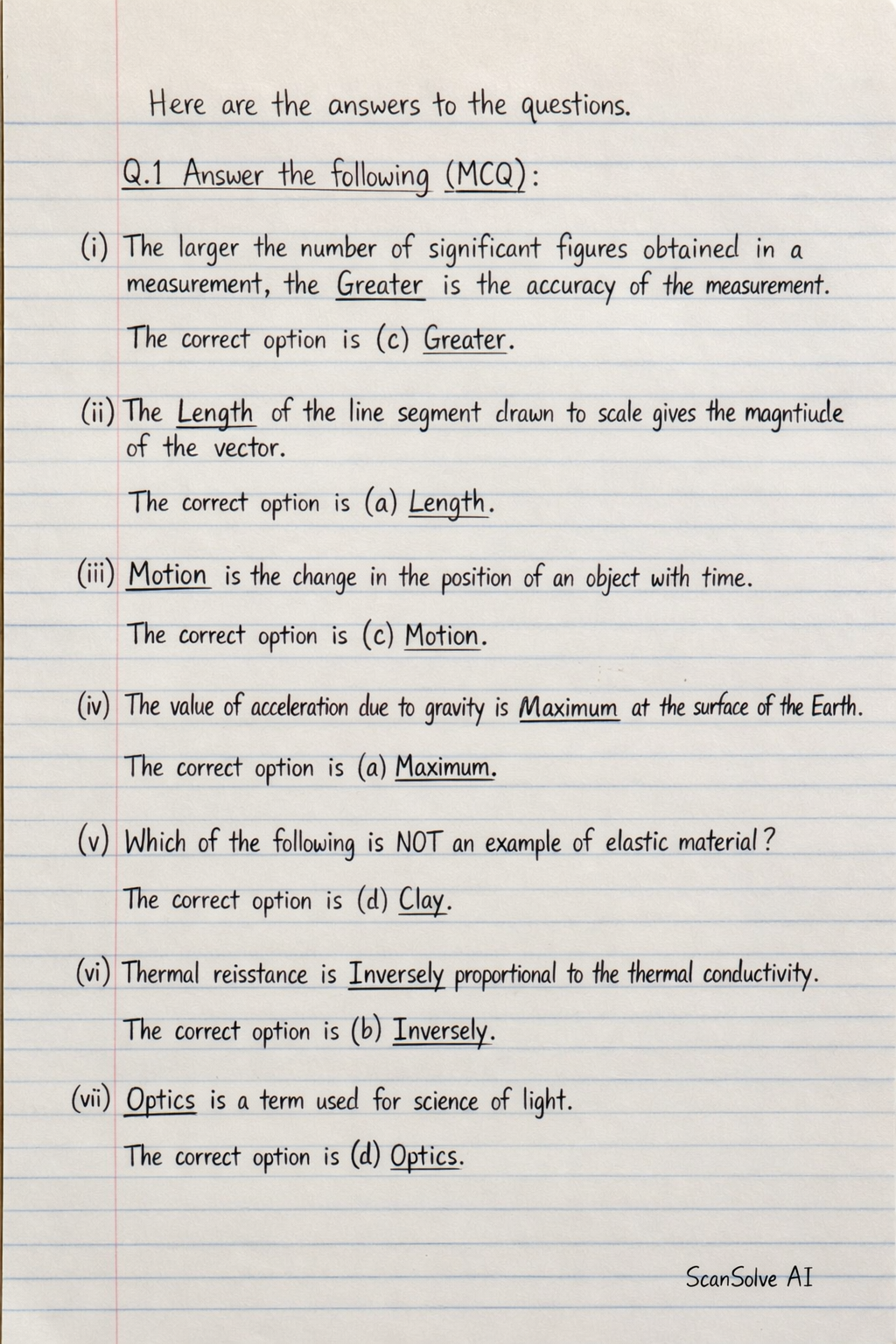
Here are the answers to the questions. Q.1 Answer the following (MCQ): i) The larger the number of significant figures obtained in a measurement, the Greater is the accuracy of the measurement. The correct option is (c) Greater. ii) The Length of the line segment drawn to scale gives the magnitude of the vector. The correct option is (a) Length. iii) Motion is the change in the position of an object with time. The correct option is (c) Motion. iv) The value of acceleration due to gravity is Maximum at the surface of the Earth. The correct option is (a) Maximum. v) Which of the following is NOT an example of elastic material? The correct option is (d) Clay. vi) Thermal resistance is Inversely proportional to the thermal conductivity. The correct option is (b) Inversely. vii) Optics is a term used for science of light. The correct option is (d) Optics. viii) Speed of light in water is 2 × 10^8 m/s. Refractive index of glass with respect to water is 1.125. What is the speed of light in glass? Step 1: Identify the given values. Speed of light in water, v_w = 2 × 10^8 m/s. Refractive index of glass with respect to water, n_gw = 1.125. Step 2: Use the formula for refractive index. The refractive index of a medium 2 with respect to medium 1 is given by the ratio of the speed of light in medium 1 to the speed of light in medium 2: n_gw = (v_w)/(v_g) Where v_g is the speed of light in glass. Step 3: Solve for v_g. v_g = (v_w)/(n_gw) v_g = 2 × 10^8 m/s1.125 v_g ≈ 1.777... × 10^8 m/s v_g ≈ 1.78 × 10^8 m/s The correct option is (d) 1.78 × 10^8 m/s. ix) The line joining the fictitious North Pole and South Pole of the Earth is called the Magnetic axis. The correct option is (a) Magnetic axis. x) Radio waves are used in the study of atomic and molecular structure. The correct option is (c) Radio waves. Q.2 Answer the following (VSA): i) Why do random errors occur? Random errors occur due to unpredictable fluctuations in experimental conditions or measurement processes, such as slight variations in instrument readings, environmental changes, or limitations of the observer. They cannot be eliminated but can be minimized by taking multiple readings and averaging. ii) Define free fall. Free fall is the motion of an object solely under the influence of gravity, with no other forces like air resistance acting upon it. In free fall, all objects accelerate downwards at the same rate, regardless of their mass. iii) Define perfectly inelastic collision. A perfectly inelastic collision is a type of collision where the colliding objects stick together after impact and move as a single combined mass. In such a collision, kinetic energy is not conserved, but momentum is conserved. iv) What is gravitational force? Gravitational force is a fundamental attractive force that exists between any two objects with mass. Its magnitude depends on the masses of the objects and the distance between their centers, as described by Newton's Law of Universal Gravitation. v) What is a thermistor? A thermistor is a type of resistor whose resistance is highly dependent on temperature. They are typically made from semiconductor materials and are used as temperature sensors or current-limiting devices. vi) Optical fibres are immune to EM interference. Explain. Optical fibres transmit data using light signals, not electrical signals. Since electromagnetic interference (EMI) affects electrical signals, optical fibres are not susceptible to it. This makes them ideal for environments with high electrical noise. vii) What is the disadvantage of cells in parallel? A primary disadvantage of connecting cells in parallel is that if one cell has a slightly lower voltage or higher internal resistance, it can *draw current