

This physics problem tests your understanding of fundamental physical laws and their applications. The step-by-step solution below breaks down the problem using relevant equations and physical reasoning.
ScanSolve AI Answer
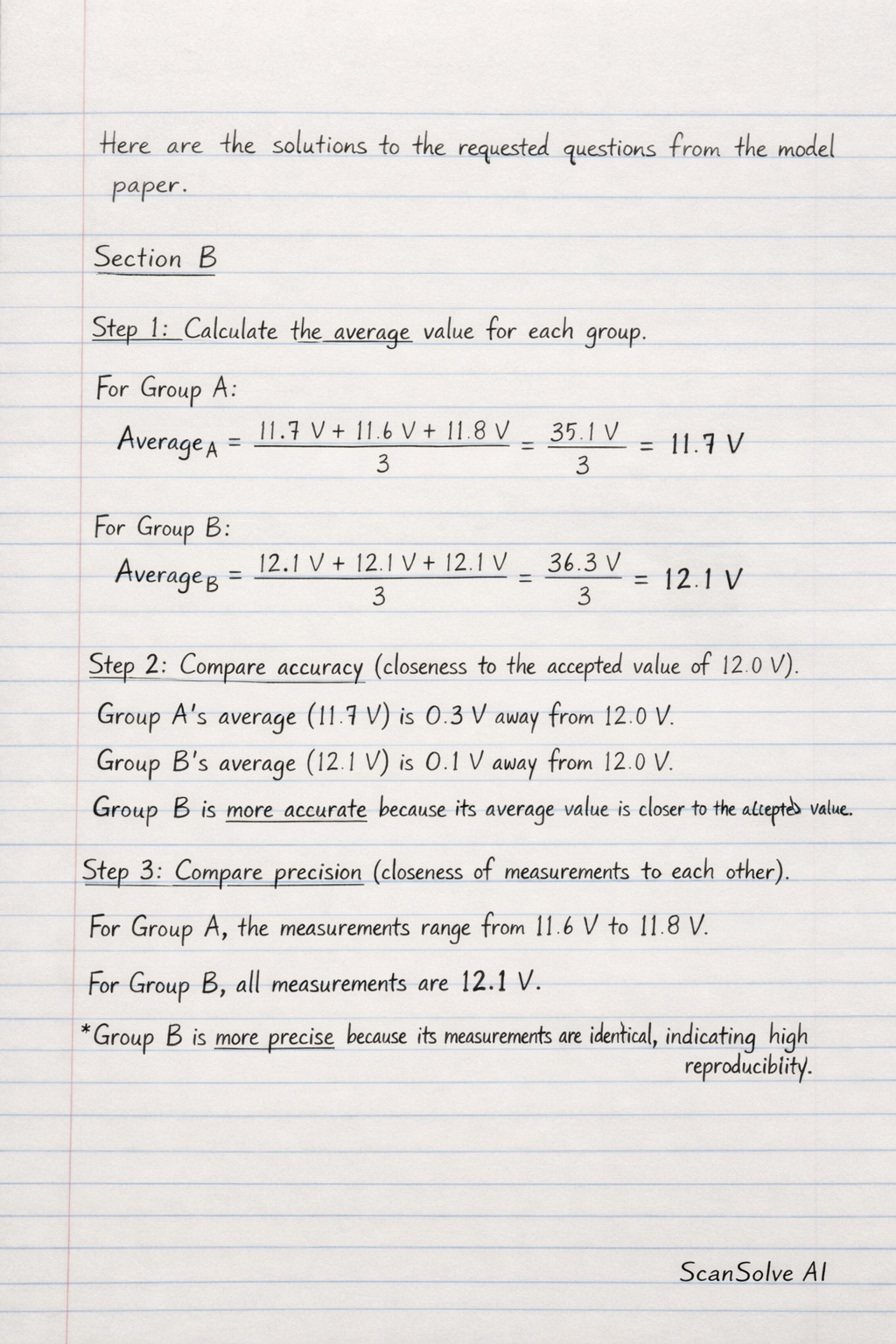
Here are the solutions to the requested questions from the model paper. Section B Q.1: Step 1: Calculate the average value for each group. For Group A: Average_A = 11.7 V + 11.6 V + 11.8 V3 = 35.1 V3 = 11.7 V For Group B: Average_B = 12.1 V + 12.1 V + 12.1 V3 = 36.3 V3 = 12.1 V Step 2: Compare accuracy (closeness to the accepted value of 12.0 V). Group A's average (11.7 V) is 0.3 V away from 12.0 V. Group B's average (12.1 V) is 0.1 V away from 12.0 V. Group B is more accurate because its average value is closer to the accepted value. Step 3: Compare precision (closeness of measurements to each other). For Group A, the measurements range from 11.6 V to 11.8 V. For Group B, all measurements are 12.1 V. Group B is more precise because its measurements are identical, indicating high reproducibility. Q.2: • SI Base Units: (a) ampere* (unit of electric current) (b) mole* (unit of amount of substance) • Derived Units: (c) cubic meter* (unit of volume, derived from length: m^3) (d) pascal* (unit of pressure, derived from force and area: N/m^2) Q.3: • Definition of Torque: Torque is the rotational equivalent of force. It is a measure of the force that can cause an object to rotate about an axis. • Mathematical Expression: = r F where is torque, r is the distance from the pivot to the point where the force is applied, F is the magnitude of the force, and is the angle between the force vector and the lever arm. • Angle for Maximum Torque: Torque is maximum when = 1, which occurs at = 90^. • Angle for Zero Torque: Torque is zero when = 0, which occurs at = 0^ or 180^. Q.4: Step 1: State the condition for balance on a seesaw. For the seesaw to be balanced, the clockwise torque must