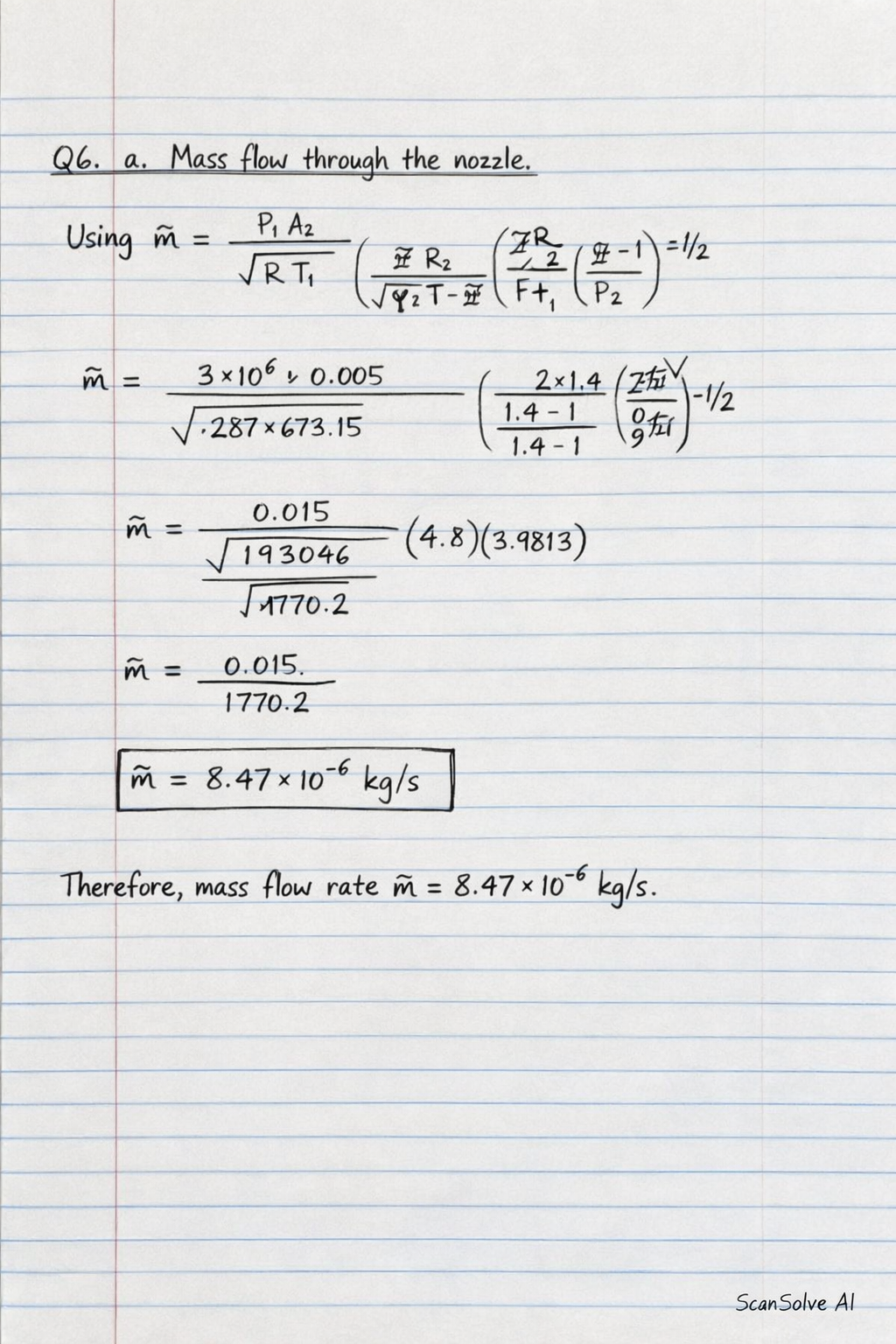
At the beginning of the compression process of an air-standard Diesel cycle operating with a compression ratio of 18, the temperature is 300K and the pressure is 0.1MPa, the cutoff ratio is 2. Determine: a. Mass flow through the nozzle; b. Throat area; c. Mach number at exit.
|Physics
At the beginning of the compression process of an air-standard Diesel cycle operating with a compression ratio of 18, the temperature is 300K and the pressure is 0.1MPa, the cutoff ratio is 2. Determine: a. Mass flow through the nozzle; b. Throat area; c. Mach number at exit.
ScanSolve AI Answer
Answer
14.90 kg/s
here are the solutions to questions 6 and 7.
Q6. Air enters a nozzle at 3MN/m2 and with a temperature of 400∘C. It leaves at a pressure of 0.5MN/m2. The exit area is 5000mm2. Expansion through the nozzle is adiabatic according to the law PVγ=constant. Determine:
Given:
Inlet pressure P1=3MN/m2=3×106 Pa
Inlet temperature T1=400\circC=400+273.15=673.15 K
Exit pressure P2=0.5MN/m2=0.5×106 Pa
Exit area A2=5000mm2=5000×10−6m2=0.005m2
For air, assume γ=1.4 and specific gas constant R=287 J/(kg K).
Specific heat at constant pressure cp=γ−1γR=1.4−11.4×287=1004.5 J/(kg K).
a. Mass flow through the nozzle.
Step 1: Calculate the exit temperature T2 using the adiabatic relation.
T1T2=(P1P2)γγ−1T2=T1(P1P2)γγ−1=673.15K(3×10⁶Pa0.5×106Pa)1.41.4−1T2=673.15(61)1.40.4=673.15×(0.16667)0.2857=673.15×0.6218=418.6 K
Step 2: Calculate the exit velocity V2 using the steady flow energy equation (assuming negligible inlet velocity).
cpT1=cpT2+2V22V2=2cp(T1−T2)=2×1004.5J/(kgK)×(673.15−418.6)KV2=2×1004.5×254.55=511400.95=715.12 m/s
Step 3: Calculate the exit density ρ2 using the ideal gas law.
ρ2=RT2P2=287J/(kgK)×418.6K0.5×106Pa=120000.2500000=4.166kg/m3
Step 4: Calculate the mass flow rate m˙.
m˙=ρ2A2V2=4.166kg/m3×0.005m2×715.12 m/sm˙=14.90 kg/s
b. Throat area.
Step 1: Determine if the flow is choked by comparing the exit pressure to the critical pressure.
The critical pressure ratio for choked flow is:
P1Pt=(γ+12)γ−1γ=(1.4+12)1.4−11.4=(2.42)3.5=(0.8333)3.5=0.5283Pt=0.5283×P1=0.5283×3×106Pa=1.5849×10⁶ Pa
Since P2=0.5×10⁶Pa<Pt, the flow is choked, and the throat pressure is Pt.
Step 2: Calculate the temperature at the throat Tt.
Tt=T1(γ+12)=673.15K(1.4+12)=673.15×2.42=560.96 K
Step 3: Calculate the velocity at the throat Vt (which is the speed of sound at the throat).
Vt=γRTt=1.4×287J/(kgK)×560.96KVt=225588.32=474.96 m/s
Step 4: Calculate the density at the throat ρt.
ρt=RTtPt=287J/(kgK)×560.96K1.5849×106Pa=161015.121584900=9.843kg/m3
Step 5: Calculate the throat area At.
m˙=ρtAtVtAt=ρtVtm˙=9.843kg/m3×474.96m/s14.90kg/s=4670.914.90=0.00319m2A_t = 3190 \text{ mm^2}
c. Mach number at exit.
Step 1: Calculate the speed of sound at the exit a2.
a2=γRT2=1.4×287J/(kgK)×418.6Ka2=168488.8=410.47 m/s
Step 2: Calculate the Mach number at the exit M2.
M2=a2V2=410.47m/s715.12m/sM2=1.742
Q7. At the beginning of the compression process of an air-standard Diesel cycle operating with compression ratio of 18, the temperature is 300 K and the pressure is 0.1 MPa. The cutoff ratio for the cycle is 2. Determine:
Given:
Air-standard Diesel cycle.
Compression ratio r=V1/V2=18.
Inlet temperature T1=300 K.
Inlet pressure P1=0.1MPa=100 kPa.
Cutoff ratio rc=V3/V2=2.
For air, assume γ=1.4 and R=0.287 kJ/(kg K).
a. The temperature and pressure at the end of each process of the cycle.
Process 1-2: Isentropic CompressionP1=0.1 MPaT1=300 K
Step 5: Calculate T4.
T4=T3(V4V3)γ−1=T3(rrc)γ−1=1905.6K×(182)1.4−1T4=1905.6×(91)0.4=1905.6×0.4105=782.3 K
b. The thermal efficiency.
Step 1: Use the formula for the thermal efficiency of a Diesel cycle.
ηth=1−rγ−11[γ(rc−1)rcγ−1]ηth=1−(18)1.4−11[1.4(2−1)(2)1.4−1]ηth=1−(18)0.41[1.4(1)2.63901−1]ηth=1−3.176091[1.41.63901]ηth=1−0.31484×1.17072ηth=1−0.36859=0.63141ηth=63.14%
c. The mean effective pressure, in MPa.
Step 1: Calculate the specific volumes at states 1 and 2.
v1=P1RT1=0.1MPa0.287kJ/(kgK)×300K=0.1MPa86.1kJ/kg=861MPakgkJ=0.861m3/kgv2=rv1=180.861m3/kg=0.04783m3/kg
Step 2: Calculate the net work output per unit mass (Wnet).
The heat added during constant pressure process 2-3 is qin=cp(T3−T2).
cp=γ−1γR=0.41.4×0.287=1.0045 kJ/(kg K).
qin=1.0045kJ/(kgK)×(1905.6−952.8)K=1.0045×952.8=957.1 kJ/kgWnet=ηthqin=0.63141×957.1kJ/kg=604.3 kJ/kg
Step 3: Calculate the mean effective pressure (MEP).
MEP=v1−v2Wnet=(0.861−0.04783)m3/kg604.3kJ/kgMEP=0.81317m3/kg604.3kJ/kg=743.1 kPaMEP=0.743 MPa
Drop the next question.
Was this helpful?
Need help with your own homework?
Get instant step-by-step solutions to any question. Free to start.
Given: Inlet pressure P_1 = 3 MN/m^2 = 3 × 10^6 Pa Inlet temperature T_1 = 400^ = 400 + 273.15 = 673.15 K Exit pressure P_2 = 0.5 MN/m^2 = 0.5 × 10^6 Pa Exit area A_2 = 5000 mm^2 = 5000 × 10^-6 m^2 = 0.005 m^2 For air, assume = 1.4 and specific gas co…
At the beginning of the compression process of an air-standard Diesel cycle operating with a compression ratio of 18, the temperature is 300K and the pressure is 0.1MPa, the cutoff ratio is 2. Determine: a. Mass flow through the nozzle; b. Throat area; c. Mach number at exit.
This physics problem tests your understanding of fundamental physical laws and their applications. The step-by-step solution below breaks down the problem using relevant equations and physical reasoning.
ScanSolve AI Answer
here are the solutions to questions 6 and 7. Q6. Air enters a nozzle at 3 MN/m^2 and with a temperature of 400^. It leaves at a pressure of 0.5 MN/m^2. The exit area is 5000 mm^2. Expansion through the nozzle is adiabatic according to the law PV^ = constant. Determine: Given: Inlet pressure P_1 = 3 MN/m^2 = 3 × 10^6 Pa Inlet temperature T_1 = 400^ = 400 + 273.15 = 673.15 K Exit pressure P_2 = 0.5 MN/m^2 = 0.5 × 10^6 Pa Exit area A_2 = 5000 mm^2 = 5000 × 10^-6 m^2 = 0.005 m^2 For air, assume = 1.4 and specific gas constant R = 287 J/(kg K). Specific heat at constant pressure c_p = ( R)/(-1) = (1.4 × 287)/(1.4-1) = 1004.5 J/(kg K). a. Mass flow through the nozzle. Step 1: Calculate the exit temperature T_2 using the adiabatic relation. (T_2)/(T_1) = ((P_2)/(P_1))^(-1)/() T_2 = T_1 ((P_2)/(P_1))^(-1)/() = 673.15 K (0.5 × 10^6 Pa3 × 10^6 Pa)^(1.4-1)/(1.4) T_2 = 673.15 ((1)/(6))^(0.4)/(1.4) = 673.15 × (0.16667)^0.2857 = 673.15 × 0.6218 = 418.6 K Step 2: Calculate the exit velocity V_2 using the steady flow energy equation (assuming negligible inlet velocity). c_p T_1 = c_p T_2 + (V_2^2)/(2) V_2 = sqrt(2 c_p (T_1 - T_2)) = sqrt(2 × 1004.5 J/(kg K)) × (673.15 - 418.6) K V_2 = sqrt(2 × 1004.5 × 254.55) = sqrt(511400.95) = 715.12 m/s Step 3: Calculate the exit density _2 using the ideal gas law. _2 = (P_2)/(R T_2) = 0.5 × 10^6 Pa287 J/(kg K) × 418.6 K = (500000)/(120000.2) = 4.166 kg/m^3 Step 4: Calculate the mass flow rate m. m = _2 A_2 V_2 = 4.166 kg/m^3 × 0.005 m^2 × 715.12 m/s m = 14.90 kg/s b. Throat area. Step 1: Determine if the flow is choked by comparing the exit pressure to the critical pressure. The critical pressure ratio for choked flow is: (P_t)/(P_1) = ((2)/(+1))^()/(-1) = ((2)/(1.4+1))^(1.4)/(1.4-1) = ((2)/(2.4))^3.5 = (0.8333)^3.5 = 0.5283 P_t = 0.5283 × P_1 = 0.5283 × 3 × 10^6 Pa = 1.5849 × 10^6 Pa Since P_2 = 0.5 × 10^6 Pa < P_t, the flow is choked, and the throat pressure is P_t. Step 2: Calculate the temperature at the throat T_t. T_t = T_1 ((2)/(+1)) = 673.15 K ((2)/(1.4+1)) = 673.15 × (2)/(2.4) = 560.96 K Step 3: Calculate the velocity at the throat V_t (which is the speed of sound at the throat). V_t = sqrt( R T_t) = sqrt(1.4 × 287 J/(kg K)) × 560.96 K V_t = sqrt(225588.32) = 474.96 m/s Step 4: Calculate the density at the throat _t. _t = (P_t)/(R T_t) = 1.5849 × 10^6 Pa287 J/(kg K) × 560.96 K = (1584900)/(161015.12) = 9.843 kg/m^3 Step 5: Calculate the throat area A_t. m = _t A_t V_t A_t = m_t V_t = 14.90 kg/s9.843 kg/m^3 × 474.96 m/s = (14.90)/(4670.9) = 0.00319 m^2 A_t = 3190 mm^2 c. Mach number at exit. Step 1: Calculate the speed of sound at the exit a_2. a_2 = sqrt( R T_2) = sqrt(1.4 × 287 J/(kg K)) × 418.6 K a_2 = sqrt(168488.8) = 410.47 m/s Step 2: Calculate the Mach number at the exit M_2. M_2 = (V_2)/(a_2) = 715.12 m/s410.47 m/s M_2 = 1.742 --- Q7. At the beginning of the compression process of an air-standard Diesel cycle operating with compression ratio of 18, the temperature is 300 K and the pressure is 0.1 MPa. The cutoff ratio for the cycle is 2. Determine: Given: Air-standard Diesel cycle. Compression ratio r = V_1/V_2 = 18. Inlet temperature T_1 = 300 K. Inlet pressure P_1 = 0.1 MPa = 100 kPa. Cutoff ratio r_c = V_3/V_2 = 2. For air, assume = 1.4 and R = 0.287 kJ/(kg K). a. The temperature and pressure at the end of each process of the cycle. Process 1-2: Isentropic Compression P_1 = 0.1 MPa T_1 = 300 K Step 1: Calculate P_2. P_2 = P_1 ((V_1)/(V_2))^ = P_1 r^ = 0.1 MPa × (18)^1.4 P_2 = 0.1 × 57.19 = 5.719 MPa Step 2: Calculate T_2. T_2 = T_1 ((V_1)/(V_2))^-1 = T_1 r^-1 = 300 K × (18)^1.4-1 T_2 = 300 × (18)^0.4 = 300 × 3.176 = 952.8 K Process 2-3: Constant Pressure Heat Addition P_3 = P_2 = 5.719 MPa V_3/V_2 = r_c = 2 Step 3: Calculate T_3. Since P_2 = P_3, for an ideal gas, (V_2)/(T_2) = (V_3)/(T_3). T_3 = T_2 ((V_3)/(V_2)) = T_2 r_c = 952.8 K × 2 = 1905.6 K Process 3-4: Isentropic Expansion V_4 = V_1 (constant volume heat rejection from 4 to 1) So, (V_4)/(V_3) = (V_1)/(V_3) = (V_1)/(V_2) × (V_2)/(V_3) = r × (1)/(r_c) = (18)/(2) = 9. Step 4: Calculate P_4. P_4 = P_3 ((V_3)/(V_4))^ = P_3 ((r_c)/(r))^ = 5.719 MPa × ((2)/(18))^1.4 P_4 = 5.719 × ((1)/(9))^1.4 = 5.719 × 0.0692 = 0.3956 MPa Step 5: Calculate T_4. T_4 = T_3 ((V_3)/(V_4))^-1 = T_3 ((r_c)/(r))^-1 = 1905.6 K × ((2)/(18))^1.4-1 T_4 = 1905.6 × ((1)/(9))^0.4 = 1905.6 × 0.4105 = 782.3 K b. The thermal efficiency. Step 1: Use the formula for the thermal efficiency of a Diesel cycle. _th = 1 - (1)/(r^-1) [(r_c^ - 1)/((r_c - 1))] _th = 1 - (1)/((18)^1.4-1) [(2)^1.4 - 11.4(2 - 1)] _th = 1 - (1)/((18)^0.4) [(2.63901 - 1)/(1.4(1))] _th = 1 - (1)/(3.17609) [(1.63901)/(1.4)] _th = 1 - 0.31484 × 1.17072 _th = 1 - 0.36859 = 0.63141 _th = 63.14\% c. The mean effective pressure, in MPa. Step 1: Calculate the specific volumes at states 1 and 2. v_1 = (R T_1)/(P_1) = 0.287 kJ/(kg K) × 300 K0.1 MPa = 86.1 kJ/kg0.1 MPa = 861 kJMPa kg = 0.861 m^3/kg v_2 = (v_1)/(r) = 0.861 m^3/kg18 = 0.04783 m^3/kg Step 2: Calculate the net work output per unit mass (W_net). The heat added during constant pressure process 2-3 is q_in = c_p (T_3 - T_2). c_p = ( R)/(-1) = (1.4 × 0.287)/(0.4) = 1.0045 kJ/(kg K). q_in = 1.0045 kJ/(kg K) × (1905.6 - 952.8) K = 1.0045 × 952.8 = 957.1 kJ/kg W_net = _th q_in = 0.63141 × 957.1 kJ/kg = 604.3 kJ/kg Step 3: Calculate the mean effective pressure (MEP). MEP = W_netv_1 - v_2 = 604.3 kJ/kg(0.861 - 0.04783) m^3/kg MEP = 604.3 kJ/kg0.81317 m^3/kg = 743.1 kPa MEP = 0.743 MPa Drop the next question.