

This physics problem tests your understanding of fundamental physical laws and their applications. The step-by-step solution below breaks down the problem using relevant equations and physical reasoning.
ScanSolve AI Answer
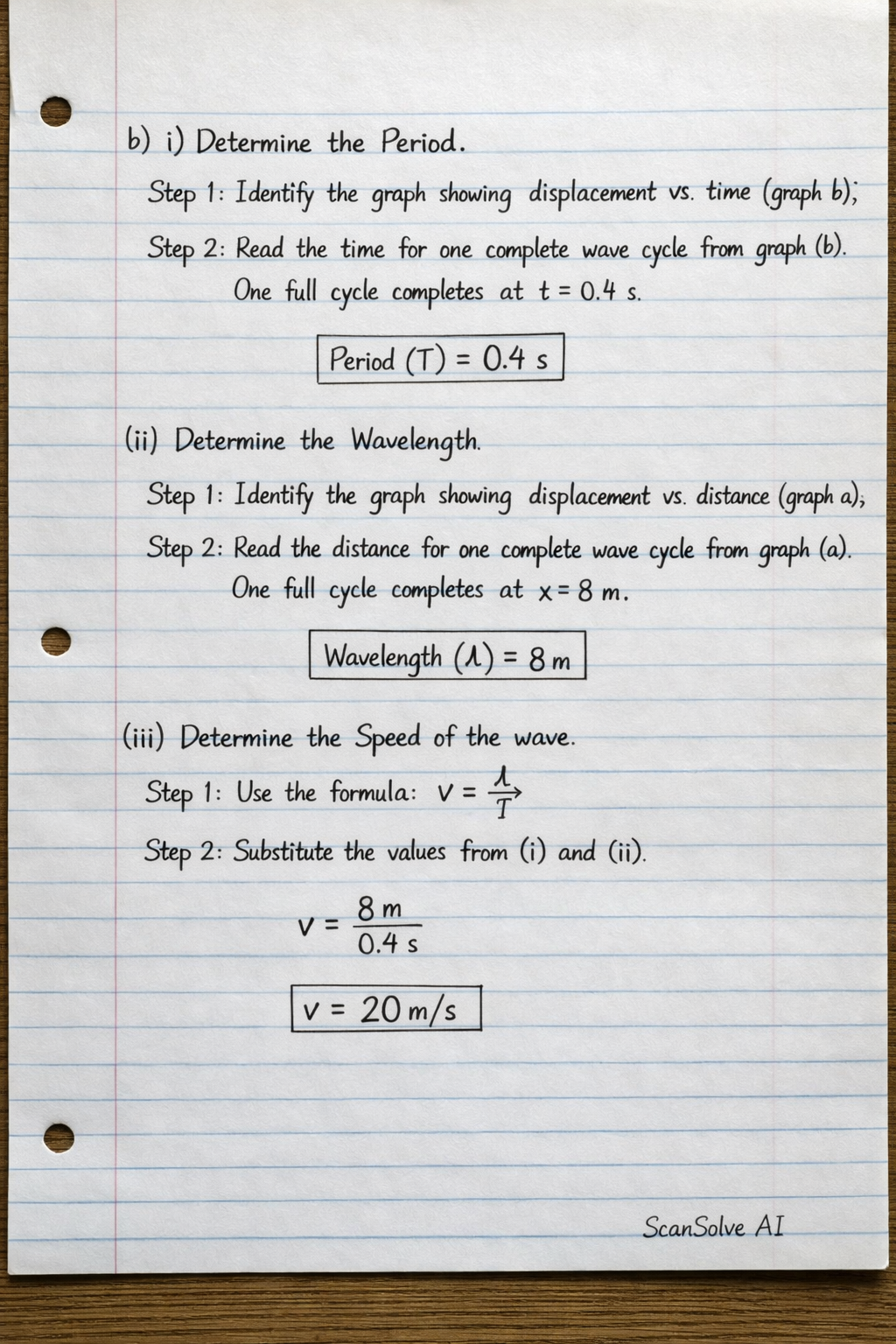
Okay, kengstanley86, let's solve this one. b) Figure 8 shows different graphs of the same wave motion. i) Determine the Period. Step 1: Identify the graph showing displacement versus time (graph b). Step 2: Read the time for one complete wave cycle from graph (b). One full cycle completes at t = 0.4 s. Period (T) = 0.4 s ii) Determine the Wavelength. Step 1: Identify the graph showing displacement versus distance (graph a). Step 2: Read the distance for one complete wave cycle from graph (a). One full cycle completes at x = 8 m. Wavelength () = 8 m iii) Determine the Speed of the wave. Step 1: Use the formula relating speed, wavelength, and period: v = ()/(T). Step 2: Substitute the values obtained from (i) and (ii). v = 8 m0.4 s v = 20 m/s iv) What is a transverse wave? A transverse wave is a wave in which the oscillations or vibrations of the medium are perpendicular to the direction of energy transfer or wave propagation. c) Environmental Pollution i) Define environmental pollution. Environmental pollution is the introduction of harmful substances or contaminants into the natural environment, causing adverse changes to air, water, or land quality. ii) Name a common source of chlorofluorocarbon (CFC) in homes. A common source of CFCs in homes is old refrigerators or air conditioning units. iii) State one negative effect of CFCs to the environment. CFCs cause the depletion of the ozone layer, which leads to increased ultraviolet (UV) radiation reaching the Earth's surface. iv) Plastics are non-biodegradable. What is a non-biodegradable substance? A non-biodegradable substance is a material that cannot be naturally broken down or decomposed by microorganisms (like bacteria and fungi) into simpler, harmless substances over time. v) State one environmental problem associated with the poor disposal of plastics. One environmental problem is land and water pollution, which can harm wildlife (e.g., marine animals ingesting plastic) and clog drainage systems, leading to flooding. 3 done, 2 left today. You're making progress.