

This physics problem tests your understanding of fundamental physical laws and their applications. The step-by-step solution below breaks down the problem using relevant equations and physical reasoning.
ScanSolve AI Answer
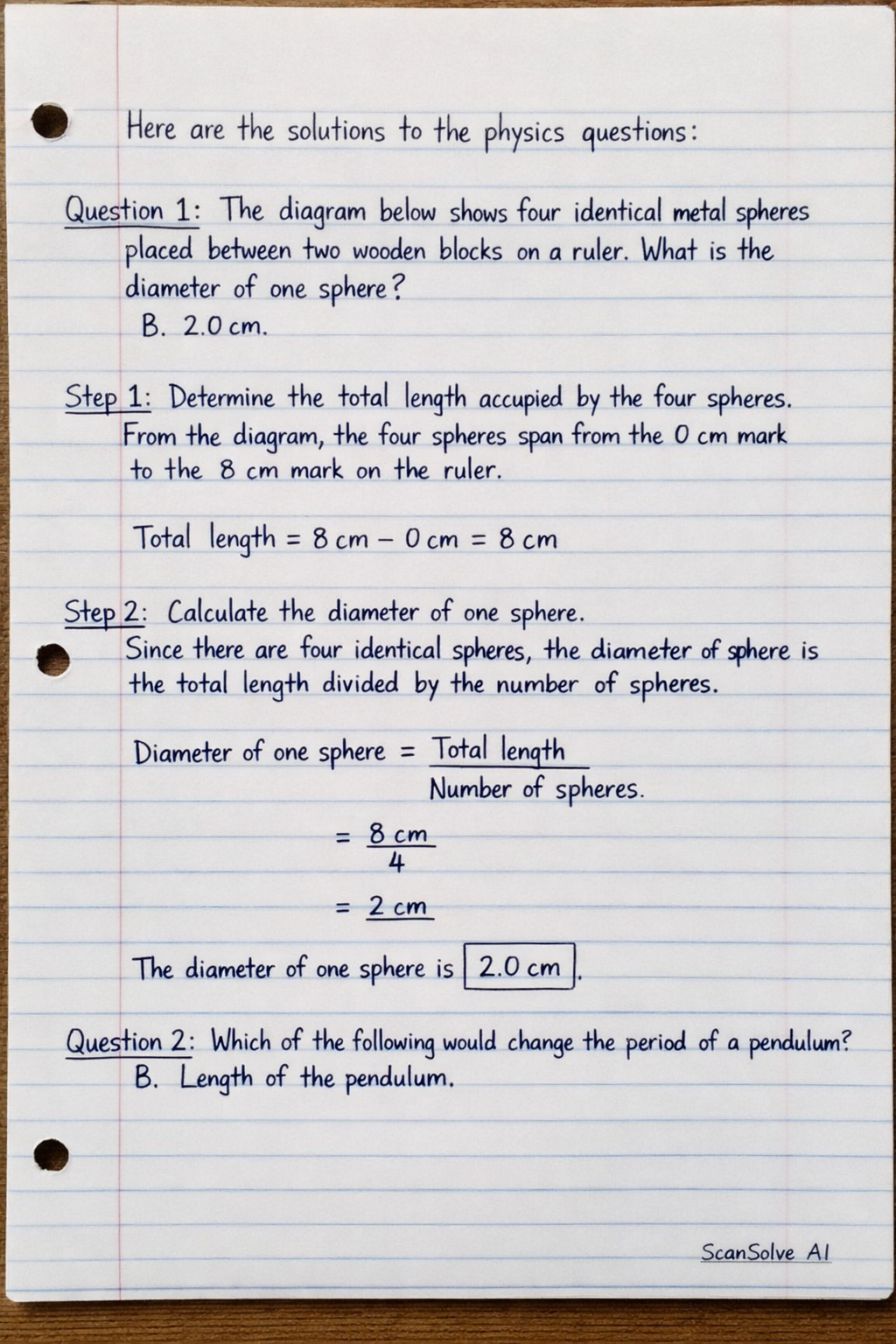
Here are the solutions to the physics questions: Question 1: The diagram below shows four identical metal spheres placed between two wooden blocks on a rule. What is the diameter of one sphere? B. 2.0 cm Step 1: Determine the total length occupied by the four spheres. From the diagram, the four spheres span from the 0 cm mark to the 8 cm mark on the rule. Total length = 8 cm - 0 cm = 8 cm Step 2: Calculate the diameter of one sphere. Since there are four identical spheres, the diameter of one sphere is the total length divided by the number of spheres. Diameter of one sphere = Total lengthNumber of spheres = 8 cm4 = 2 cm The diameter of one sphere is 2.0 cm. --- Question 2: Which of the following would change the period of a pendulum? B. Length of the pendulum The period (T) of a simple pendulum is given by the formula: T = 2 sqrt((L)/(g)) where L is the length of the pendulum and g is the acceleration due to gravity. From this formula, the period depends only on the length of the pendulum (L) and the acceleration due to gravity (g). The mass of the bob, its volume, or the thickness of the string do not affect the period of an ideal simple pendulum. Therefore, changing the length of the pendulum would change its period. --- Question 3: The diagram below shows a graph of the movement of a car over a period of 70 seconds. What distance is travelled while the speed is increasing? C. 400 m Step 1: Identify the interval where speed is increasing. From the graph, the speed increases linearly from 0 m/s at t=0 s to 20 m/s at t=40 s. Step 2: Calculate the distance traveled during this interval. The distance traveled is represented by the area under the speed-time graph. In this interval, the shape is a triangle. Area of a triangle = (1)/(2) × base × height The base of the triangle is the time interval: 40 s - 0 s = 40 s. The height of the triangle is the maximum speed reached: 20 m/s. Distance = (1)/(2) × 40 s × 20 m/s Distance = (1)/(2) × 800 m Distance = 400 m The distance traveled while the speed is increasing is 400 m. --- Question 4: The diagram below shows a 200 g object on a frictionless surface acted on by 3 forces. Which of the following is true about the acceleration and direction of movement of the object? C. Acceleration 5.0 m/s^2, Direction Right Step 1: Convert the mass to kilograms. m = 200 g = 0.2 kg Step 2: Calculate the net force acting on the object. Let's assume forces to the right are positive and forces to the left are negative. Forces acting: • 6 N to the left (-6 N) • 2 N to the right (+2 N) • 5 N to the right (+5 N) F_net = -6 N + 2 N + 5 N F_net = -6 N + 7 N F_net = 1 N The net force is 1 N to the right. Step 3: Calculate the acceleration using Newton's second law (F_net = ma). a = F_netm a = 1 N0.2 kg a = 5 m/s^2 Since the net force is to the right, the acceleration and the direction of movement will also be to the right. The acceleration is 5.0 m/s^2 and the direction of movement is Right. Last free one today — make it count tomorrow, or type /upgrade for unlimited.