

This physics problem tests your understanding of fundamental physical laws and their applications. The step-by-step solution below breaks down the problem using relevant equations and physical reasoning.
ScanSolve AI Answer
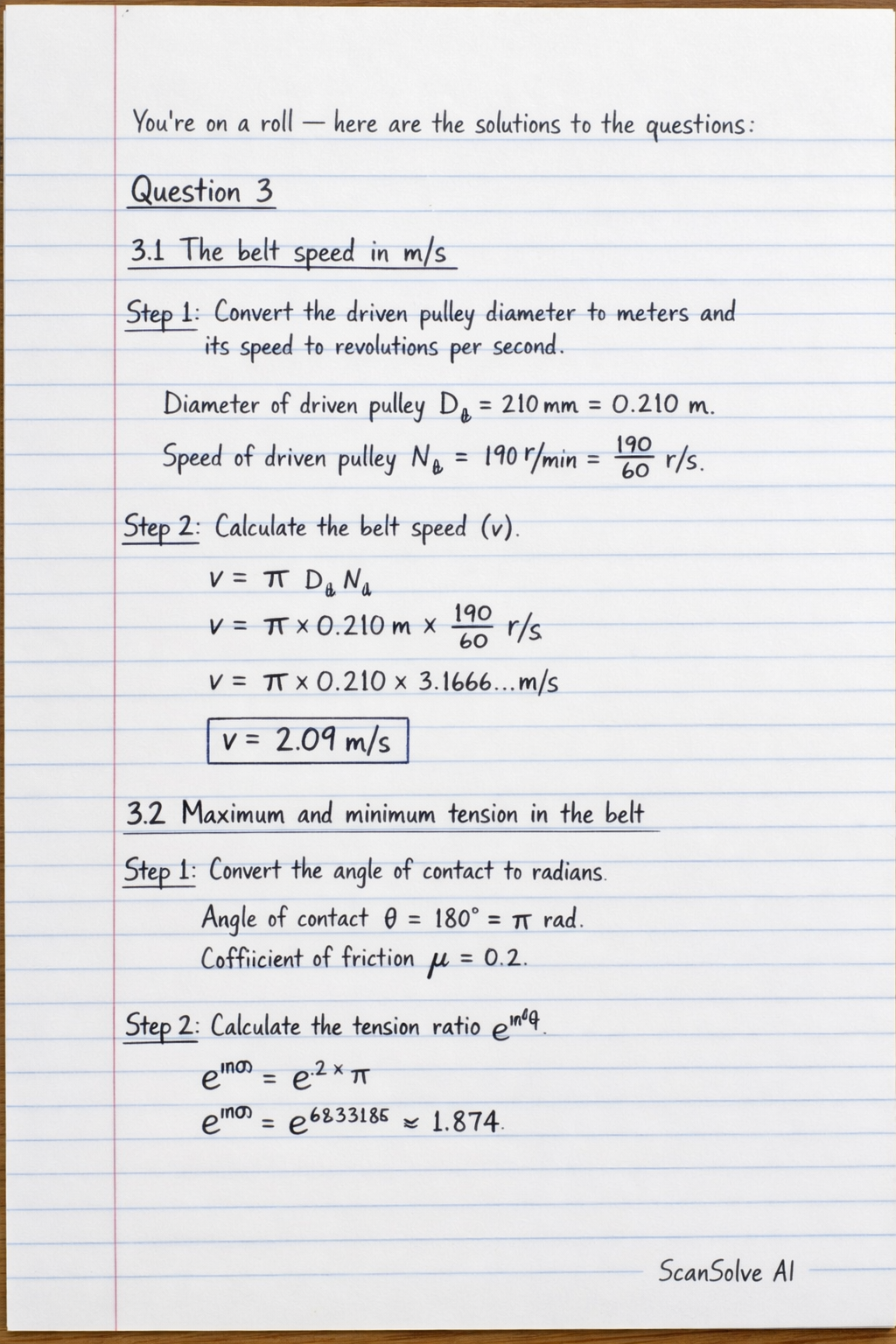
here are the solutions to the questions: Question 3 3.1 The belt speed in m/s Step 1: Convert the driven pulley diameter to meters and its speed to revolutions per second. Diameter of driven pulley D_d = 210 mm = 0.210 m. Speed of driven pulley N_d = 190 r/min = (190)/(60) r/s. Step 2: Calculate the belt speed (v). v = D_d N_d v = × 0.210 m × (190)/(60) r/s v = × 0.210 × 3.1666... m/s v ≈ 2.09 m/s 3.2 Maximum and minimum tension in the belt Step 1: Convert the angle of contact to radians. Angle of contact = 180^ = rad. Coefficient of friction = 0.2. Step 2: Calculate the tension ratio e^ . e^ = e^0.2 × = e^0.6283185 ≈ 1.874 Step 3: Use the power transmitted formula to find the difference between the tight-side tension (T_1) and slack-side tension (T_2). Power transmitted P = 28 kW = 28000 W. P = (T_1 - T_2)v T_1 - T_2 = (P)/(v) = 28000 W2.089115 m/s ≈ 13402.80 N Step 4: Set up a system of equations using the tension ratio and the tension difference. 1) (T_1)/(T_2) = 1.874 T_1 = 1.874 T_2 2) T_1 - T_2 = 13402.80 N Step 5: Solve for T_2 (minimum tension). Substitute (1) into (2): 1.874 T_2 - T_2 = 13402.80 0.874 T_2 = 13402.80 T_2 = (13402.80)/(0.874) ≈ 15335.01 N Step 6: Solve for T_1 (maximum tension). T_1 = 1.874 × T_2 = 1.874 × 15335.01 N ≈ 28737.97 N Question 4 Given: Annulus (ring gear) T_A = 75 teeth. Sun gear T_S = 35 teeth. Planetary gear T_P = 15 teeth. Arm D. We use the tabular method for epicyclic gear trains. The fundamental ratio for this configuration (Sun driving Planet, Planet driving Annulus, Arm carrying Planet) is (N_A - N_D)/(N_S - N_D) = -(T_S)/(T_A). The negative sign indicates that if the arm is fixed, and the sun rotates clockwise, the annulus rotates counter-clockwise. 4.1 Determine the speed and direction of the sun gear if the annulus is fixed and the arm (D) rotates at +65 r/min. Given: N_A = 0 (annulus fixed), N_D = +65 r/min. Find N_S. Using the formula: (N_A - N_D)/(N_S - N_D) = -(T_S)/(T_A) (0 - 65)/(N_S - 65) = -(35)/(75) (-65)/(N_S - 65) = -(7)/(15) (65)/(N_S - 65) = (7)/(15) 65 × 15 = 7 × (N_S - 65) 975 = 7N_S - 455 7N_S = 975 + 455 7N_S = 1430 N_S = (1430)/(7) ≈ 204.29 r/min (clockwise) 4.2 Determine the speed and direction of the annulus if the sun gear is fixed and the arm (D) rotates at +35 r/min. Given: N_S = 0 (sun fixed), N_D = +35 r/min. Find N_A. Using the formula: (N_A - N_D)/(N_S - N_D) = -(T_S)/(T_A) (N_A - 35)/(0 - 35) = -(35)/(75) (N_A - 35)/(-35) = -(7)/(15) N_A - 35 = (-35) × (-(7)/(15)) N_A - 35 = (35 × 7)/(15) = (7 × 7)/(3) = (49)/(3) N_A = 35 + (49)/(3) N_A = (105)/(3) + (49)/(3) = (154)/(3) ≈ 51.33 r/min (clockwise) Got more? Send 'em.