

This physics problem tests your understanding of fundamental physical laws and their applications. The step-by-step solution below breaks down the problem using relevant equations and physical reasoning.
ScanSolve AI Answer
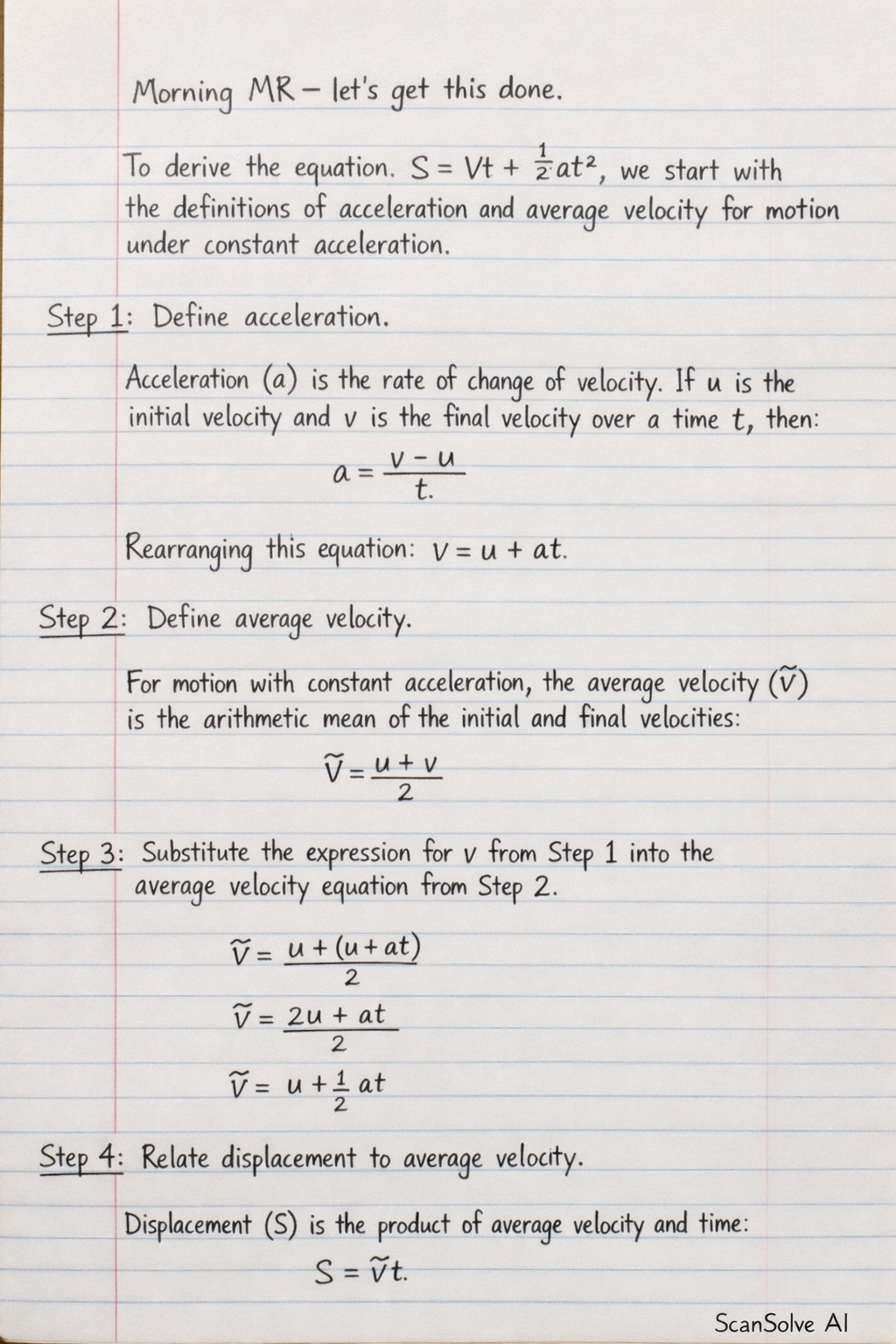
Morning MR — let's get this done. To derive the equation S = Vt + (1)/(2)at^2, we start with the definitions of acceleration and average velocity for motion under constant acceleration. Step 1: Define acceleration. Acceleration (a) is the rate of change of velocity. If u is the initial velocity and v is the final velocity over a time t, then: a = (v - u)/(t) Rearranging this equation to solve for the final velocity v: v = u + at Step 2: Define average velocity. For motion with constant acceleration, the average velocity (v) is the arithmetic mean of the initial and final velocities: v = (u + v)/(2) Step 3: Substitute the expression for v from Step 1 into the average velocity equation from Step 2. v = (u + (u + at))/(2) v = (2u + at)/(2) v = u + (1)/(2)at Step 4: Relate displacement to average velocity. Displacement (S) is the product of average velocity and time: S = vt Step 5: Substitute the expression for v from Step 3 into the displacement equation from Step 4. S = (u + (1)/(2)at)t S = ut + (1)/(2)at^2 Step 6: Match the notation. The question uses V for initial velocity instead of u. Replacing u with V: S = Vt + (1)/(2)at^2 This is the derived equation. The derived equation is: S = Vt + (1)/(2)at^2 Send me the next one 📸