
We read your photo as:
Choose the correct options for the following questions: a) Which of the following is a fundamental unit? c) Which of the following is a derived unit? d) Which of the following units denote newton? Giv
ScanSolve AI Answer
Step-by-step solution
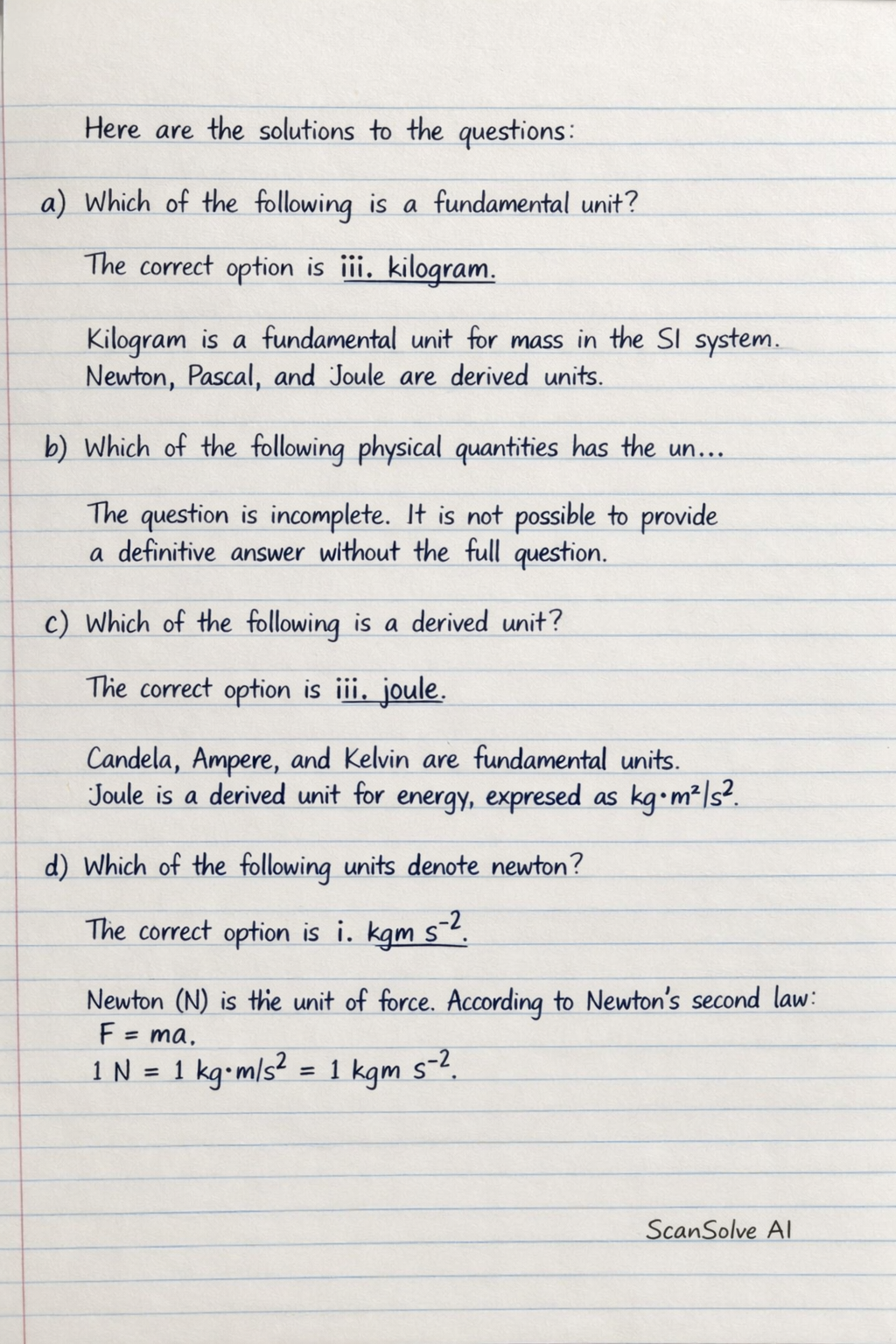
3 stepsHere are the solutions to the questions:
Choose the correct options for the following questions:
a) Which of the following is a fundamental unit?
The correct option is iii. kilogram.
Kilogram is a fundamental unit for mass in the SI system. Newton, Pascal, and Joule are derived units.
b) Which of the following physical quantities has the un...
The question is incomplete. It is not possible to provide a definitive answer without the full question.
c) Which of the following is a derived unit?
The correct option is iii. joule.
Candela, Ampere, and Kelvin are fundamental units. Joule is a derived unit for energy, expressed as .
d) Which of the following units denote newton?
The correct option is i. .
Newton (N) is the unit of force. According to Newton's second law (), .
Give reason:
a) Joule is the derived unit of work.
Work is defined as force multiplied by displacement (). The unit of force is Newton () and the unit of displacement is meter (). Therefore, the unit of work, Joule, is derived from these fundamental units:
Since Joule is expressed in terms of fundamental units (kilogram, meter, second), it is a derived unit.
b) Some variables should be controlled while performing an experiment.
Controlling variables in an experiment ensures that any observed changes in the dependent variable are directly attributable to the manipulation of the independent variable, and not to other extraneous factors. This helps to establish a clear cause-and-effect relationship and increases the validity and reliability of the experimental results.
c) is not a valid relation.
For a physical relation to be valid, it must be dimensionally consistent. Let's check the dimensions of both sides:
Determine the dimension of the left side ().
The dimension of velocity () is .
So, the dimension of is .Determine the dimension of the right side ().
The dimension of velocity () is .
The dimension of time () is .
So, the dimension of is .Compare the dimensions.
Since , the relation is not dimensionally consistent and therefore not a valid physical relation.
Still stuck on this one?
Ask a follow-up, and the answer starts from this question.
More Physics Questions
Handwritten Step-by-Step Solution
Get this as a handwritten image on WhatsApp — like a tutor wrote it for you.
Try on WhatsApp