
We read your photo as:
Calculate the common velocity after the impact. 8. State two evidences that matter is made up of small particles
ScanSolve AI Answer
Step-by-step solution
3 stepsHere are the solutions to your questions:
7. Calculate the common velocity after the impact.
Identify the given values and convert units.
Mass of arrow,
Mass of block of wood,
Initial velocity of arrow,
Initial velocity of block of wood, (since it is at rest)
Common final velocity,Apply the principle of conservation of momentum.
The total momentum before impact equals the total momentum after impact.
Substitute the values into the equation and solve for .
The common velocity after impact is .
8. State two evidences that matter is made up of small particles
Two evidences that matter is made up of small particles are:
- Diffusion: The spreading out of particles from a region of higher concentration to a region of lower concentration, such as the smell of perfume spreading in a room.
- Brownian motion: The random movement of microscopic particles suspended in a fluid (liquid or gas) due to their collision with the fast-moving atoms or molecules in the fluid.
9. Distinguish between conduction and convection
- Conduction is the transfer of heat through direct contact between particles, without the bulk movement of the material itself.
- Convection is the transfer of heat through the movement of fluids (liquids or gases) from hotter regions to colder regions.
Still stuck on this one?
Ask a follow-up, and the answer starts from this question.
More Physics Questions
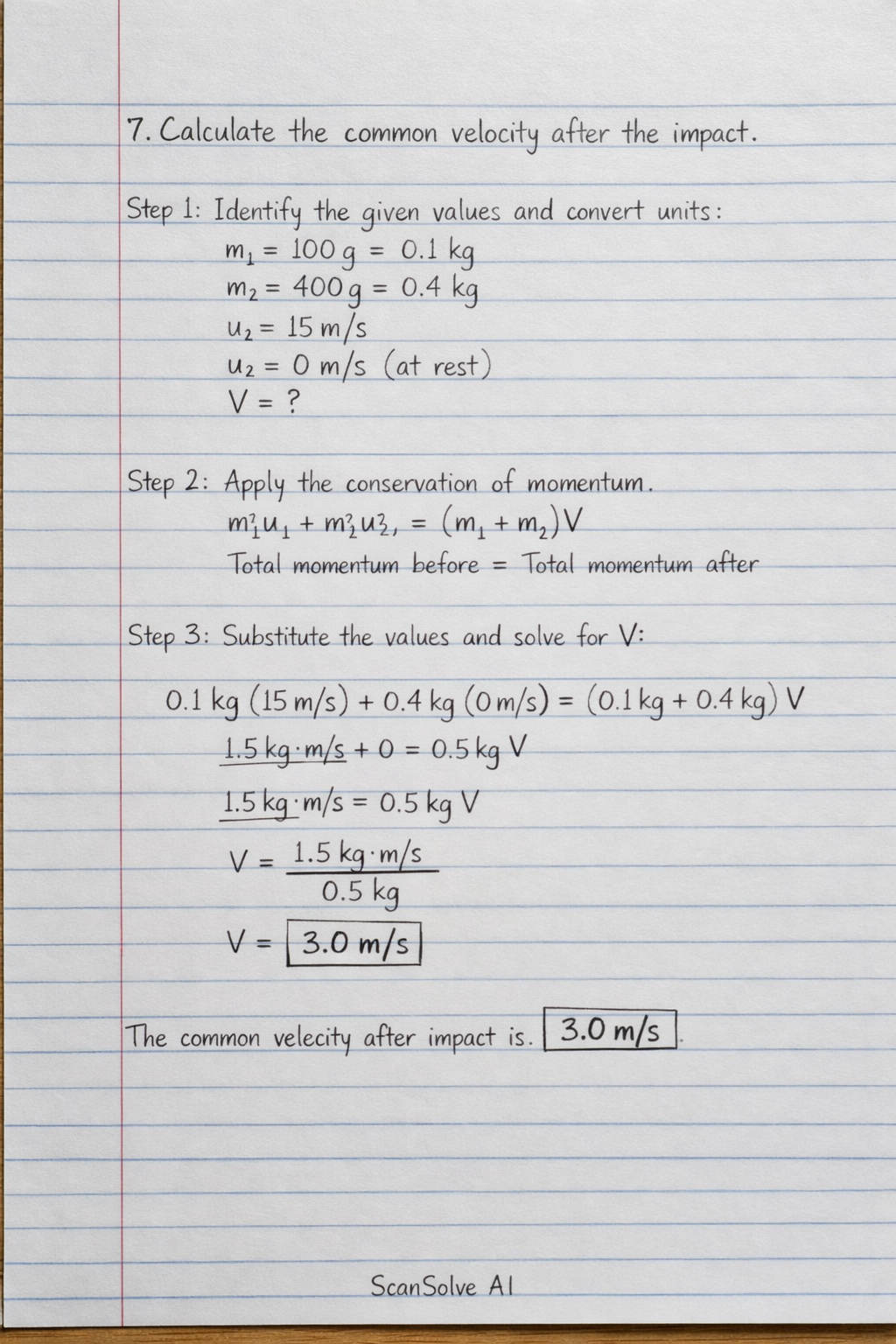
Handwritten Step-by-Step Solution
Get this as a handwritten image on WhatsApp — like a tutor wrote it for you.
Try on WhatsApp