
We read your photo as:
Compare atomic size and ionization energy.
ScanSolve AI Answer
Step-by-step solution
2 stepsQuestion 1(c): Explain why lithium is less reactive than potassium.
Compare atomic size and ionization energy.
Lithium has a smaller atomic radius and higher ionization energy compared to potassium. This is because lithium's valence electron is closer to the nucleus and experiences a stronger effective nuclear charge.
Relate to electron loss and reactivity.
Reactivity for alkali metals is determined by their tendency to lose their single valence electron. Since lithium requires more energy to lose its electron (due to higher ionization energy), it is less reactive than potassium, which readily loses its electron.
Lithium is less reactive than potassium because its valence electron is held more strongly by the nucleus due to its smaller atomic size and higher ionization energy, making it harder to lose the electron.
Still stuck on this one?
Ask a follow-up, and the answer starts from this question.
More Physics Questions
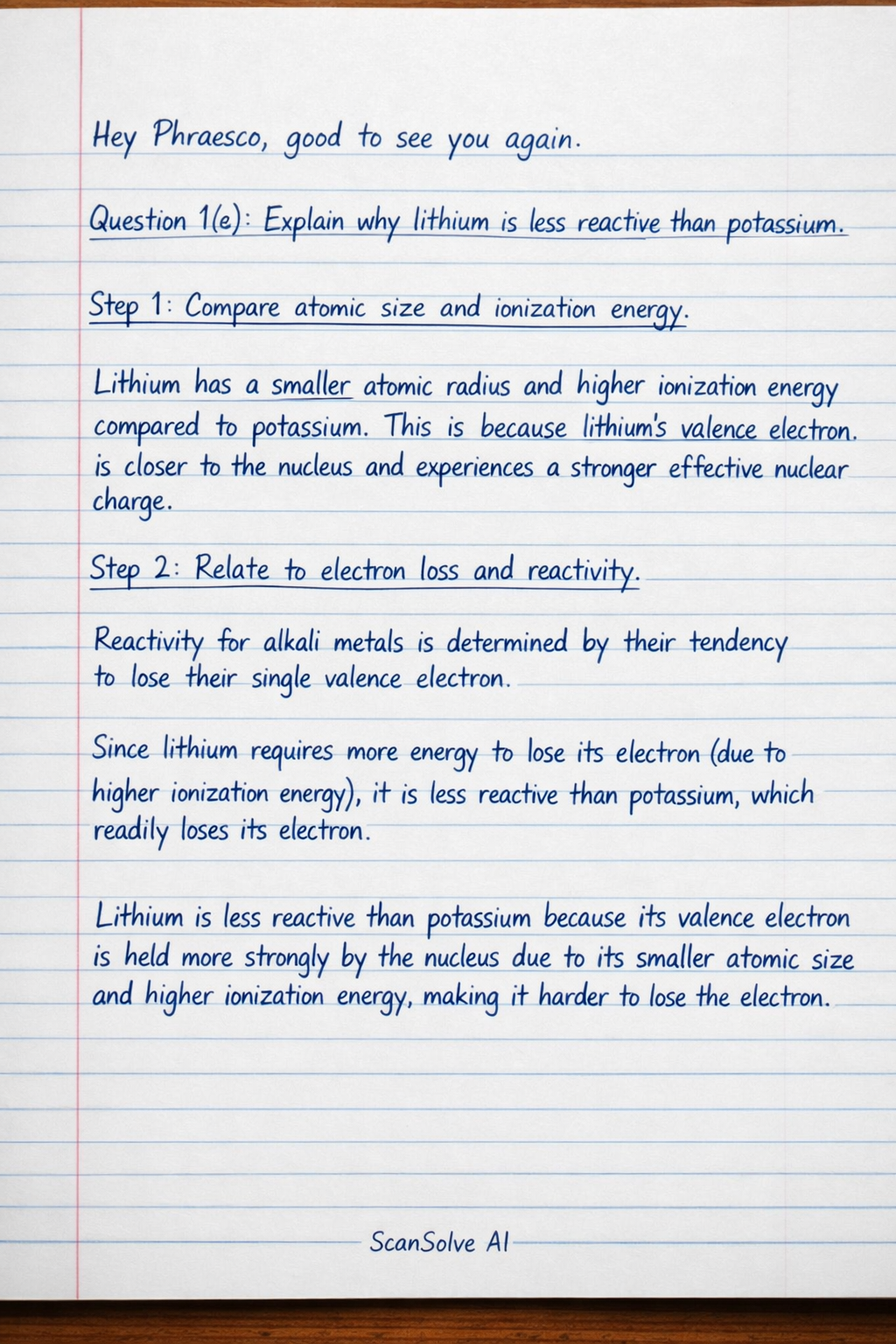
Handwritten Step-by-Step Solution
Get this as a handwritten image on WhatsApp — like a tutor wrote it for you.
Try on WhatsApp