

This chemistry question involves key chemical concepts and calculations. The detailed solution below walks through each step, from identifying the reaction type to computing the final answer.
ScanSolve AI Answer
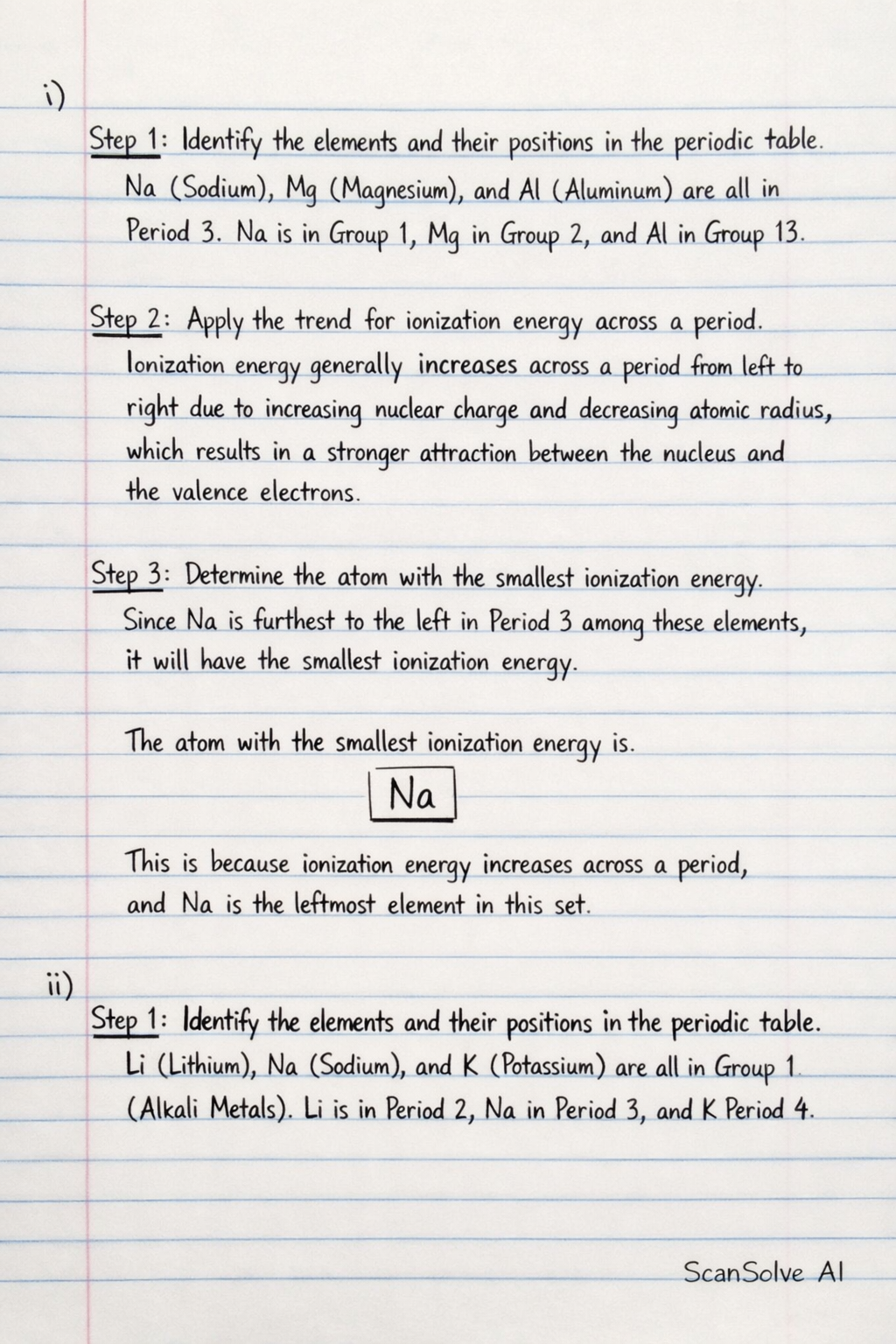
i) Step 1: Identify the elements and their positions in the periodic table. Na (Sodium), Mg (Magnesium), and Al (Aluminum) are all in Period 3. Na is in Group 1, Mg in Group 2, and Al in Group 13. Step 2: Apply the trend for ionization energy across a period. Ionization energy generally increases across a period from left to right due to increasing nuclear charge and decreasing atomic radius, which results in a stronger attraction between the nucleus and the valence electrons. Step 3: Determine the atom with the smallest ionization energy. Since Na is furthest to the left in Period 3 among these elements, it will have the smallest ionization energy. The atom with the smallest ionization energy is Na. This is because ionization energy increases across a period, and Na is the leftmost element in this set. ii) Step 1: Identify the elements and their positions in the periodic table. Li (Lithium), Na (Sodium), and K (Potassium) are all in Group 1 (Alkali Metals). Li is in Period 2, Na in Period 3, and K in Period 4. Step 2: Apply the trend for ionization energy down a group. Ionization energy generally decreases down a group due to increasing atomic radius and increased shielding effect from inner electrons, which reduces the effective nuclear charge experienced by the valence electrons, making them easier to remove. Step 3: Determine the atom with the smallest ionization energy. Since K is at the bottom of this group among these elements, it will have the smallest ionization energy. The atom with the smallest ionization energy is K. This is because ionization energy decreases down a group, and K is the lowest element in this set. iii) Step 1: Identify the elements and their positions in the periodic table. Cl (Chlorine), Br (Bromine), and I (Iodine) are all in Group 17 (Halogens). Cl is in Period 3, Br in Period 4, and I in Period 5. Step 2: Apply the trend for ionization energy down a group. Ionization energy generally decreases down a group due to increasing atomic radius and increased shielding effect from inner electrons, which reduces the effective nuclear charge experienced by the valence electrons, making them easier to remove. Step 3: Determine the atom with the smallest ionization energy. Since I is at the bottom of this group among these elements, it will have the smallest ionization energy. The atom with the smallest ionization energy is I. This is because ionization energy decreases down a group, and I is the lowest element in this set.