
We read your photo as:
Complete the diagram to locate the position of the object for a concave lens given its virtual image.
ScanSolve AI Answer
Step-by-step solution
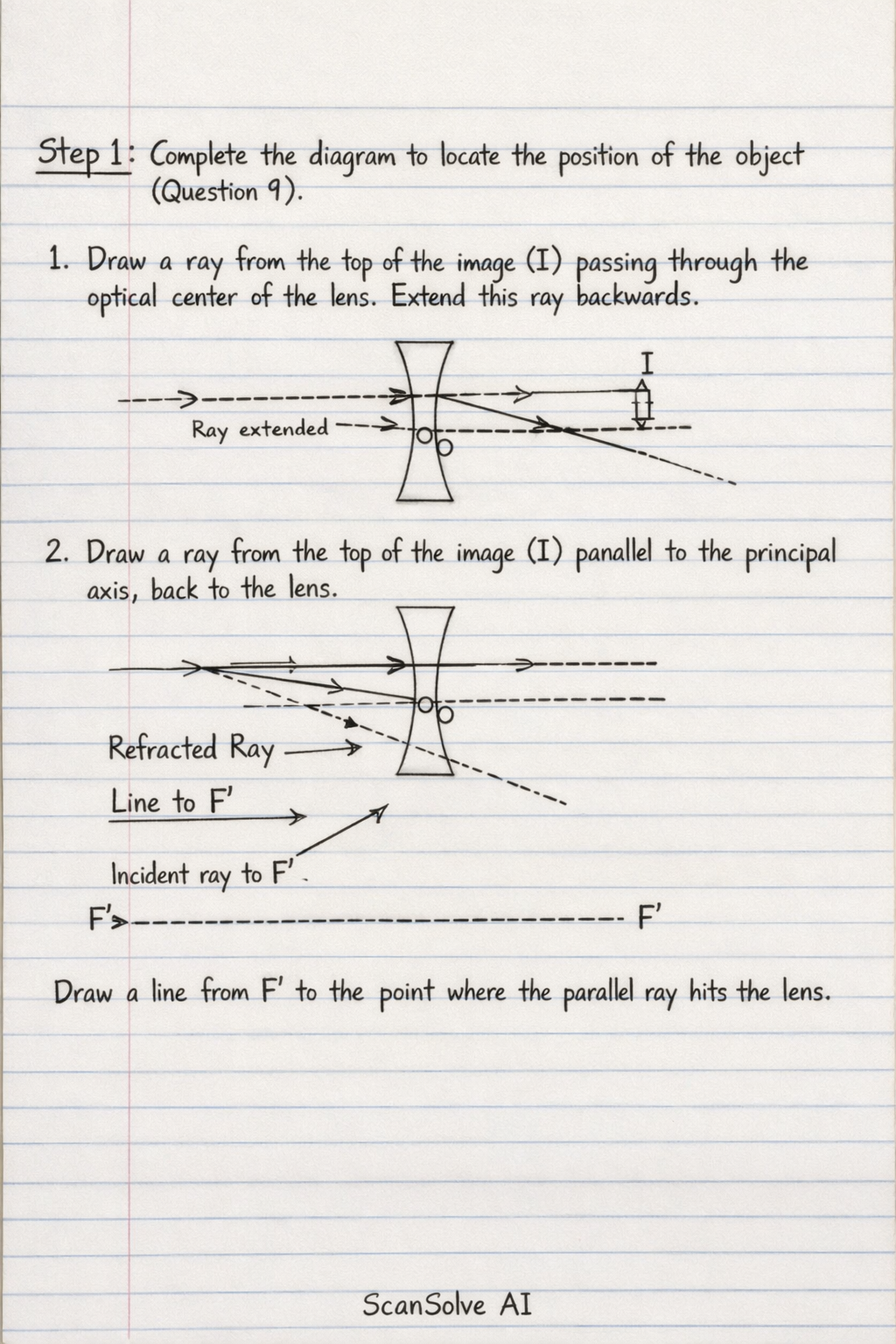
3 stepsComplete the diagram to locate the position of the object (Question 9).
For a concave lens, a real object always forms a virtual, erect, and diminished image between the optical center and the principal focus (F) on the same side as the object. To find the object's position given the image (I):
- Draw a ray from the top of the image (I) passing through the optical center of the lens. Extend this ray backwards. The top of the object must lie on this extended line.
- Draw a ray from the top of the image (I) parallel to the principal axis, back to the lens. This is the refracted ray. For a concave lens, an incident ray parallel to the principal axis refracts such that its extension passes through the principal focus F (on the object side). Therefore, the incident ray that produced this refracted ray must have been directed towards F' (the principal focus on the other side of the lens). Draw a line from F' to the point where the parallel ray hits the lens. This line represents the incident ray.
- The intersection of the extended ray from step 1 and the incident ray from step 2 gives the position of the top of the object. Draw the object from this point down to the principal axis.
The completed diagram would show the object placed further away from the lens than F, on the same side as the image.
State the adjustment that should be made on the x-ray tube to increase the hardness of the X-rays produced (Question 10a).
The hardness of X-rays refers to their penetrating power, which is directly related to their energy. Higher energy X-rays are produced when the electrons striking the target have higher kinetic energy. This is achieved by increasing the accelerating voltage.
The adjustment is to increase the accelerating voltage (or potential difference) across the X-ray tube.Complete the arrangement of electromagnetic waves in Figure 5 (Question 10b).
The electromagnetic spectrum is arranged in order of increasing energy (and frequency) as follows: Radio waves, Microwaves, Infrared, Visible Light, Ultraviolet, X-rays, Gamma rays.
Given "Visible Light" and "Increasing energy" to the right:- The wave immediately to the left of Visible Light (lower energy) is Infrared. So, B = Infrared.
- The wave immediately to the left of Infrared (lower energy) is Microwaves. So, A = Microwaves.
- The wave immediately to the right of Visible Light (higher energy) is Ultraviolet. So, C = Ultraviolet.
The completed table is:
Still stuck on this one?
Ask a follow-up, and the answer starts from this question.
More Physics Questions
Handwritten Step-by-Step Solution
Get this as a handwritten image on WhatsApp — like a tutor wrote it for you.
Try on WhatsApp