
We read your photo as:
Explain the concepts of electrical energy and power, including their commercial units and the principles of power transmission.
ScanSolve AI Answer
Here are notes based on the objectives for Electrical Energy and Power:
-
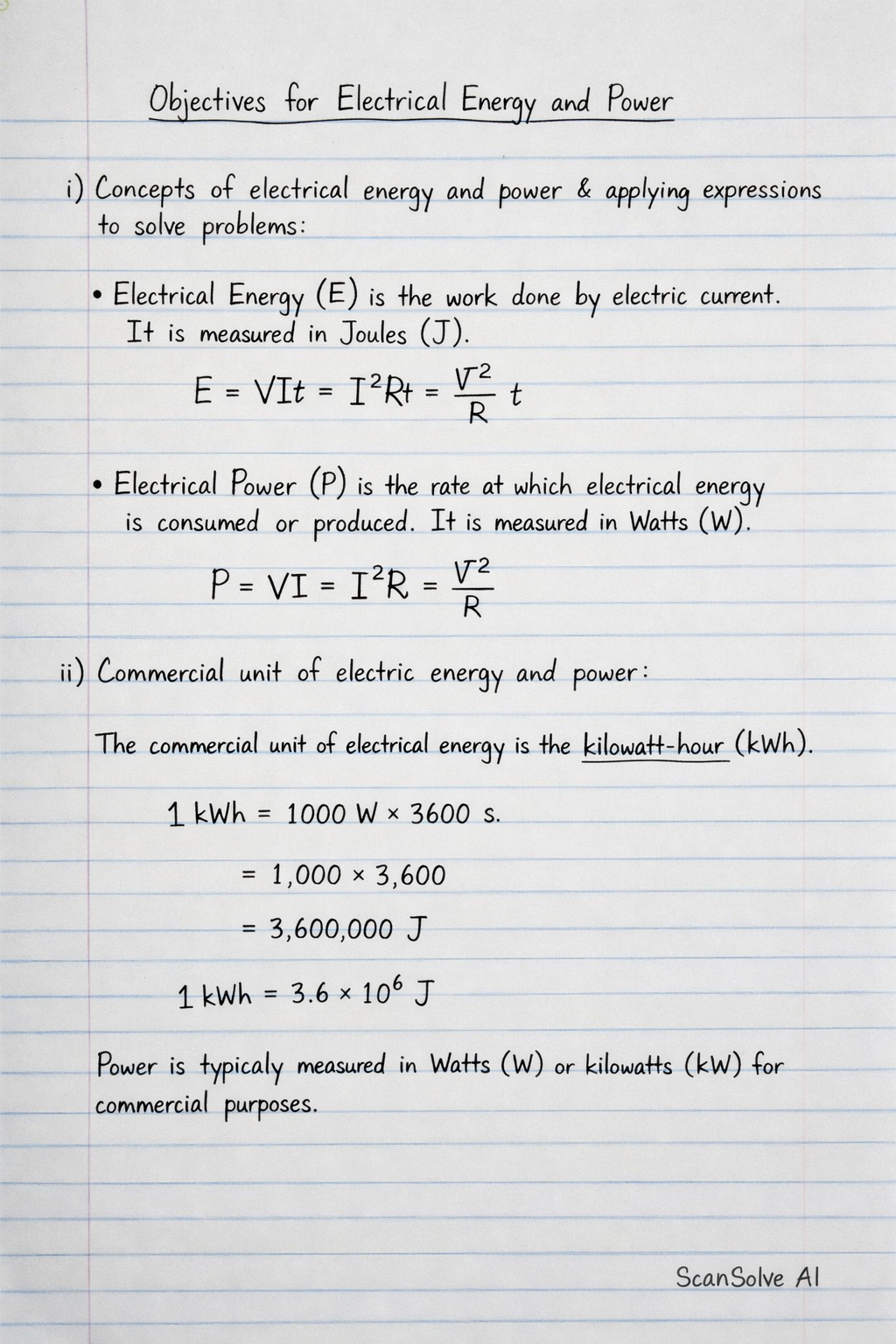
i) Concepts of electrical energy and power & applying expressions to solve problems:
- Electrical Energy () is the work done by electric current. It is measured in Joules (J).
- Electrical Power () is the rate at which electrical energy is consumed or produced. It is measured in Watts (W).
-
ii) Commercial unit of electric energy and power: The commercial unit of electrical energy is the kilowatt-hour (kWh).
Power is typically measured in Watts (W) or kilowatts (kW) for commercial purposes.
-
iii) Electric power transmission & analyzing how power is transmitted:
- Electricity is generated at power stations and transmitted over long distances at very high voltages (e.g., hundreds of kilovolts) to minimize power loss.
- Step-up transformers increase the voltage at the power station.
- Power loss in transmission cables is given by . By increasing voltage (), the current () for a given power () is reduced, significantly decreasing losses.
- Step-down transformers reduce the voltage for distribution to homes and industries for safety and usability.
-
iv) Heating effects of electric current & its uses:
- The heating effect of electric current (Joule heating) occurs when current flows through a resistor, converting electrical energy into heat energy. The heat produced is .
- Uses: Electric heaters, toasters, kettles, electric irons, incandescent light bulbs, and fuses.
-
v) Electrical wiring of houses & advantages of parallel arrangement over series:
- Houses are wired in a parallel arrangement.
- Advantages of parallel wiring:
- Each appliance receives the full supply voltage.
- Appliances can be switched on and off independently.
- If one appliance fails, others continue to operate.
- Disadvantages of series wiring: Appliances would not receive full voltage, could not be operated independently, and the failure of one would break the entire circuit.
-
vi) Use of fuses & determining the fuse rating:
- A fuse is a safety device that protects electrical circuits and appliances from overcurrent. It contains a thin wire that melts and breaks the circuit if the current exceeds a safe limit.
- The fuse rating is the maximum current a fuse can carry continuously without melting.
- To determine the fuse rating for an appliance, calculate its normal operating current using the formula , where is the power of the appliance and is the supply voltage. The fuse rating should be slightly higher than this calculated current.
- For example, a 2400 W appliance on a 240 V supply draws . A 13 A fuse would be appropriate.
Still stuck on this one?
Ask a follow-up, and the answer starts from this question.
More Physics Questions
Handwritten Step-by-Step Solution
Get this as a handwritten image on WhatsApp — like a tutor wrote it for you.
Try on WhatsApp