
We read your photo as:
Consider the following substances: MgBr2, NH3, Mn. 4.1 Define a chemical bond. 4.2 Write down a substance from the list above which has: 4.2.1 a covalent bond. 4.2.2 An ionic bond. 4.3 Magnesium reacts with bromine to form magnesium bromide.
ScanSolve AI Answer
Step-by-step solution
4 stepsHere are the solutions to the questions:
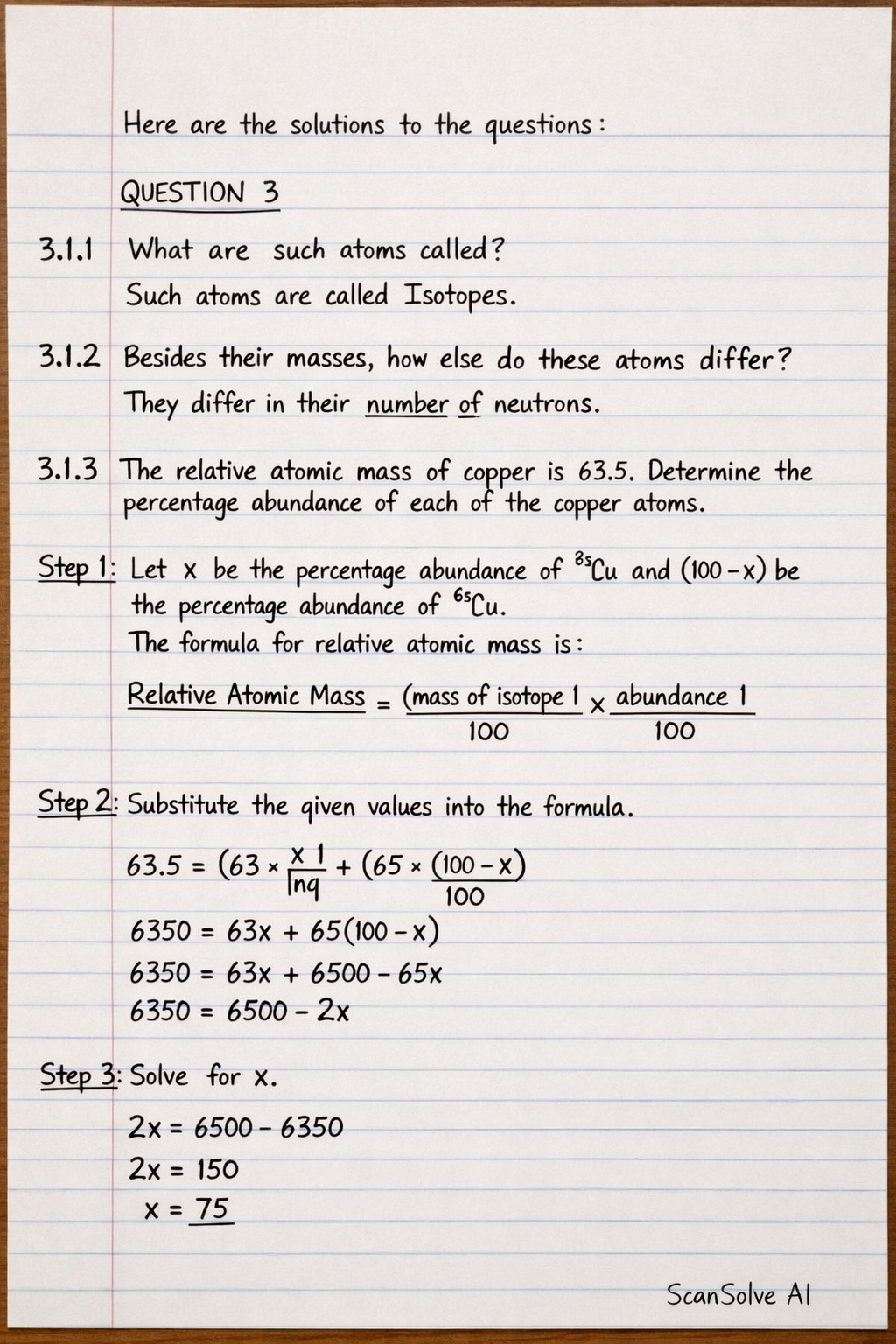
QUESTION 3
3.1.1 What are such atoms called?
Such atoms are called Isotopes.
3.1.2 Besides their masses, how else do these atoms differ?
They differ in their number of neutrons.
3.1.3 The relative atomic mass of copper is 63.5. Determine the percentage abundance of each of the copper atoms.
Let be the percentage abundance of and be the percentage abundance of .
The formula for relative atomic mass is:
Substitute the given values into the formula.
Solve for .
Determine the percentage abundance for each isotope.
Percentage abundance of .
Percentage abundance of .
The percentage abundance of is and is .3.2 Complete the table below.
-
Aluminium
- 3.2.1 Mass Number: For Aluminium (Atomic Number 13), the most common isotope has a mass number of 27.
- 3.2.2 Number of Neutrons: Mass Number - Atomic Number = .
- 3.2.3 Number of Electrons: For a neutral Aluminium atom, the number of electrons equals the atomic number, which is 13.
- 3.2.1 Mass Number: For Aluminium (Atomic Number 13), the most common isotope has a mass number of 27.
-
Ion
- 3.2.4 Element: Given Mass Number = 30 and Number of Neutrons = 16.
Atomic Number = Mass Number - Number of Neutrons = .
The element with atomic number 14 is Silicon (Si).
- 3.2.5 Atomic Number: As calculated above, the atomic number is 14.
- 3.2.4 Element: Given Mass Number = 30 and Number of Neutrons = 16.
Atomic Number = Mass Number - Number of Neutrons = .
The element with atomic number 14 is Silicon (Si).
3.3 Write down:
3.3.1 the name of the compound:
The name of the compound is Potassium permanganate.3.3.2 the chemical formula for iron (III) chloride.
Iron (III) means and chloride means . To balance the charges, three chloride ions are needed for one iron (III) ion.
The chemical formula is .
QUESTION 4
4.1 Define a chemical bond.
A chemical bond is a strong attractive force that holds atoms together in molecules or compounds, resulting from the electrostatic attraction between oppositely charged ions or between nuclei and shared electrons.4.2 Write down a substance from the list above which has:
List: ; ;4.2.1 a covalent bond.
(Ammonia consists of nitrogen and hydrogen, both non-metals, sharing electrons).4.2.2 An ionic bond.
(Magnesium is a metal and bromine is a non-metal, forming bonds by electron transfer).4.3 Magnesium reacts with bromine to form magnesium bromide.
4.3.1 Using Lewis dot diagrams, show how magnesium reacts with bromine to form magnesium bromide.
Magnesium (Mg) is in Group 2, so it has 2 valence electrons. Bromine (Br) is in Group 17, so it has 7 valence electrons. Magnesium will lose its 2 valence electrons, and each bromine atom will gain 1 electron. Therefore, one magnesium atom reacts with two bromine atoms.4.3.2 Draw the Aufbau (orbital box) diagram for the magnesium ion.
Magnesium (Mg) has an atomic number of 12.
Electron configuration of neutral Mg: .
The magnesium ion is , meaning it has lost its two outermost electrons (from the orbital).
Electron configuration of : .Orbital box diagram for :
-
Still stuck on this one?
Ask a follow-up, and the answer starts from this question.
More Physics Questions
Handwritten Step-by-Step Solution
Get this as a handwritten image on WhatsApp — like a tutor wrote it for you.
Try on WhatsApp