
We read your photo as:
Convert 2.5 g/mm2 to kg/m2 and check the dimensional correctness of T = 2pisqrt(m/(F/x)).
ScanSolve AI Answer
Answers
2 partsStep-by-step solution
9 stepsHere are the solutions to the questions from the image:
Part a· 3 steps
Convert to .
Convert grams (g) to kilograms (kg).
We know that .
Convert square millimeters () to square meters ().
We know that .
Therefore, .Substitute the conversions into the given value.
The converted value is .
Part b
Determine if the formula is dimensionally correct. Where is time period, is mass, is force and is distance.
Determine the dimension of the Left Hand Side (LHS).
The LHS is , which represents time period.
Dimension of LHS =Determine the dimensions of the terms in the Right Hand Side (RHS).
is a dimensionless constant.
Dimension of mass () =
Dimension of force () =
Dimension of distance () =Calculate the dimension of the term .
Dimension of
Calculate the dimension of the term .
Dimension of
Calculate the dimension of the square root term.
Dimension of
Compare the dimensions of LHS and RHS.
Dimension of LHS =
Dimension of RHS = Dimension of Dimension of
Since the dimension of LHS equals the dimension of RHS, the formula is dimensionally correct.
The formula is .
Part c
State the conditions for two vectors to be equal. Give any four examples of the term "magnitude" as applied to vector and scalar quantities.
Conditions for two vectors to be equal:
- They must have the same magnitude.
- They must have the same direction.
- They must represent the same physical quantity.
Examples of quantities that have magnitude:
- Mass (Scalar): e.g.,
- Velocity (Vector): e.g., North
- Temperature (Scalar): e.g.,
- Force (
Try one yourself
A new problem that tests the same skill.
Still stuck on this one?
Ask a follow-up, and the answer starts from this question.
More Physics Questions
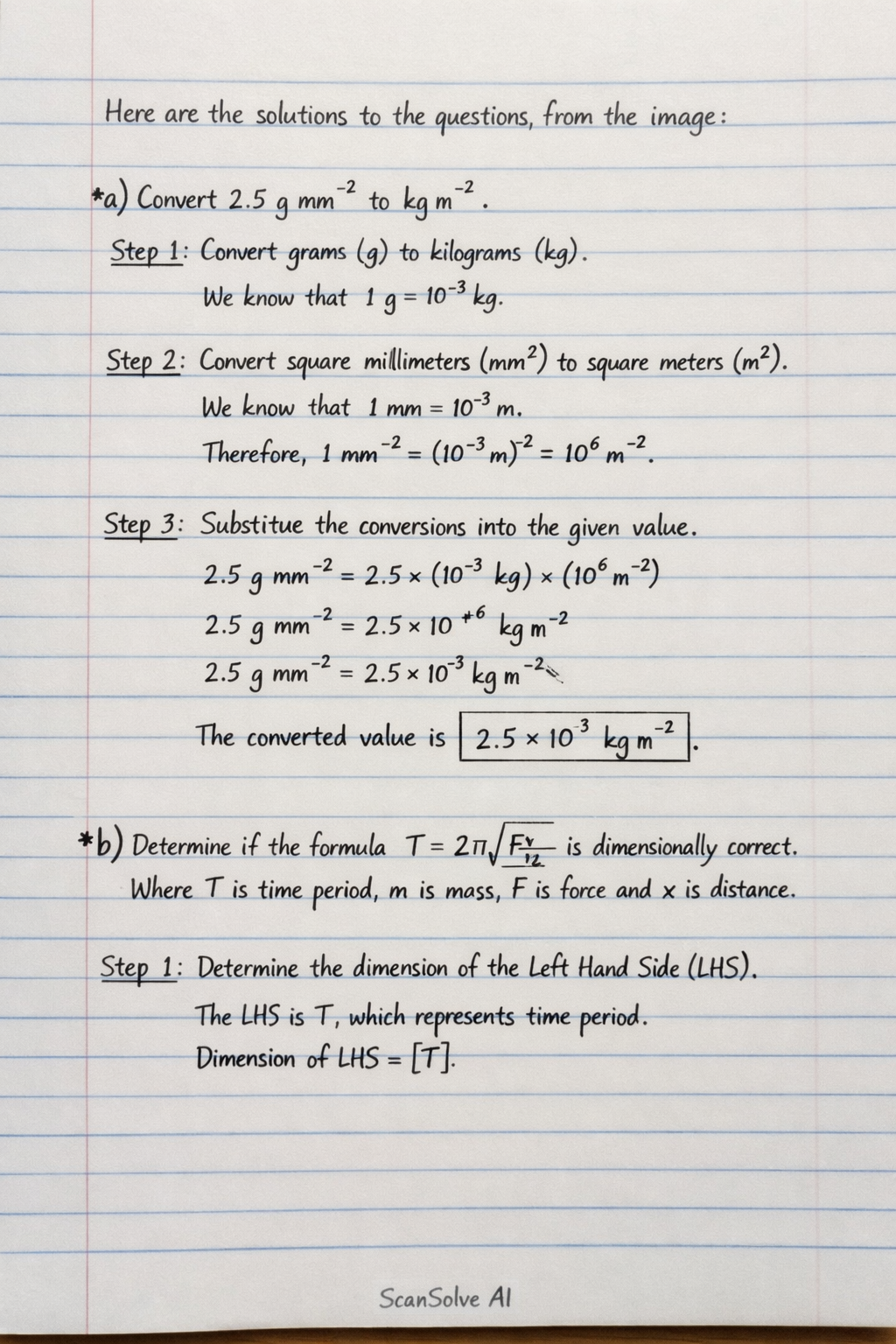
Handwritten Step-by-Step Solution
Get this as a handwritten image on WhatsApp — like a tutor wrote it for you.
Try on WhatsApp