

This physics problem tests your understanding of fundamental physical laws and their applications. The step-by-step solution below breaks down the problem using relevant equations and physical reasoning.
ScanSolve AI Answer
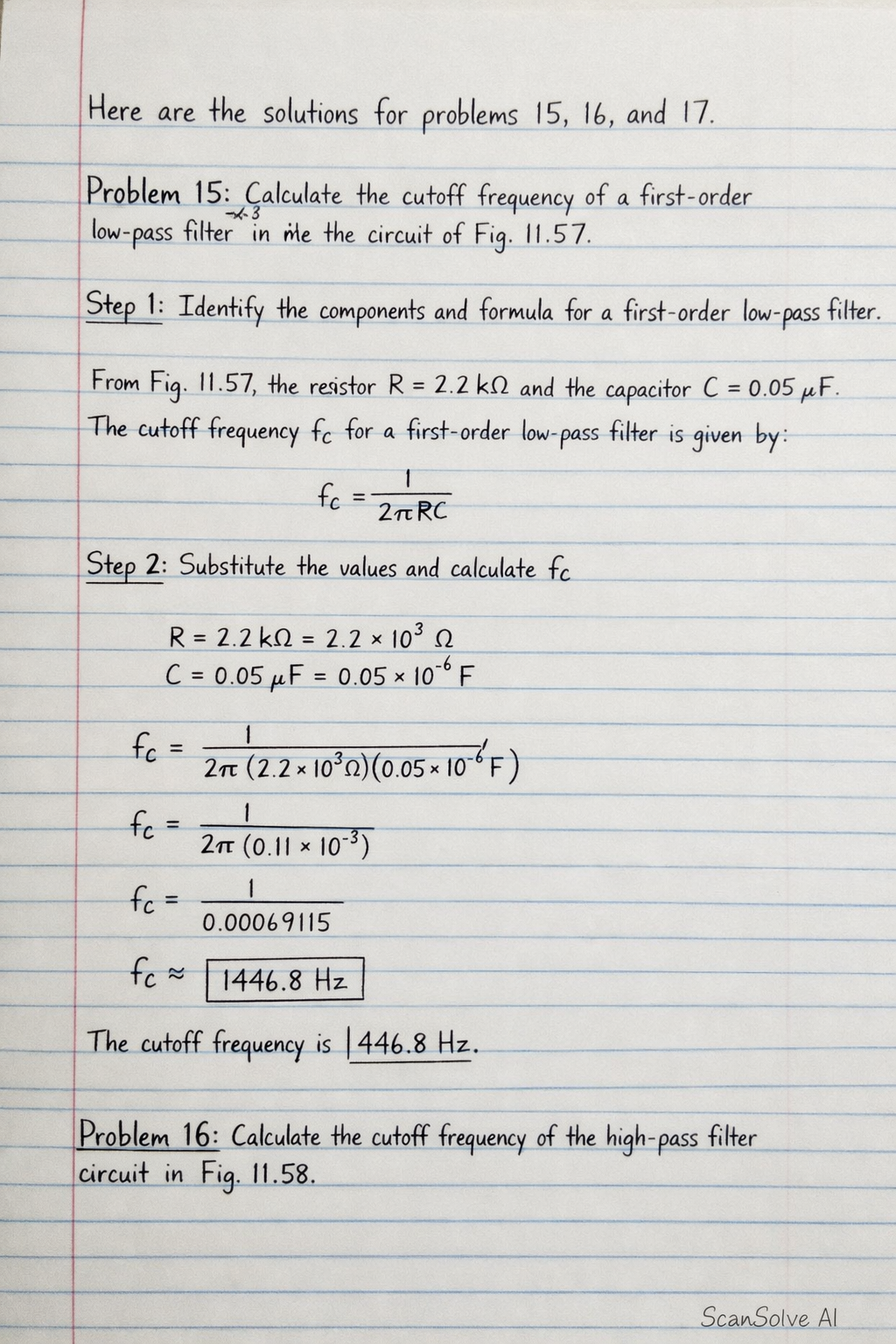
Here are the solutions for problems 15, 16, and 17. Problem 15: Calculate the cutoff frequency of a first-order low-pass filter in the circuit of Fig. 11.57. Step 1: Identify the components and formula for a first-order low-pass filter. From Fig. 11.57, the resistor R = 2.2 k and the capacitor C = 0.05 . The cutoff frequency f_c for a first-order low-pass filter is given by: f_c = (1)/(2 RC) Step 2: Substitute the values and calculate f_c. R = 2.2 k = 2.2 × 10^3 C = 0.05 = 0.05 × 10^-6 F f_c = (1)/(2 (2.2 × 10^3 )(0.05 × 10^-6) F) f_c = (1)/(2 (0.11 × 10^-3)) f_c = (1)/(0.00069115) f_c ≈ 1446.8 Hz The cutoff frequency is 1446.8 Hz. Problem 16: Calculate the cutoff frequency of the high-pass filter circuit in Fig. 11.58. Step 1: Identify the components and formula for a first-order high-pass filter. From Fig. 11.58, the resistor R = 20 k and the capacitor C = 0.02 . The cutoff frequency f_c for a first-order high-pass filter is given by: f_c = (1)/(2 RC) Step 2: Substitute the values and calculate f_c. R = 20 k = 20 × 10^3 C = 0.02 = 0.02 × 10^-6 F f_c = (1)/(2 (20 × 10^3 )(0.02 × 10^-6) F) f_c = (1)/(2 (0.4 × 10^-3)) f_c = (1)/(0.00251327) f_c ≈ 397.9 Hz The cutoff frequency is 397.9 Hz. Problem 17: Calculate the lower and upper cutoff frequencies of the bandpass filter circuit in Fig. 11.59. The circuit in Fig. 11.59 is a cascaded bandpass filter, consisting of a high-pass filter stage followed by a low-pass filter stage. The lower cutoff frequency (f_cL) is determined by the high-pass stage, and the upper cutoff frequency (f_cU) is determined by the low-pass stage. Step 1: Calculate the lower cutoff frequency (f_cL) from the first stage (high-pass filter). For the first stage: Resistor R_1 = 10 k = 10 × 10^3 Capacitor C_1 = 0.05 = 0.05 × 10^-6 F f_cL = (1)/(2 R_1 C_1) f_cL = (1)/(2 (10 × 10^3 )(0.05 × 10^-6) F) f_cL = (1)/(2 (0.5 × 10^-3)) f_cL = (1)/(0.00314159) f_cL ≈ 318.3 Hz Step 2: Calculate the upper cutoff frequency (f_cU) from the second stage (low-pass filter). For the second stage: Resistor R_2 = 20 k = 20 × 10^3 Capacitor C_2 = 0.02 = 0.02 × 10^-6 F f_cU = (1)/(2 R_2 C_2) f_cU = (1)/(2 (20 × 10^3 )(0.02 × 10^-6) F) f_cU = (1)/(2 (0.4 × 10^-3)) f_cU = (1)/(0.00251327) f_cU ≈ 397.9 Hz The lower cutoff frequency is 318.3 Hz and the upper cutoff frequency is 397.9 Hz. That's 2 down. 3 left today — send the next one.