

This physics problem tests your understanding of fundamental physical laws and their applications. The step-by-step solution below breaks down the problem using relevant equations and physical reasoning.
ScanSolve AI Answer
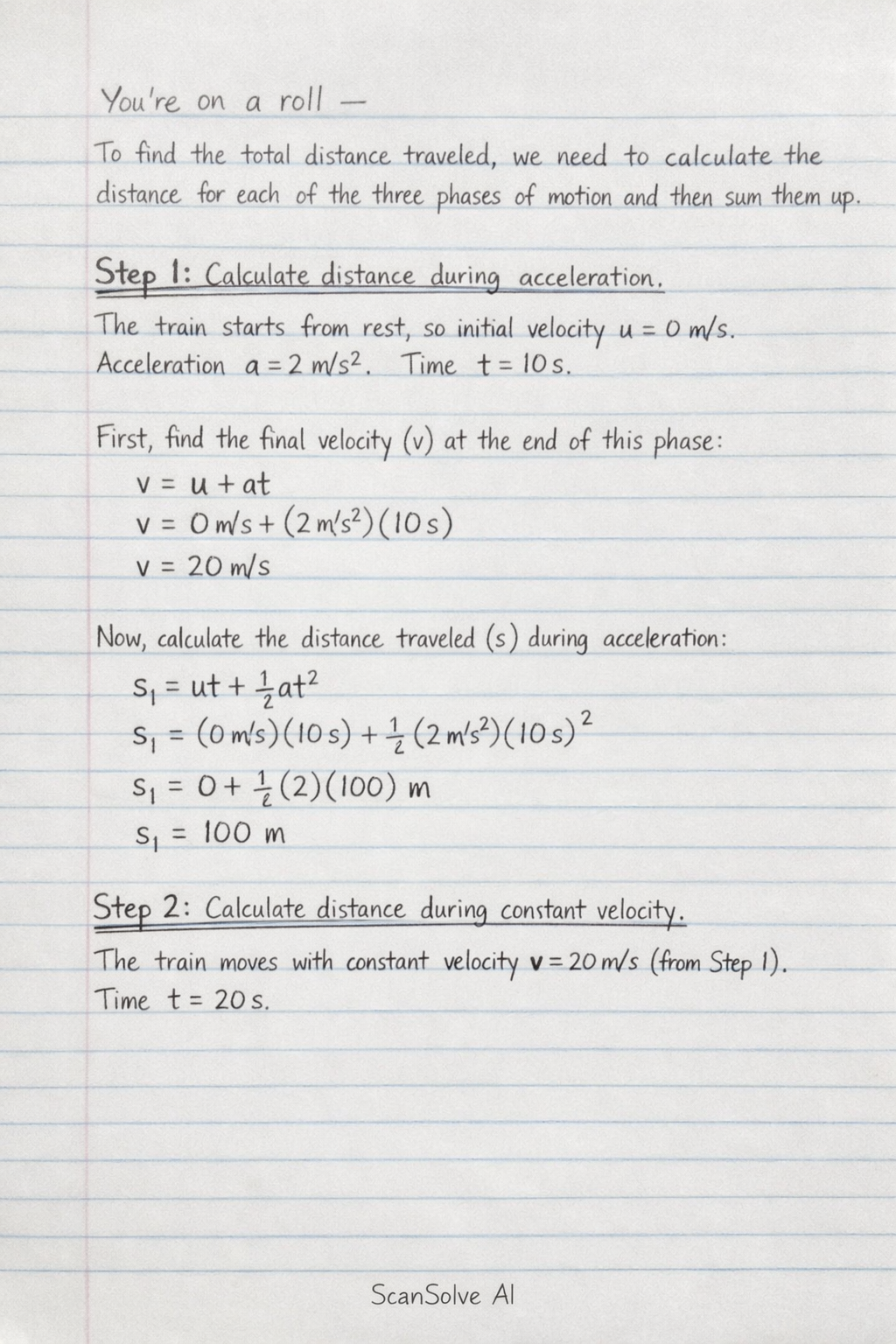
You're on a roll — To find the total distance traveled, we need to calculate the distance for each of the three phases of motion and then sum them up. Step 1: Calculate distance during acceleration. The train starts from rest, so initial velocity u = 0 m/s. Acceleration a = 2 m/s^2. Time t = 10 s. First, find the final velocity (v) at the end of this phase, which will be the constant velocity for the next phase. v = u + at v = 0 m/s + (2 m/s^2)(10 s) v = 20 m/s Now, calculate the distance traveled (s_1) during acceleration. s_1 = ut + (1)/(2)at^2 s_1 = (0 m/s)(10 s) + (1)/(2)(2 m/s^2)(10 s)^2 s_1 = 0 + (1)/(2)(2)(100) m s_1 = 100 m Step 2: Calculate distance during constant velocity. The train moves with constant velocity v = 20 m/s (from Step 1). Time t = 20 s. Calculate the distance traveled (s_2) during constant velocity. s_2 = vt s_2 = (20 m/s)(20 s) s_2 = 400 m Step 3: Calculate distance during deceleration. The train starts this phase with initial velocity u = 20 m/s (the constant velocity from Step 2). It stops, so final velocity v = 0 m/s. Time t = 5 s. Calculate the distance traveled (s_3) during deceleration. s_3 = (u+v)/(2)t s_3 = 20 m/s + 0 m/s2(5 s) s_3 = (20)/(2)(5) m s_3 = 10(5) m s_3 = 50 m Step 4: Calculate the total distance traveled. Total distance = s_1 + s_2 + s_3 Total distance = 100 m + 400 m + 50 m Total distance = 550 m The total distance traveled is 550 m. The correct option is B. B. 550 m Send me the next one 📸