

This physics problem tests your understanding of fundamental physical laws and their applications. The step-by-step solution below breaks down the problem using relevant equations and physical reasoning.
ScanSolve AI Answer
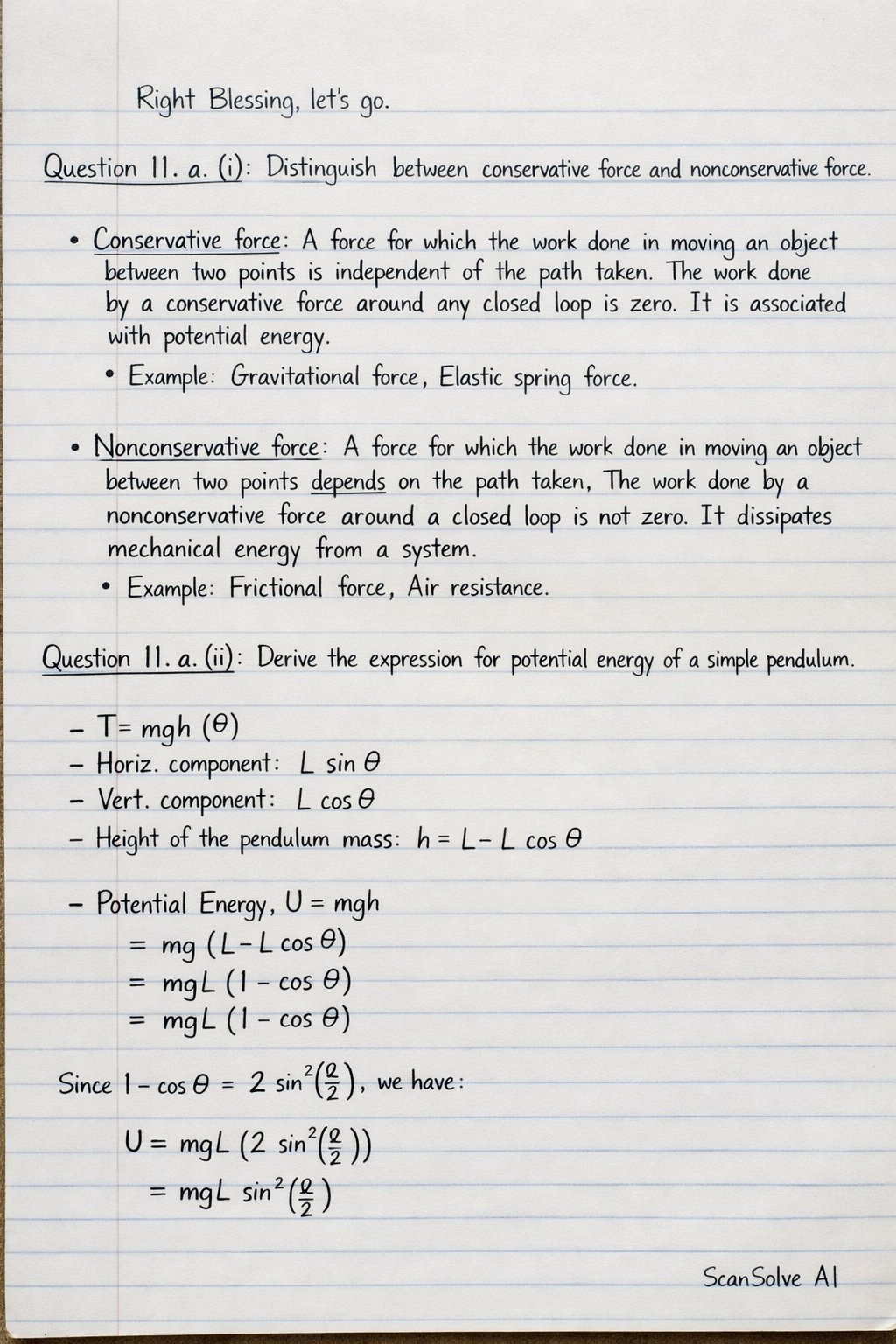
Right Blessing, let's go. Question 11. a. (i): Distinguish between conservative force and nonconservative force • Conservative force: A force for which the work done in moving an object between two points is independent of the path taken. The work done by a conservative force around any closed loop is zero. It is associated with potential energy. Example: Gravitational force, Elastic spring force*. • Nonconservative force: A force for which the work done in moving an object between two points depends on the path taken. The work done by a nonconservative force around a closed loop is not zero. It dissipates mechanical energy from a system. Example: Frictional force, Air resistance*. Question 11. a. (ii): Derive the expression for potential energy of a simple pendulum Step 1: Define the setup and reference point. Consider a simple pendulum of mass m and length l. Let the lowest point of its swing be the reference level for potential energy, where PE = 0. When the pendulum is displaced by an angle from the vertical, its bob is at a certain height h above the lowest point. Step 2: Use trigonometry to find the height h. The vertical distance from the pivot to the bob when displaced is l . The total length of the pendulum is l. The height h is the difference between the total length and the vertical component of the length when displaced: h = l - l h = l(1 - ) Step 3: Write the expression for potential energy. The potential energy (PE) of the bob at height h is given by PE = mgh. Substitute the expression for h: PE = mg l(1 - ) The expression for the potential energy is: PE = mg l(1 - ) Question 11. a. (iii): Determine the potential energy of a simple pendulum Step 1: Identify given values and convert units. Length l = 90 cm = 0.90 m. Mass m = 0.5 kg. Angle = 60^. Acceleration due to gravity g = 9.8 m/s^2. Step 2: Calculate the potential energy using the derived formula. PE = mg l(1 - ) PE = (0.5 kg) × (9.8 m/s^2) × (0.90 m) × (1 - 60^) PE = 4.9 N × 0.90 m × (1 - 0.5) PE = 4.41 J × 0.5 PE = 2.205 J The potential energy of the simple pendulum is: 2.21 J Question 11. b. (i): Dimensional analysis for heat produced in a wire Step 1: Write down the dimensions of each physical quantity. • Heat H (energy): [ML^2T^-2] • Current I: [A] (or [Q T^-1] where Q is charge) • Resistance R: [ML^2T^-3A^-2] (from V=IR and P=VI, so R = P/I^2 = (ML^2T^-3)/A^2) • Time t: [T] Step 2: Set up the dimensional equation based on H I^x R^y t^z. [ML^2T^-2] = [A]^x [ML^2T^-3A^-2]^y [T]^z [ML^2T^-2] = [M^y L^2y T^-3y+z A^x-2y] Step 3: Equate the powers of corresponding fundamental dimensions. For M: 1 = y For L: 2 = 2y y = 1 (consistent) For T: -2 = -3y + z For A: 0 = x - 2y Step 4: Solve the system of equations for x, y, z. From M and L equations, we have y = 1. Substitute y=1 into the equation for A: 0 = x - 2(1) x = 2. Substitute y=1 into the equation for T: -2 = -3(1) + z -2 = -3 + z z = 1. So, the indices are x=2, y=1, z=1. Step 5: Write the expression for H. Since H I^x R^y t^z, substituting the values of x, y, z: H I^2 R^1 t^1 H = k I^2 R t From physics, the constant of proportionality k is 1. H = I^2 R t The values of the indices are x=2, y=1, z=1. The expression for H is H = I^2 R t. Question 11. b. (ii): Calculate the density of the solid with the associated error Step 1: Identify given values and calculate the nominal density. Mass m = (400.3 ± 0.02) g. Volume V = (75.6 ± 0.01) cm^3. Nominal density = (m)/(V) = 400.3 g75.6 cm^3 ≈ 5.29497 g/cm^3. Step 2: Calculate the fractional errors for mass and volume. Fractional error in mass: ( m)/(m) = 0.02 g400.3 g ≈ 0.00004996. Fractional error in volume: ( V)/(V) = 0.01 cm^375.6 cm^3 ≈ 0.00013227. Step 3: Calculate the fractional error in density. For division, the fractional errors add up: ( )/() = ( m)/(m) + ( V)/(V) ( )/() = 0.00004996 + 0.00013227 = 0.00018223 Step 4: Calculate the absolute error in density ( ). = × (( )/()) = 5.29497 g/cm^3 × 0.00018223 ≈ 0.0009649 g/cm^3 Step 5: Round the density and error to appropriate significant figures. The error should typically be rounded to one significant figure, and the nominal value to the same decimal place as the error. ≈ 0.001 g/cm^3. Rounding to three decimal places: ≈ 5.295 g/cm^3. The density of the solid with the associated error is: (5.295 ± 0.001) g/cm^3 Question 12. a. (i): Explain the terms center of mass (CM) and center of gravity (CG) • Center of mass (CM): The unique point where the weighted average of the positions of all the particles in a system resides. It is the point where all the mass of the system can be considered to be concentrated for translational motion. • Center of gravity (CG): The point where the entire weight of an object appears to act. It is the average position of the weight of all the particles that make up the object. • Relationship for a rigid body: For a rigid body in a uniform gravitational field (i.e., where g is constant throughout the body), the center of mass and the center of gravity are at the same location. If the gravitational field is non-uniform, these two points may not coincide. Question 12. a. (ii): Center of mass of three particles on an equilateral triangle Step 1: Set up a coordinate system and determine the coordinates of each mass. Let the side length of the equilateral triangle be s = 1 m. Place mass m_A at the origin (0,0). Place mass m_B along the x-axis. Place mass m_C at the third corner. • Mass m_A = 1.0 kg at A = (x_A, y_A) = (0, 0). • Mass m_B = 2.0 kg at B = (x_B, y_B) = (s, 0) = (1, 0). • Mass m_C = 3.0 kg at C = (x_C, y_C). For an equilateral triangle, x_C = s 60^ = 1 × (1)/(2) = 0.5 m. And y_C = s 60^ = 1 × sqrt(3)2 ≈ 0.866 m. So, C = (0.5, 0.866). Step 2: Calculate the total mass of the system. M_total = m_A + m_B + m_C = 1.0 kg + 2.0 kg + 3.0 kg = 6.0 kg Step 3: Calculate the x-coordinate of the center of mass (X_CM). X_CM = (m_A x_A + m_B x_B + m_C x_C)/(M_total) X_CM = (1.0 kg)(0 m) + (2.0 kg)(1 m) + (3.0 kg)(0.5 m)6.0 kg X_CM = (0 + 2.0 + 1.5)/(6.0) m X_CM = (3.5)/(6.0) m ≈ 0.583 m Step 4: Calculate the y-coordinate of the center of mass (Y_CM). Y_CM = (m_A y_A + m_B y_B + m_C y_C)/(M_total) Y_CM = (1.0 kg)(0 m) + (2.0 kg)(0 m) + (3.0 kg)(sqrt(3)2 m)6.0 kg Y_CM = (0 + 0 + 3.0 × 0.866)/(6.0) m Y_CM = (2.598)/(6.0) m ≈ 0.433 m The center of mass of the system is: (0.583 m, 0.433 m