Distinguish between the phase and group velocity. Assuming that a 100 KHz plane wave is used to communicate a submerged submarine for sea water, σ = 4 s/m, ε = 80ε₀, µ = µ₀, compute the attenuation, phase velocity and skin depth of the wave.
|Physics
Distinguish between the phase and group velocity. Assuming that a 100 KHz plane wave is used to communicate a submerged submarine for sea water, σ = 4 s/m, ε = 80ε₀, µ = µ₀, compute the attenuation, phase velocity and skin depth of the wave.
ScanSolve AI Answer
Answer
1.257 Np/m
here are the answers to question 4:
a) Distinguish between phase and group velocity:
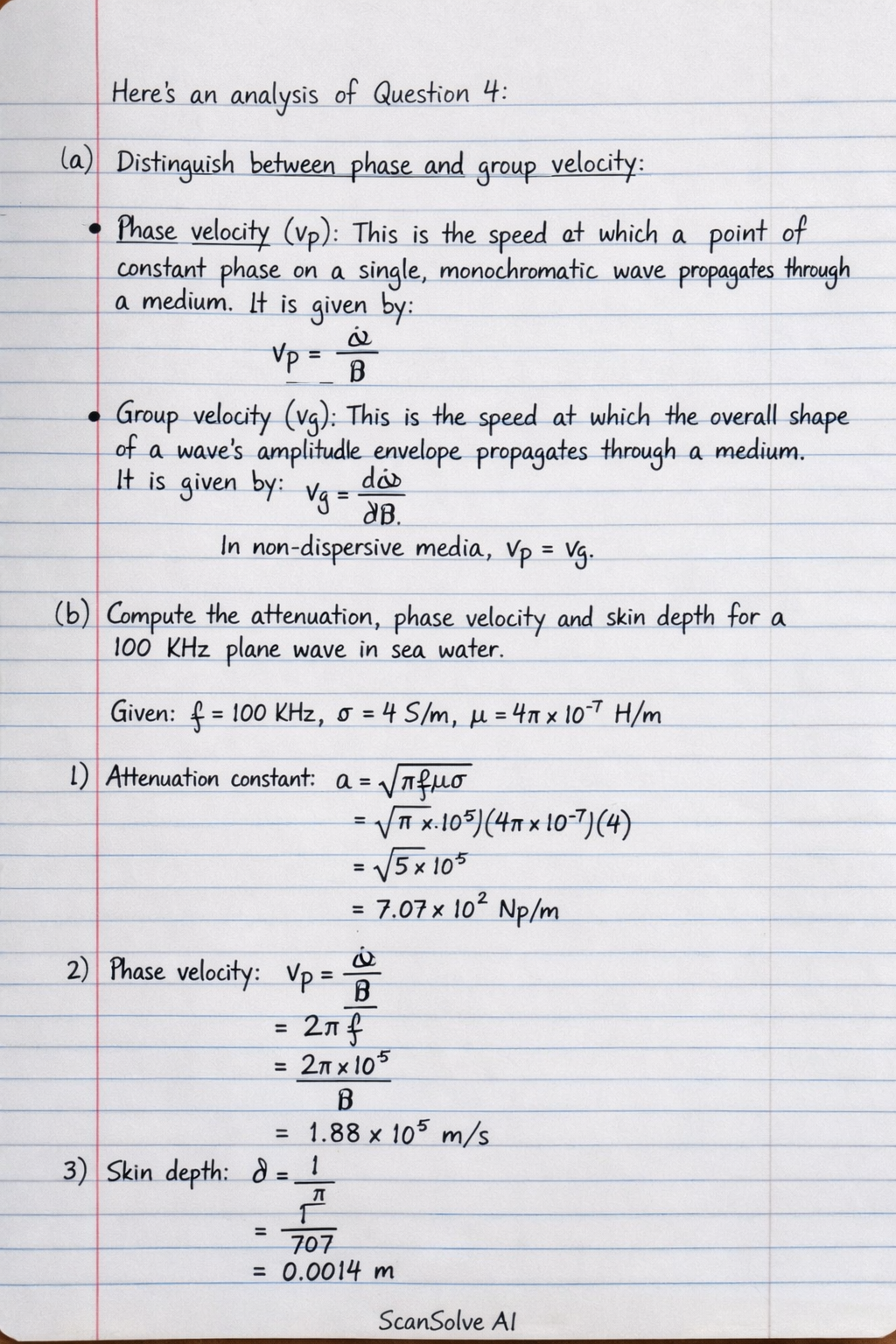
Phase velocity (vp): This is the speed at which a point of constant phase on a single, monochromatic wave propagates through a medium. It describes how fast the crests or troughs of a wave move. For a wave with angular frequency ω and wave number β, the phase velocity is given by vp=βω.
Group velocity (vg): This is the speed at which the overall shape of a wave's amplitude envelope (the "group" of waves) propagates through a medium. It represents the speed at which energy or information is transmitted by the wave. For a wave in a dispersive medium, the group velocity is given by vg=dβdω. In non-dispersive media, phase and group velocities are equal.
b) Compute the attenuation, phase velocity, and skin depth for a 100 KHz plane wave in sea water.
Given:
Frequency f=100KHz=105 Hz
Conductivity σ=4 S/m
Relative permittivity ϵr=80
Relative permeability μr=1 (since μ=μ0)
Permittivity of free space ϵ0=8.85×10⁻¹² F/m
Permeability of free space μ0=4π×10−7 H/m
Step 1: Calculate angular frequency ω and absolute permittivity ϵ.
ω=2πf=2π(105)rad/sϵ=ϵrϵ0=80×(8.85×10−12)=7.08×10−10F/m
Step 2: Determine if sea water is a good conductor or a good dielectric at this frequency.
We compare the conduction current to the displacement current by calculating the ratio ωϵσ:
ωϵσ=(2π×105)×(7.08×10−10)4=4.4488×10−44≈8991.1
Since ωϵσ≫1, sea water is a good conductor at 100 KHz.
Step 3: Calculate the attenuation constant α.
For a good conductor, the attenuation constant is given by:
α=2ωμσ
Substitute the values:
α=2(2π×105)×(4π×10−7)×4α=232π2×10−2=16π2×10−2=0.16π2α=0.4π≈0.4×3.14159α≈1.257 Np/m
Step 4: Calculate the phase velocity vp.
For a good conductor, the phase constant β is approximately equal to the attenuation constant α.
β≈α=0.4πrad/m
The phase velocity is given by:
vp=βωvp=0.4π2π×105=0.42×10⁵vp=5×10⁵ m/s
Step 5: Calculate the skin depth δ.
The skin depth is the reciprocal of the attenuation constant:
δ=α1δ=0.4π1=1.25661δ≈0.796 m
Drop the next question.
Was this helpful?
Need help with your own homework?
Get instant step-by-step solutions to any question. Free to start.
a) Distinguish between phase and group velocity: Phase velocity (v_p): This is the speed at which a point of constant phase on a single, monochromatic wave propagates through a medium.
Distinguish between the phase and group velocity. Assuming that a 100 KHz plane wave is used to communicate a submerged submarine for sea water, σ = 4 s/m, ε = 80ε₀, µ = µ₀, compute the attenuation, phase velocity and skin depth of the wave.
This physics problem tests your understanding of fundamental physical laws and their applications. The step-by-step solution below breaks down the problem using relevant equations and physical reasoning.
ScanSolve AI Answer
here are the answers to question 4: a) Distinguish between phase and group velocity: Phase velocity (v_p): This is the speed at which a point of constant phase on a single, monochromatic wave propagates through a medium. It describes how fast the crests or troughs of a wave move. For a wave with angular frequency and wave number , the phase velocity is given by v_p = ()/(). Group velocity (v_g): This is the speed at which the overall shape of a wave's amplitude envelope (the "group" of waves) propagates through a medium. It represents the speed at which energy or information is transmitted by the wave. For a wave in a dispersive medium, the group velocity is given by v_g = (d)/(d). In non-dispersive media, phase and group velocities are equal. b) Compute the attenuation, phase velocity, and skin depth for a 100 KHz plane wave in sea water. Given: Frequency f = 100 KHz = 10^5 Hz Conductivity = 4 S/m Relative permittivity _r = 80 Relative permeability _r = 1 (since = _0) Permittivity of free space _0 = 8.85 × 10^-12 F/m Permeability of free space _0 = 4 × 10^-7 H/m Step 1: Calculate angular frequency and absolute permittivity . = 2 f = 2 (10^5) rad/s = _r _0 = 80 × (8.85 × 10^-12) = 7.08 × 10^-10 F/m Step 2: Determine if sea water is a good conductor or a good dielectric at this frequency. We compare the conduction current to the displacement current by calculating the ratio ()/(): ()/() = (4)/((2 × 10^5) × (7.08 × 10^-10)) = (4)/(4.4488 × 10^-4) ≈ 8991.1 Since ()/() 1, sea water is a good conductor at 100 KHz. Step 3: Calculate the attenuation constant . For a good conductor, the attenuation constant is given by: = sqrt(()/(2)) Substitute the values: = sqrt((2 × 10^5) × (4 × 10^-7)) × 42 = sqrt(32^2 × 10^-2)2 = sqrt(16^2 × 10^-2) = sqrt(0.16^2) = 0.4 ≈ 0.4 × 3.14159 ≈ 1.257 Np/m Step 4: Calculate the phase velocity v_p. For a good conductor, the phase constant is approximately equal to the attenuation constant . ≈ = 0.4 rad/m The phase velocity is given by: v_p = ()/() v_p = (2 × 10^5)/(0.4) = (2 × 10^5)/(0.4) v_p = 5 × 10^5 m/s Step 5: Calculate the skin depth . The skin depth is the reciprocal of the attenuation constant: = (1)/() = (1)/(0.4) = (1)/(1.2566) ≈ 0.796 m Drop the next question.