
We read your photo as:
Calculate the dot product of vectors A = 2i − 3j + 5k and B = 3i + 5j − 2k. Convert degrees to radians and explain inertia and radius of gyration.
ScanSolve AI Answer
Step-by-step solution
3 stepsIdentify the given vectors.
The vectors are and .
Apply the dot product formula.
The dot product of two vectors and is given by:
Substitute the components and calculate.
5b. Convert the following degree to radian.
The specific degree value to be converted is not provided in the question. However, the general formula for converting degrees to radians is:For example, to convert to radians:
1.E. Explain the following:
i. Inertia of a body:
Inertia is the fundamental property of a body to resist any change in its state of motion, whether at rest or in uniform motion. The more mass an object has, the greater its inertia.ii. Radius of gyration:
The radius of gyration () is the distance from an axis of rotation at which the entire mass of a body could be concentrated to have the same moment of inertia as the actual body. It is related to the moment of inertia () and mass () by the formula .iii. Moment of inertia:
Moment of inertia () is a measure of an object's resistance to changes in its rotational motion. It depends on both the mass of the object and how that mass is distributed relative to the axis of rotation.iv. Angular acceleration:
Angular acceleration () is the rate of change of angular velocity with respect to time. It describes how quickly an object's rotational speed or direction changes, and its unit is radians per second squared ().v. Total angular displacement:
Total angular displacement () is the total angle through which a body rotates about an axis. It is the change in angular position of a rotating body and is typically measured in radians.vi. Viscosity:
Viscosity is a measure of a fluid's resistance to flow. It quantifies the internal friction within a fluid, where a higher viscosity indicates a thicker fluid that flows more slowly.2a. State four (4) differences between adhesive force and cohesive force.
- Cohesive forces are attractive forces between molecules of the same substance, while adhesive forces are attractive forces between molecules of different substances.
- Cohesive forces are responsible for the surface tension of a liquid, while adhesive forces are responsible for a liquid wetting a surface.
- When cohesive forces are stronger than adhesive forces (e.g., mercury on glass), the liquid forms a convex meniscus.
- When adhesive forces are stronger than cohesive forces (e.g., water on glass), the liquid forms a concave meniscus.
2b. State Stokes law with its formula.
Stokes' Law describes the drag force () experienced by a small spherical object moving through a viscous fluid at a low Reynolds number. It states that the drag force is directly proportional to the radius of the sphere, its velocity, and the fluid's viscosity.
The formula for Stokes' Law is:where:
- is the drag force
- is the fluid viscosity
- is the radius of the sphere
- is the terminal velocity of the sphere
3. Explain moment of inertia of the following:
i. Rectangular block:
For a rectangular block of mass with sides and , rotating about an axis passing through its center and perpendicular to the plane formed by and :ii. Hollow cylinder:
For a hollow cylinder of mass , inner radius , and outer radius , rotating about its central longitudinal axis:iii. Uniform rod (rotation at the middle):
For a uniform rod of mass and length , rotating about an axis perpendicular to the rod and passing through its center:iv. Uniform rod (rotation at one end):
For a uniform rod of mass and length , rotating about an axis perpendicular to the rod and passing through one end:v. Uniform sphere:
For a uniform solid sphere of mass and radius , rotating about an axis passing through its center:5a. Explain molecular explanation of surface tension.
Surface tension arises from the cohesive forces between liquid molecules. Molecules within the bulk of the liquid are attracted equally in all directions by neighboring molecules. However, molecules at the surface experience a net inward attractive force because there are no molecules above them to exert an upward pull. This inward force causes the liquid surface to contract to the smallest possible area, behaving like a stretched elastic film.
Still stuck on this one?
Ask a follow-up, and the answer starts from this question.
More Physics Questions
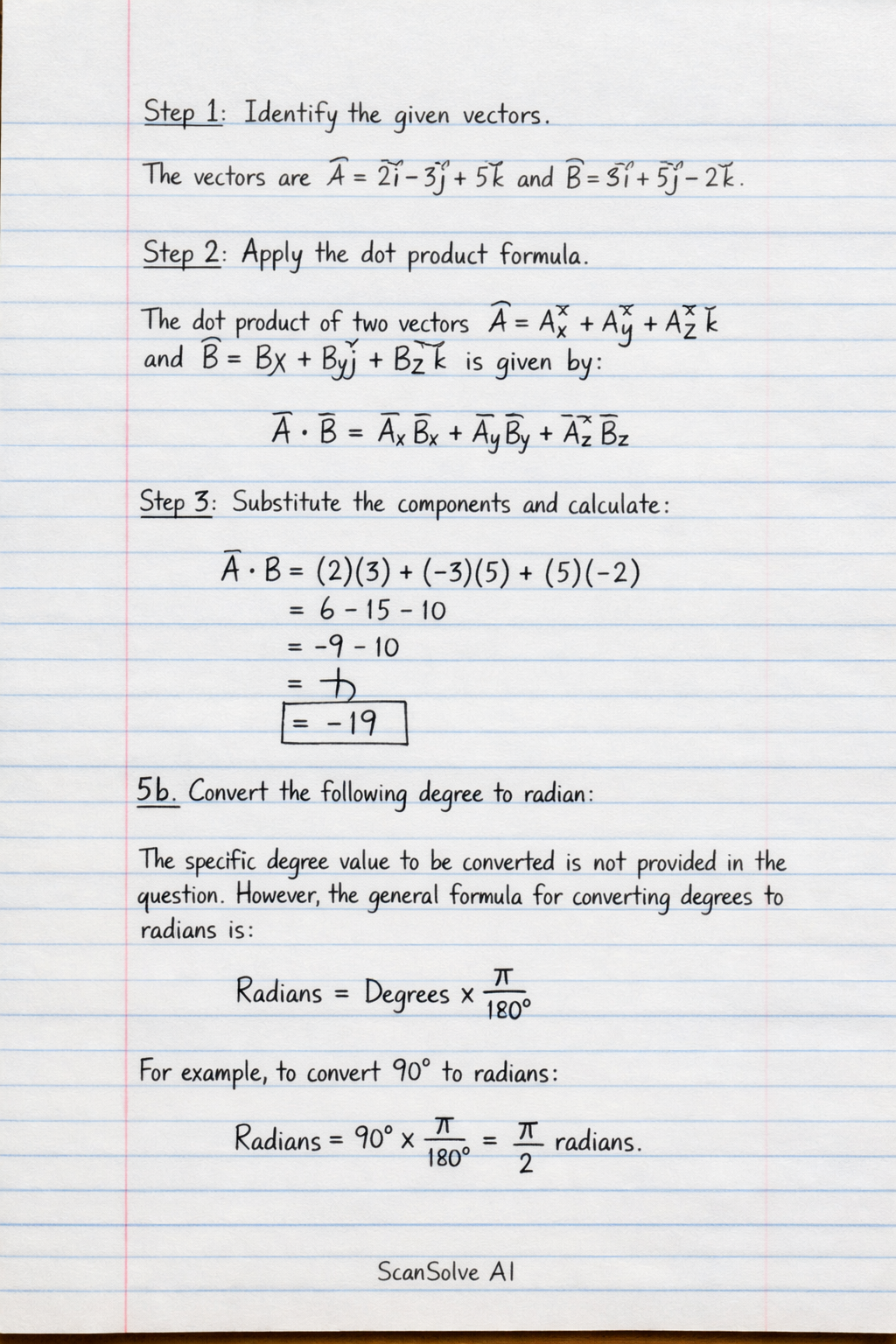
Handwritten Step-by-Step Solution
Get this as a handwritten image on WhatsApp — like a tutor wrote it for you.
Try on WhatsApp