
We read your photo as:
Write down the amplitude of the wave in metres. Label the points marked:
ScanSolve AI Answer
Answers
5 partsStep-by-step solution
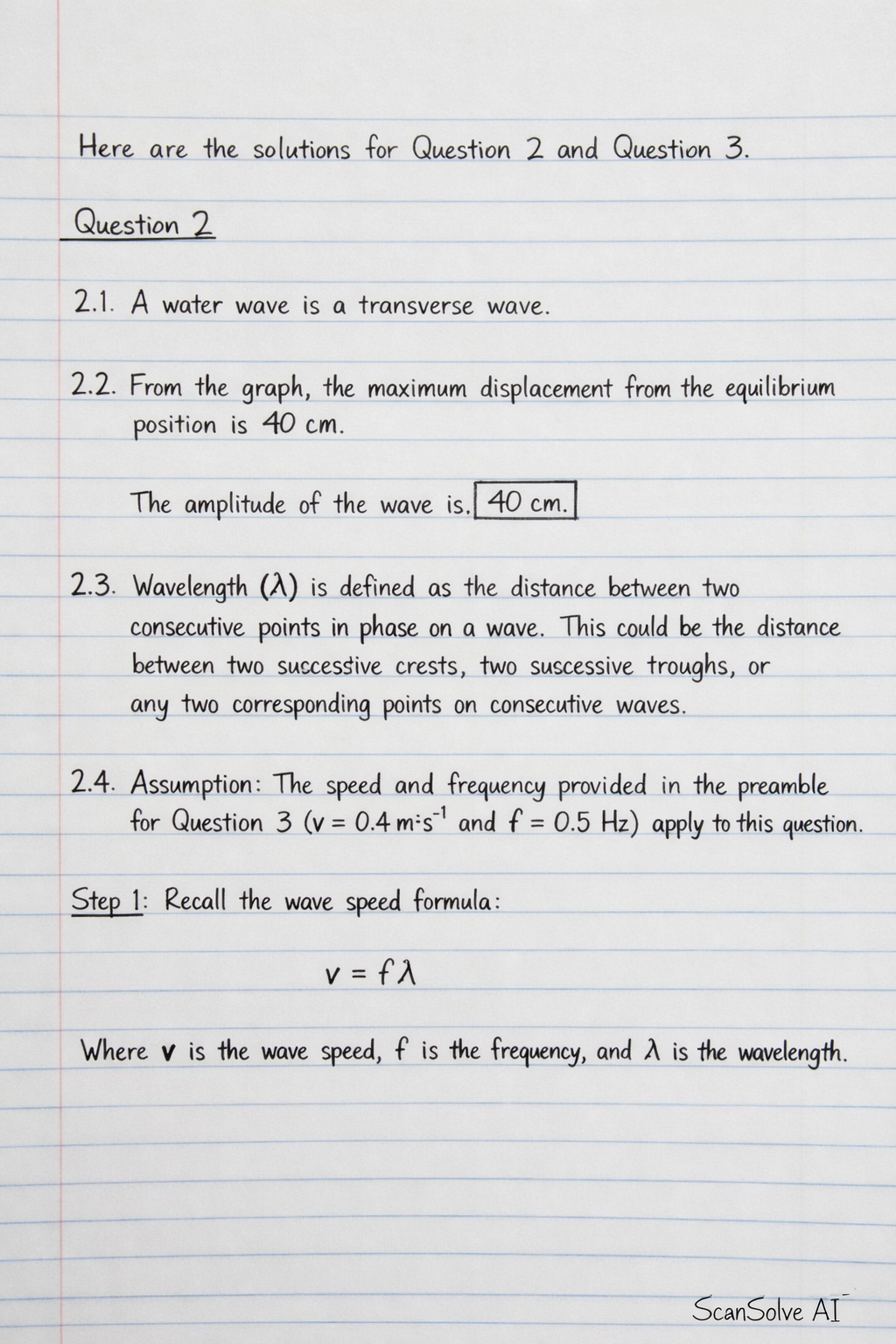
6 stepsHere are the solutions for Question 2 and Question 3.
Part 2
Part 2.1
A water wave is a *transverse wave
Part 2.2
From the graph, the maximum displacement from the equilibrium position is .
The amplitude of the wave is .
2.3 Wavelength () is defined as the distance between two consecutive points in phase on a wave. This could be the distance between two successive crests, two successive troughs, or any two corresponding points on consecutive waves.
Part 2.4
Assumption: The speed and frequency provided in the preamble for Question 3 ( and ) apply to this question.
Recall the wave speed formula.
Where is the wave speed, is the frequency, and is the wavelength.
Rearrange the formula to solve for wavelength and substitute the given values.
The wavelength of the wave is .
2.5 Points in phase are points on the wave that have the same displacement and are moving in the same direction. From the wave form, points C and E are both crests, meaning they are at their maximum positive displacement and are in the same phase.
Two points on the wave form that are in phase are .
Part 2.6
Assumption: The frequency provided in the preamble for Question 3 () applies to this question.
Calculate the period () of the wave.
The period is the inverse of the frequency.
Determine the time taken for FOUR crests to move past a certain point.
The time between the first crest and the fourth crest passing a point is equivalent to three periods (1st to 2nd is 1T, 2nd to 3rd is 1T, 3rd to 4th is 1T).
The time taken for four crests to move past a certain point is .
Part 2.7
Assumption: The frequency provided in the preamble for Question 3 () applies to this question, and the wavelength calculated in 2.4 () is used.
Recall the wave speed formula.
Substitute the frequency and wavelength values.
The speed of the wave is .
Part 3
Part 3.1
From the graph, the maximum amplitude is . To convert this to metres, divide by 100.
The amplitude of the wave in metres is .
Part 3.2
- Point A: Node (or equilibrium position)
- Point B: Node (or equilibrium position)
- Point C: Crest
- Point D: Trough
- Point E: Crest
Try one yourself
A new problem that tests the same skill.
Still stuck on this one?
Ask a follow-up, and the answer starts from this question.
More Physics Questions
Handwritten Step-by-Step Solution
Get this as a handwritten image on WhatsApp — like a tutor wrote it for you.
Try on WhatsApp