
We read your photo as:
Edit my write up below to capture the full information that is in this image Do not add or change anything from the image. Just ensure you my write up is edited neatly and beautifully to capture the full information in this image I'm sending now, just this image only and Only, my write up below 5a _ 48 5 ~ 5 A*body'accelerates »„tfotmly from res. a, the rate o f 3ms'! for 8s. C . l c u l a ^ d i s m c e covered by the body during acceleration. Solution Using appropriate symbols deduce, the known and unknown from the question. Acceleration, a = 3m/s2; initial velocity, u = 0; time, t = 8s; distance, s „„notion Therefore the most appropriate equation that includes a, u, t and s is t e secon of motion: s = ut + X a t2 Substituting: s = 0x8 + j^ x 3 x 8 2 = 0 + ^ x 3 x 6 4 = 96 m Exam ple 5 Starting from rest, a Formular One car accelerates uniformly at 25m/s" for 30s. What distance does it cover in the (i) last one second of motion. (ii) seventeenth second of motion. Solution The d
ScanSolve AI Answer
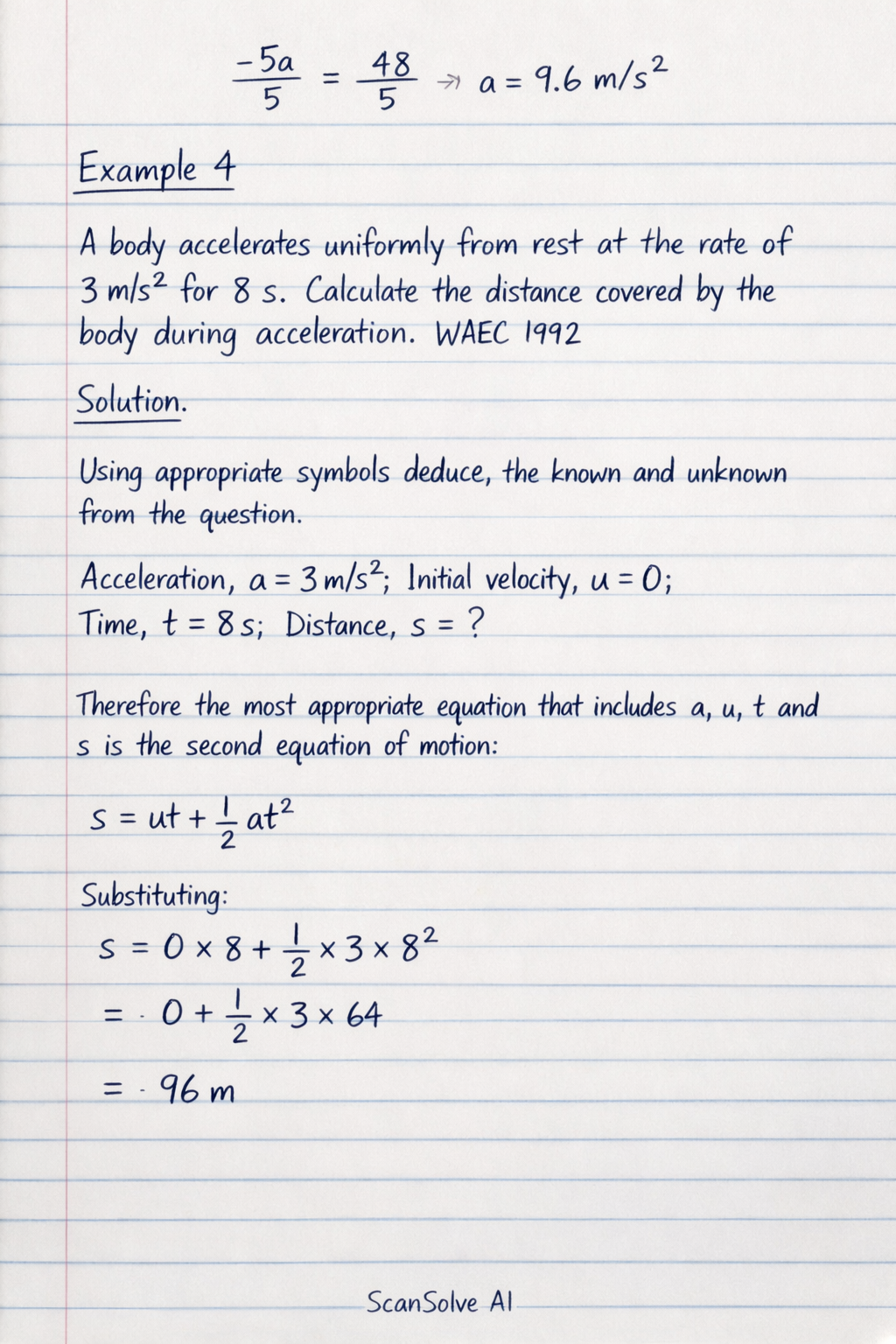
Example 4
A body accelerates uniformly from rest at the rate of for . Calculate the distance covered by the body during acceleration. WAEC 1992
Solution
Using appropriate symbols deduce, the known and unknown from the question.
Acceleration, ; initial velocity, ; time, ; distance,
Therefore the most appropriate equation that includes , , and is the second equation of motion:
Substituting:
Example 5
Starting from rest, a Formular One car accelerates uniformly at for . What distance does it cover in the
(i) last one second of motion.
(ii) seventeenth second of motion.
Solution
The distance in the last one second of motion is the distance it covered between time interval of the and second. It is calculated by subtracting the distance in the sec from that of the sec.
Distance,
But, and
Starting from rest, initial velocity, . Therefore, in each case
From the question, acceleration, ; ; . So substituting into above equation:
(ii) From question acceleration, ; initial velocity, ; time, is not equal to because the second is actually the time interval between the and second, therefore time, .
Substituting into
Note: In
Still stuck on this one?
Ask a follow-up, and the answer starts from this question.
More Physics Questions
Handwritten Step-by-Step Solution
Get this as a handwritten image on WhatsApp — like a tutor wrote it for you.
Try on WhatsApp