
We read your photo as:
Electrode: An electrode is an electrical conductor, typically a metal or graphite, that makes contact with a nonmetallic part of a circuit, such as an electrolyte. In electrochemistry, e
ScanSolve AI Answer
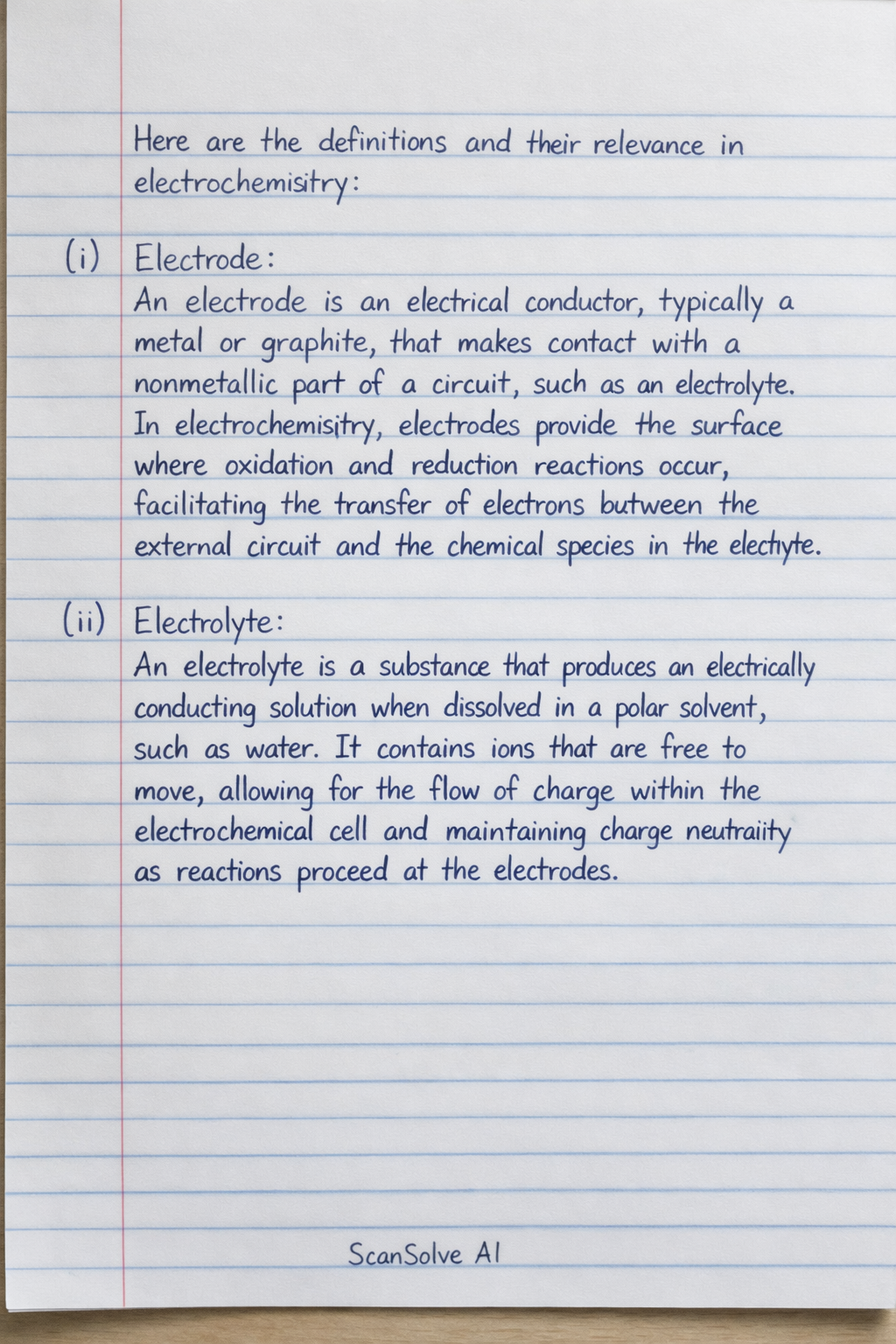
Here are the definitions and their relevance in electrochemistry:
-
(i) Electrode: An electrode is an electrical conductor, typically a metal or graphite, that makes contact with a nonmetallic part of a circuit, such as an electrolyte. In electrochemistry, electrodes provide the surface where oxidation and reduction reactions occur, facilitating the transfer of electrons between the external circuit and the chemical species in the electrolyte.
-
(ii) Electrolyte: An electrolyte is a substance that produces an electrically conducting solution when dissolved in a polar solvent, such as water. It contains ions that are free to move, allowing for the flow of charge within the electrochemical cell and maintaining charge neutrality as reactions proceed at the electrodes.
-
(iii) Half-cell: A half-cell is one of two compartments in an electrochemical cell where either oxidation or reduction occurs. Each half-cell consists of an electrode immersed in an electrolyte, and the combination of two half-cells forms a complete electrochemical cell where electron flow generates or consumes electricity.
-
(iv) Cell potential (): Cell potential is the potential difference between the two half-cells in an electrochemical cell, measured in volts. It indicates the driving force for the redox reaction and determines the spontaneity of the reaction, with a positive cell potential signifying a spontaneous reaction.
-
(v) Oxidation: Oxidation is the loss of electrons by a chemical species, resulting in an increase in its oxidation state. In an electrochemical cell, oxidation always occurs at the anode, releasing electrons into the external circuit.
-
(vi) Reduction: Reduction is the gain of electrons by a chemical species, resulting in a decrease in its oxidation state. In an electrochemical cell, reduction always occurs at the cathode, consuming electrons from the external circuit.
Still stuck on this one?
Ask a follow-up, and the answer starts from this question.
More Physics Questions
Handwritten Step-by-Step Solution
Get this as a handwritten image on WhatsApp — like a tutor wrote it for you.
Try on WhatsApp