
We read your photo as:
Explain electromagnetic induction, including what happens when a switch is opened, two ways to increase galvanometer deflection, and a calculation of induced EMF.
ScanSolve AI Answer
Answer
Step-by-step solution
4 stepsHere are the answers to your questions:
Part a
On opening the switch
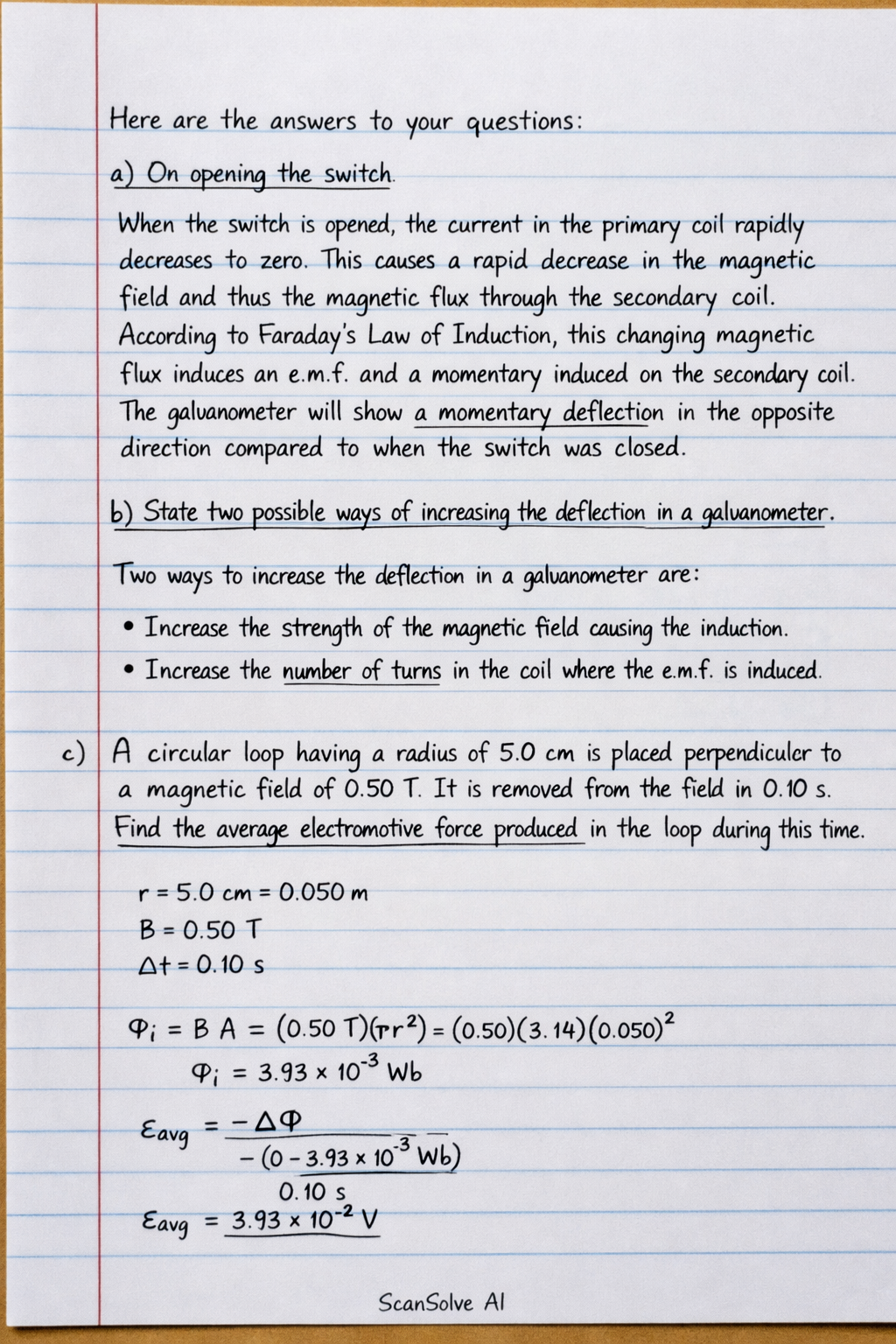
When the switch is opened, the current in the primary coil rapidly decreases to zero. This causes a rapid decrease in the magnetic field and thus the magnetic flux through the secondary coil. According to Faraday's Law of Induction, this changing magnetic flux induces an e.m.f. and a momentary induced current in the secondary coil. The galvanometer will show a momentary deflection in the opposite direction compared to when the switch was closed.
Part b
State two possible ways of increasing the deflection in a galvanometer.
Two ways to increase the deflection in a galvanometer are:
- Increase the strength of the magnetic field causing the induction.
- Increase the number of turns in the coil where the e.m.f. is induced.
c) A circular loop having a radius of 5.0 cm is placed perpendicular to a magnetic field of 0.50 T. It is removed from the field in 0.10 s. Find the average electromotive force produced in the loop during this time.
Convert the radius to meters and calculate the area of the loop.
Given radius .
The area of the circular loop is .Calculate the initial and final magnetic flux.
The loop is perpendicular to the magnetic field, so and .
Initial magnetic field .
Initial magnetic flux .
When the loop is removed from the field, the final magnetic field .
Final magnetic flux .Calculate the change in magnetic flux.
Calculate the average induced electromotive force (e.m.f.).
According to Faraday's Law of Induction, for a single loop ():
Given .
Using :
The average electromotive force produced is .
Part d
Distinguish between impulse and linear momentum.
Impulse is the change in an object's linear momentum. It is calculated as the product of the average force acting on an object and the time interval over which the force acts, with units of Newton-seconds (N·s). Linear momentum is a measure of the quantity of motion an object possesses, defined as the product of its mass and velocity, with units of kilogram-meters per second (kg·m/s).
Part e(i)
Calculate the velocity of the 10 kg mass.
A 5 kg mass moving with a velocity of 10 m/s collides with 10 kg mass moving with a velocity of 4 m/s in the same direction along the same line.
Given:
Mass 1: ,
Mass 2: ,
Assuming an elastic collision for this part, we use the conservation of momentum and the relative velocity equation.
Conservation of momentum:
Divide by 5:
Relative velocity for elastic collision:
From Equation 2, .
Try one yourself
A new problem that tests the same skill.
Still stuck on this one?
Ask a follow-up, and the answer starts from this question.
More Physics Questions
Handwritten Step-by-Step Solution
Get this as a handwritten image on WhatsApp — like a tutor wrote it for you.
Try on WhatsApp