
We read your photo as:
Calculate the electrostatic force between two spheres with charges q1 = 2 x 10⁻⁷ C and q2 = 3 x 10⁻⁷ C, separated by 30 cm.
ScanSolve AI Answer
Step-by-step solution
5 stepsIdentify the given values for Question 5.
The charges on the spheres are and .
The distance between the spheres is .
The electrostatic constant for air is .Calculate the electrostatic force using Coulomb's Law.
The formula for Coulomb's Law is .
Since both charges are positive, the force is repulsive.
The force is and is repulsive.Identify the given values for Question 6 (a).
The charge on the first sphere is .
The force experienced is .
The charge on the second sphere is .
The electrostatic constant for air is .Calculate the distance between the spheres for Question 6 (a).
Using Coulomb's Law, . We need to find .
Rearranging the formula for :Substitute the given values:
Now, take the square root to find :
Converting to centimeters:
The distance between the spheres is .
Determine the force on the second sphere due to the first for Question 6 (b).
According to Newton's third law, the force exerted by the first sphere on the second sphere is equal in magnitude and opposite in direction to the force exerted by the second sphere on the first sphere.
Therefore, if the first sphere experiences a force of due to the second sphere, the second sphere will also experience a force of due to the first sphere.
The force on the second sphere due to the first sphere is .
Still stuck on this one?
Ask a follow-up, and the answer starts from this question.
More Physics Questions
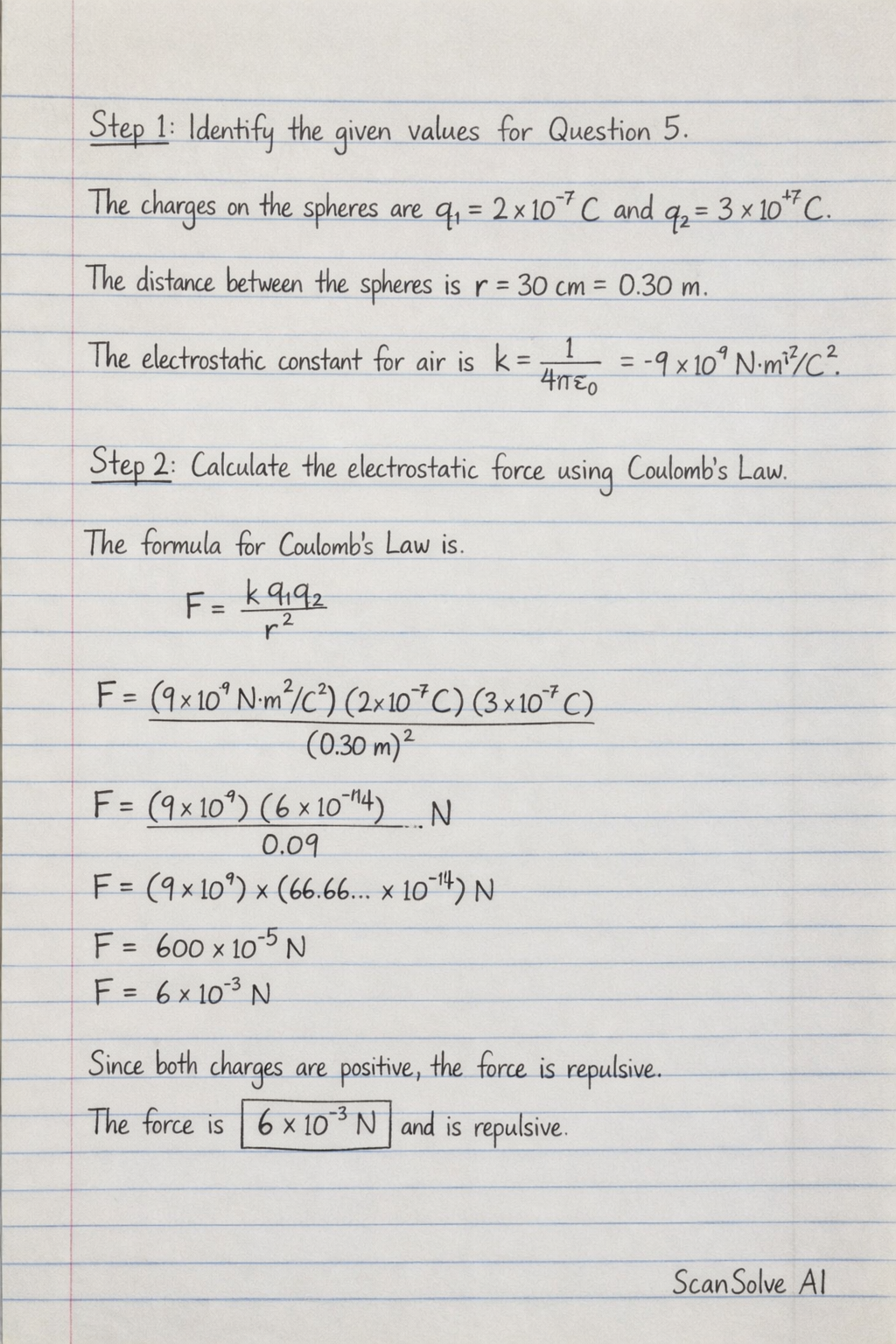
Handwritten Step-by-Step Solution
Get this as a handwritten image on WhatsApp — like a tutor wrote it for you.
Try on WhatsApp