
We read your photo as:
Equate potential energy to kinetic energy.
ScanSolve AI Answer
Step-by-step solution
5 stepsTo find the velocity acquired by the electron, we use the principle of conservation of energy. The potential energy lost by the electron as it moves through the potential difference is converted into kinetic energy.
Equate potential energy to kinetic energy.
The potential energy (PE) lost by an electron with charge moving through a potential difference is .
The kinetic energy (KE) gained by an electron with mass and velocity is .
According to the conservation of energy:Rearrange the equation to solve for velocity .
Multiply both sides by 2:
Divide by :
Take the square root of both sides:
This can be rewritten using the given charge-to-mass ratio :
Substitute the given values into the equation.
Given:
Potential difference,
Ratio of charge to mass,Calculate the final velocity.
Rounding to two significant figures, we get:
Compare the result with the given options.
A.
B.
C.
D.The calculated velocity matches option A.
The final answer is .
Still stuck on this one?
Ask a follow-up, and the answer starts from this question.
More Physics Questions
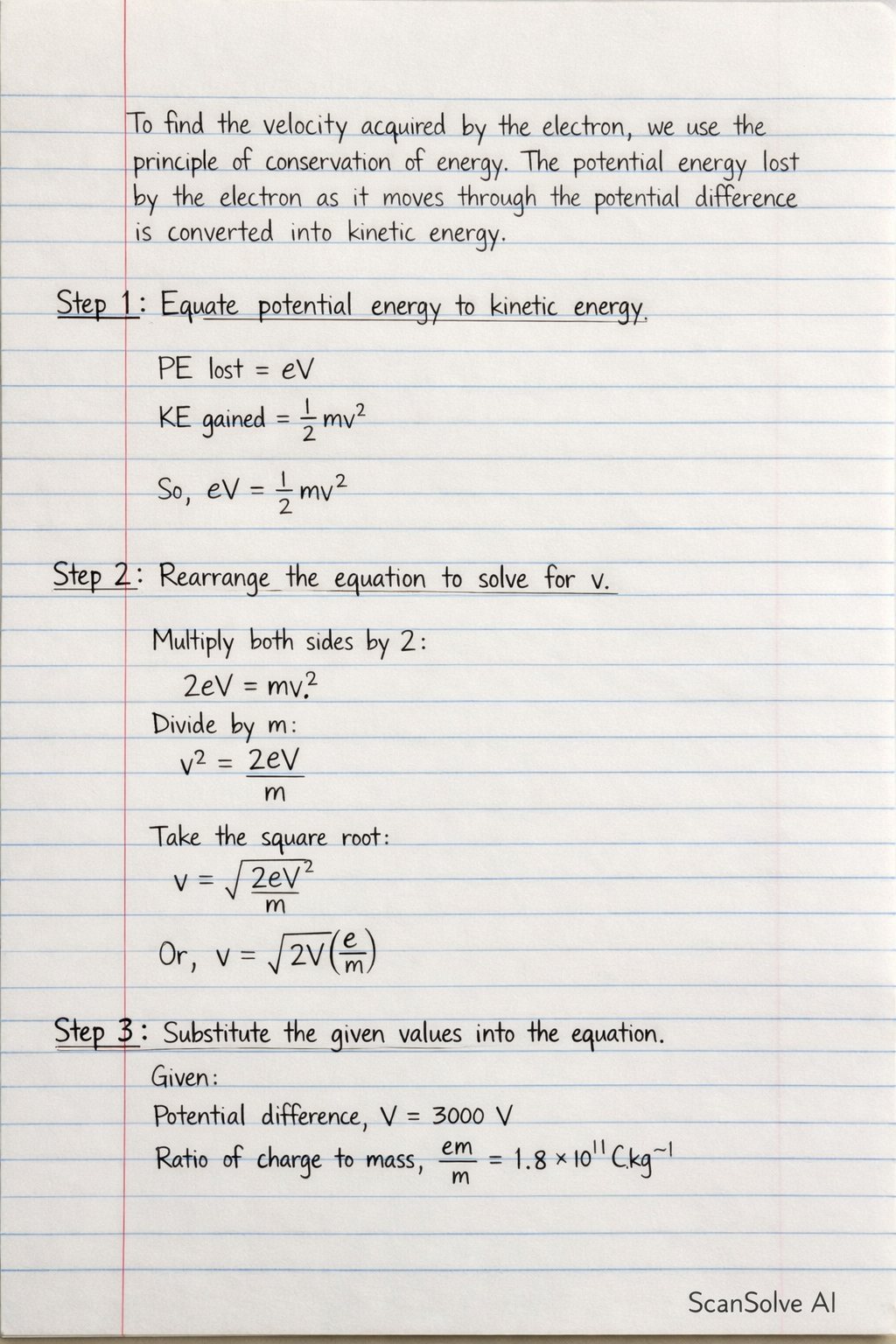
Handwritten Step-by-Step Solution
Get this as a handwritten image on WhatsApp — like a tutor wrote it for you.
Try on WhatsApp