
We read your photo as:
How does rubbing a glass rod with wool charge the rod? What happens when a positively charged rod is brought near a negatively charged object?
ScanSolve AI Answer
Step-by-step solution
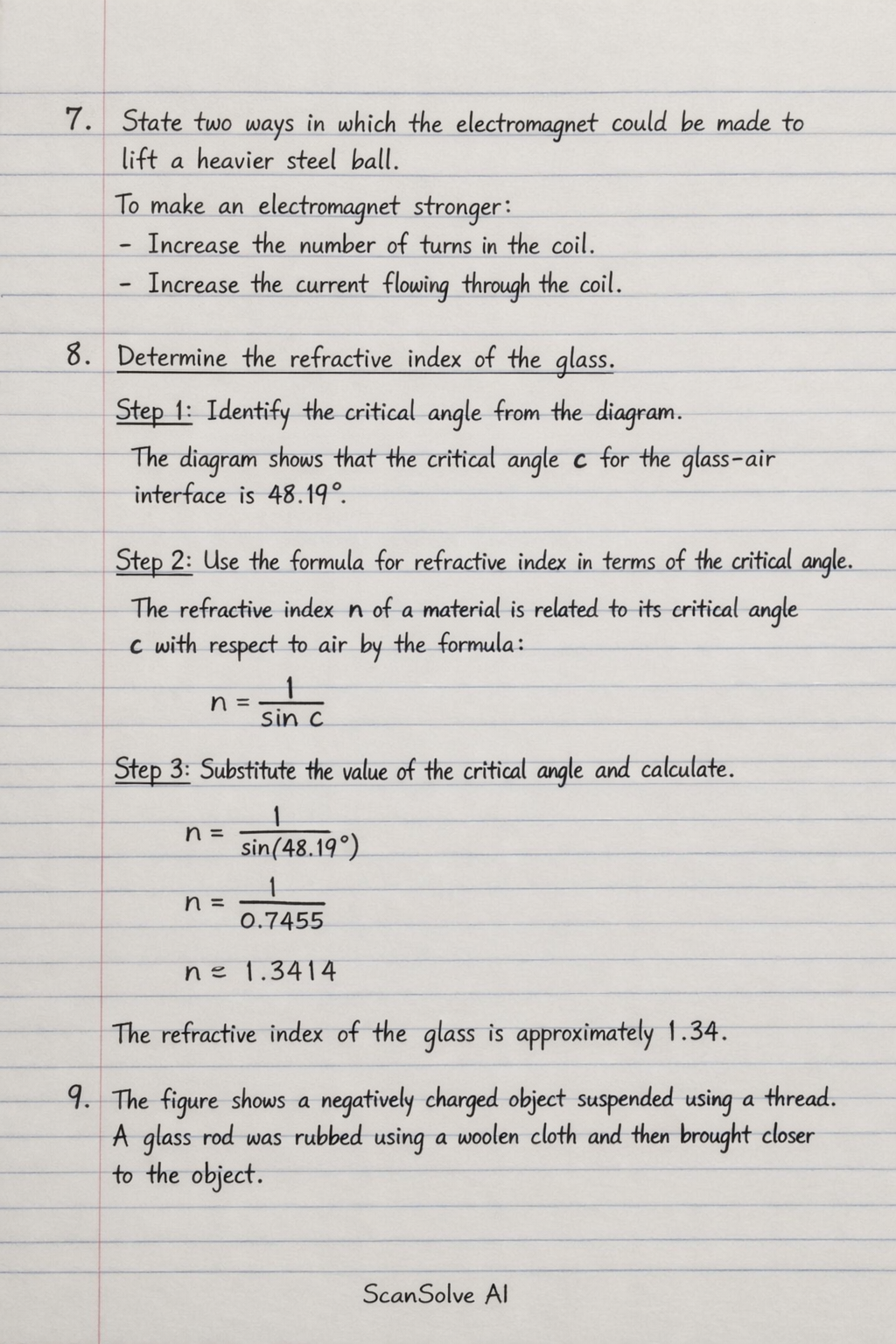
7 steps7. State two ways in which the electromagnet could be made to lift a heavier steel ball.
To make an electromagnet stronger:
- Increase the number of turns in the coil.
- Increase the current flowing through the coil.
8. Determine the refractive index of the glass
Identify the critical angle from the diagram.
The diagram shows that the critical angle for the glass-air interface is .
Use the formula for refractive index in terms of the critical angle.
The refractive index of a material is related to its critical angle with respect to air by the formula:
Substitute the value of the critical angle and calculate.
The refractive index of the glass is approximately 1.34.
9. The figure shows a negatively charged object suspended using a thread. A glass rod was rubbed using a woolen cloth and then brought closer to the object.
Determine the charge of the glass rod.
When a glass rod is rubbed with a woolen cloth, the glass rod loses electrons and becomes positively charged.
Identify the charge of the suspended object.
The suspended object is stated to be negatively charged.
Describe the interaction between the two objects.
Opposite charges attract each other. Therefore, the positively charged glass rod will attract the negatively charged suspended object.
State the observable effect.
The negatively charged light sphere will be attracted towards the glass rod, causing it to swing closer to the rod.
Still stuck on this one?
Ask a follow-up, and the answer starts from this question.
More Physics Questions
Handwritten Step-by-Step Solution
Get this as a handwritten image on WhatsApp — like a tutor wrote it for you.
Try on WhatsApp