
We read your photo as:
Describe the experimental procedure for determining the Earth's gravitational field strength using a simple pulley system, including a diagram and assumed values.
Physics
ScanSolve AI Answer
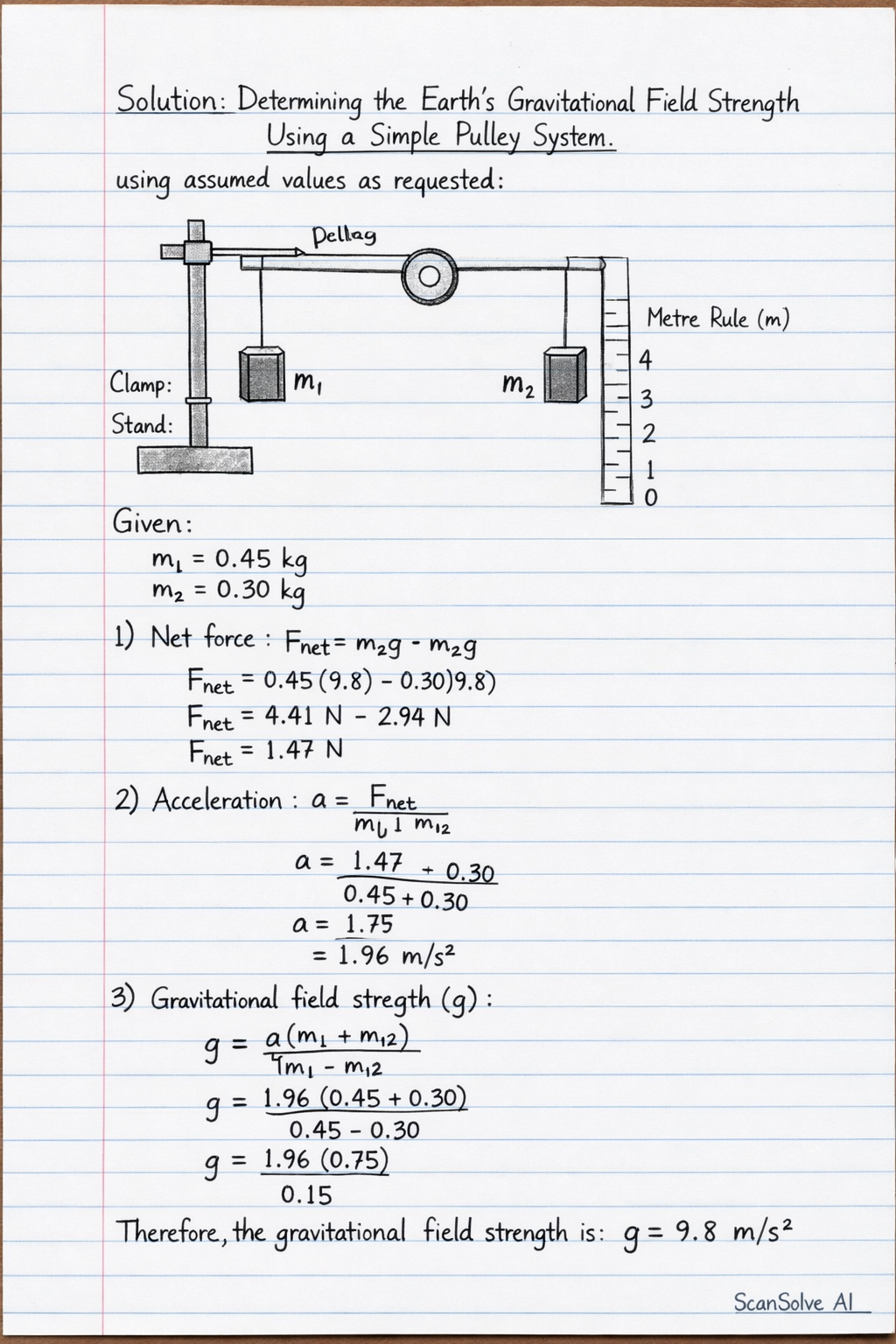
Here is the solution for the experiment "Determining the Earth's Gravitational Field Strength Using a Simple Pulley System", using assumed values as requested:
Diagram
\begin{tikzpicture}[scale=1.0]
    % Clamp stand
    \draw[thick] (0,0) -- (0,5);
    \draw[thick] (-1,5) -- (1,5);
    \draw[thick] (0,0) -- (2,0);
    \node at (0.5,5.3) {Clamp};
    \node at (1,0.3) {Stand};

    % Pulley
    \draw[thick] (0,4.5) circle (0.5);
    \draw[thick] (0,4.5) -- (0,5);
    \node at (0.8,4.5) {Pulley};

    % String
    \draw[thick] (0,4) -- (-2,4);
    \draw[thick] (0,4) -- (2,4);

    % Mass m1
    \draw[thick] (-2,4) -- (-2,3);
    \draw[thick, fill=gray!50] (-2,3) rectangle (-2.5,2.5);
    \node at (-2.25,2.2) {$m_1$};

    % Mass m2
    \draw[thick] (2,4) -- (2,1);
    \draw[thick, fill=gray!50] (2,1) rectangle (2.5,0.5);
    \node at (2.25,0.2) {$m_2$};

    % Metre Rule
    \draw[thick] (2.8,0) -- (2.8,4);
    \foreach \y in {0,1,2,3,4}
        \draw (2.8,\y) -- (2.9,\y) node[right] {\y};
    \node at (3.2,2) {Metre Rule (m)};

    % Height h
    \draw[<->] (2.6,1) -- (2.6,4) node[left, midway] {$h$};

    % Stopwatch
    \draw[thick] (-3,0.5) rectangle (-2,1.5);
    \node at (-2.5,1) {Stopwatch};
\end{tikzpicture}
Procedure
- Set up the apparatus as shown in the diagram. Ensure the pulley is frictionless and the string is light and inextensible.
- Measure the masses of the two mass holders, and , using an electronic balance. Adjust them so that .
- Attach and to the ends of the string, passing the string over the pulley.
- Adjust the position of to a suitable initial height () above the ground, using the metre rule.
- Release the system from rest and simultaneously start the stopwatch.
- Stop the stopwatch when hits the ground. Record the time .
- Repeat steps 4-6 for the same height at least three times to obtain an average time.
- Vary the height (e.g., ) and repeat steps 5-7 for each height.
- For each height, calculate the average time and then .
Observations/Results
- Assumed mass
- Assumed mass
- Total mass
- Difference in mass
| Height (m) | Time (s) | Time (s) | Time (s) | Average Time (s) | (s) |
|---|---|---|---|---|---|
| 0.2 | 0.64 | 0.63 | 0.64 | 0.64 | 0.41 |
| 0.3 | 0.78 | 0.79 | 0.78 | 0.78 | 0.61 |
| 0.4 | 0.90 | 0.91 | 0.90 | 0.90 | 0.81 |
| 0.5 | 1.01 | 1. |
Was this helpful?
Still stuck on this one?
Ask a follow-up, and the answer starts from this question.
Got a different question?Ask your own question
More Physics Questions
QWhat are the steps and assumed values for the experiment "Determining the Earth's Gravitational…QHow to determine the acceleration due to gravity (g) using a simple pendulum experiment and record…QWhich of the following instruments measures the earth's gravitational pull on a body?QDraw one example of a pulleyQThe earth has ratio 6400km the gravitational field strength on the earth surface is 9.81N/kg. Use…
Browse by topic:Mechanics
Handwritten Step-by-Step Solution
Get this as a handwritten image on WhatsApp — like a tutor wrote it for you.
Try on WhatsApp