
We read your photo as:
Describe the experimental procedure to observe light refraction through a glass block, including measuring width, drawing normals and rays, and using pins to trace the refracted ray.
ScanSolve AI Answer
Step-by-step solution
10 stepsHere are the steps for the experiment on light refraction through a glass block:
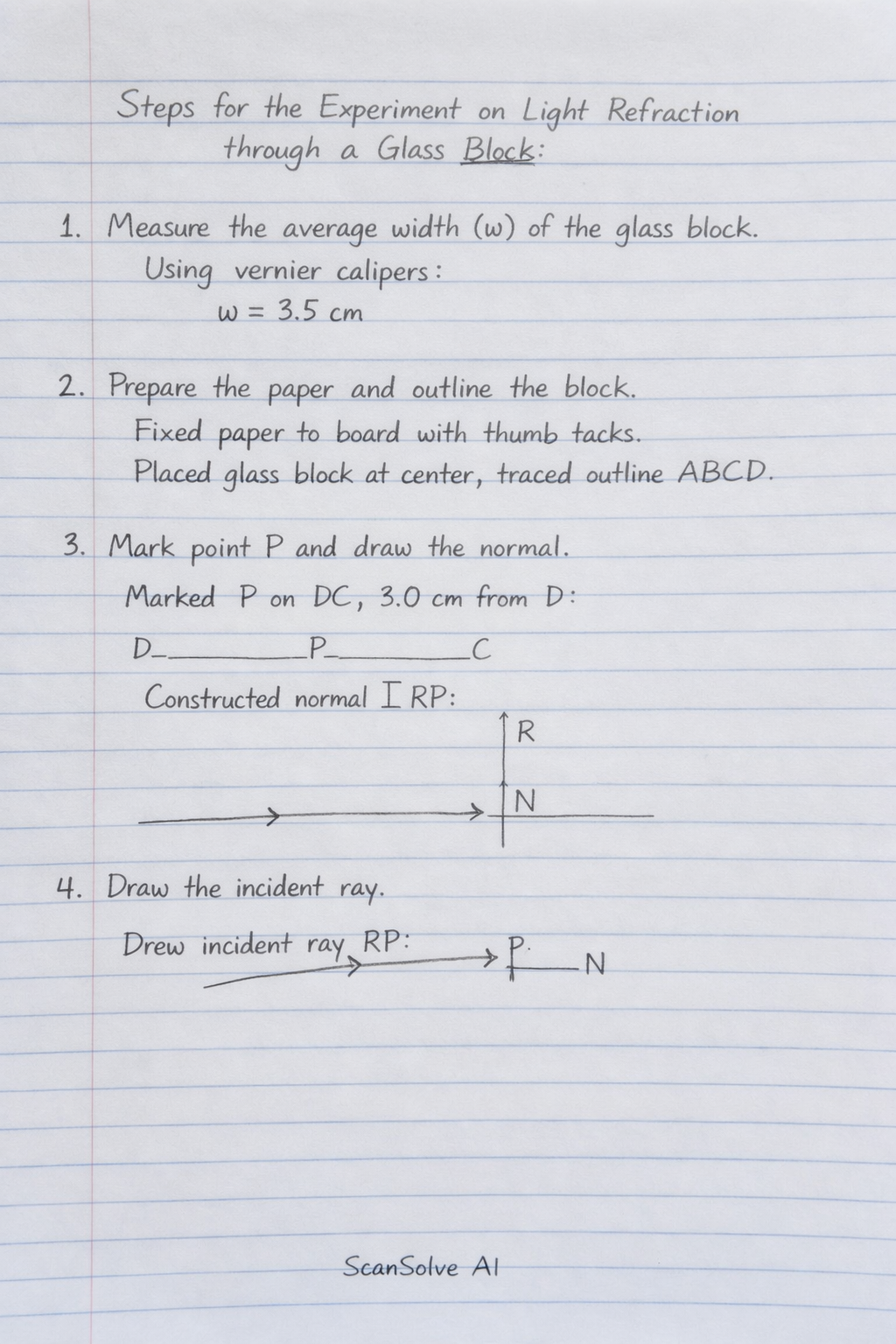
Measure the average width (w) of the glass block.
Use vernier calipers to measure the average width (w) of the glass block. Record this value.
Prepare the paper and outline the block.
Fasten a plane sheet of paper onto a wooden board using thumb tacks. Place the cuboidal glass block at the center of the paper and carefully trace its outline ABCD with a pencil.
Mark point P and draw the normal.
Remove the glass block. Mark a point P on the line DC, exactly 3.0 cm from point D. Construct a normal (a line perpendicular) N at point P to the face DC. Extend this normal to meet the line AB at point R.
Draw the incident ray.
Draw an incident ray to the left of point P, such that it meets the interface DC at point P.
Trace the refracted ray using pins.
Replace the glass block precisely on its outline. Insert two optical pins, P1 and P2, vertically along the incident ray (P2 should be placed at point P, the point of incidence on the interface DC). Observe through the face AB of the glass block. Insert a third optical pin, P3, along AB such that P1, P2, and P3 appear to be in a straight line when viewed through face AB.
Draw the refracted ray and measure length h.
Remove the glass block and all pins. Draw a straight line connecting the pinholes of P2 and P3. This line represents the refracted ray. Let this refracted ray meet the line AB at point Q. Measure the length QP, which is denoted as h.
Measure the angle of incidence.
Measure the angle of incidence, , between the incident ray (P1P2) and the normal N at point P using a protractor.
Repeat for different angles of incidence.
Vary the angle of incidence by changing the position of pin P1. Repeat steps 5, 6, and 7 to obtain at least five other corresponding values of and h.
Record data in a table.
Record all measured values of and h in a table. Calculate and for each set of readings.
Table of values:
S/N (degrees) h (cm) (cm) 1 2 3 4 5 Plot the graph.
Plot a graph with on the vertical axis against on the horizontal axis. Draw the best-fit straight line through the plotted points.
Still stuck on this one?
Ask a follow-up, and the answer starts from this question.
More Physics Questions
Handwritten Step-by-Step Solution
Get this as a handwritten image on WhatsApp — like a tutor wrote it for you.
Try on WhatsApp