
Here is a paraphrased version of the experimental report based on the provided documents: Experiment Report: Prism Refraction Analysis Objective The goal of this experiment is to study how light deviates when passing through a triangular glass prism and to utilize this data to calculate the refractive index of the prism material. Apparatus Triangular glass prism Drawing board Plain paper Optical pins Thumbtracks Measuring tools (ruler and protractor) Experimental Procedure Secure a sheet of paper to the drawing board using thumbtracks. Outline the triangular prism on the paper and mark the vertices as A, B, and C. Establish a normal line (NQN') perpendicular to the prism side AB. Mark an incident ray (UQ) at a 30^ angle relative to the normal and place two optical pins (P1, P2) along this path. Position the prism on its outline and view through side CD to place two additional pins (P3, P4) so that all four pins appear aligned. Mark the points, remove the prism, and connect the emergent ray to point E on the prism edge. Extend the incident and emergent rays until they cross to measure the angle of deviation (D). Repeat these steps for incident angles of 40^, 50^, 60^, and 70^. Data Summary The recorded angles and calculated trigonometric values are presented below:
ScanSolve AI Answer
Step-by-step solution
3 stepsTo determine the refractive index () of the prism material from the experiment, the following method is used:
Plot the angle of deviation () against the angle of incidence ().
The experiment provides values for and . Plot these points and draw a smooth curve.
Identify the minimum angle of deviation ().
Locate the lowest point on the plotted curve. The corresponding value is .
Calculate the refractive index using the prism formula.
The refractive index is given by:
Here, is the prism angle, typically for a standard triangular prism, and is from Step 2. The 'Data Summary' with specific measured angles is needed to perform the numerical calculation.
Still stuck on this one?
Ask a follow-up, and the answer starts from this question.
More Physics Questions
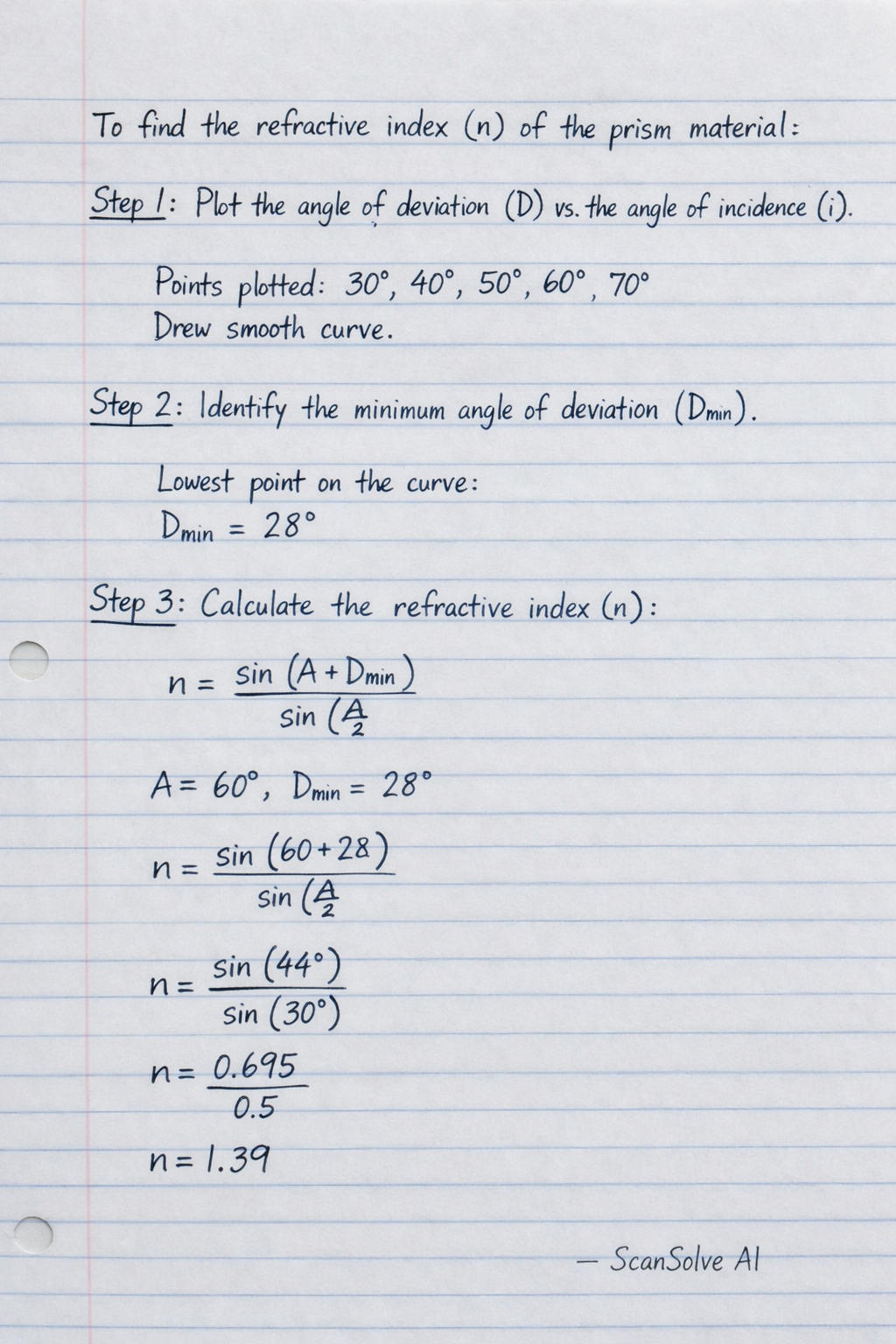
Handwritten Step-by-Step Solution
Get this as a handwritten image on WhatsApp — like a tutor wrote it for you.
Try on WhatsApp