
Explain external resistance
Physics
ScanSolve AI Answer
External resistance refers to the total resistance of all components in an electrical circuit that are outside the power source (like a battery or generator). It includes the resistance of wires, resistors, light bulbs, motors, and any other load connected to the source. This resistance determines how much current flows through the circuit for a given voltage supplied by the source, according to Ohm's Law ().
Was this helpful?
Still stuck on this one?
Ask a follow-up, and the answer starts from this question.
Got a different question?Ask your own question
More Physics Questions
QA cell is connected to an external resistor. When the external resistance is 2 Ω, the current is 0.8…QExplain how polarization of a cell increase the cell internal resistanceQFor the power supplied by a battery given its voltage and the external load resistance.QQuelques sont différents types de résistanceQA circuit has a 3 Ohm and a 6 Ohm resistor in series with a parallel combination of a 4.5 Ohm and a…
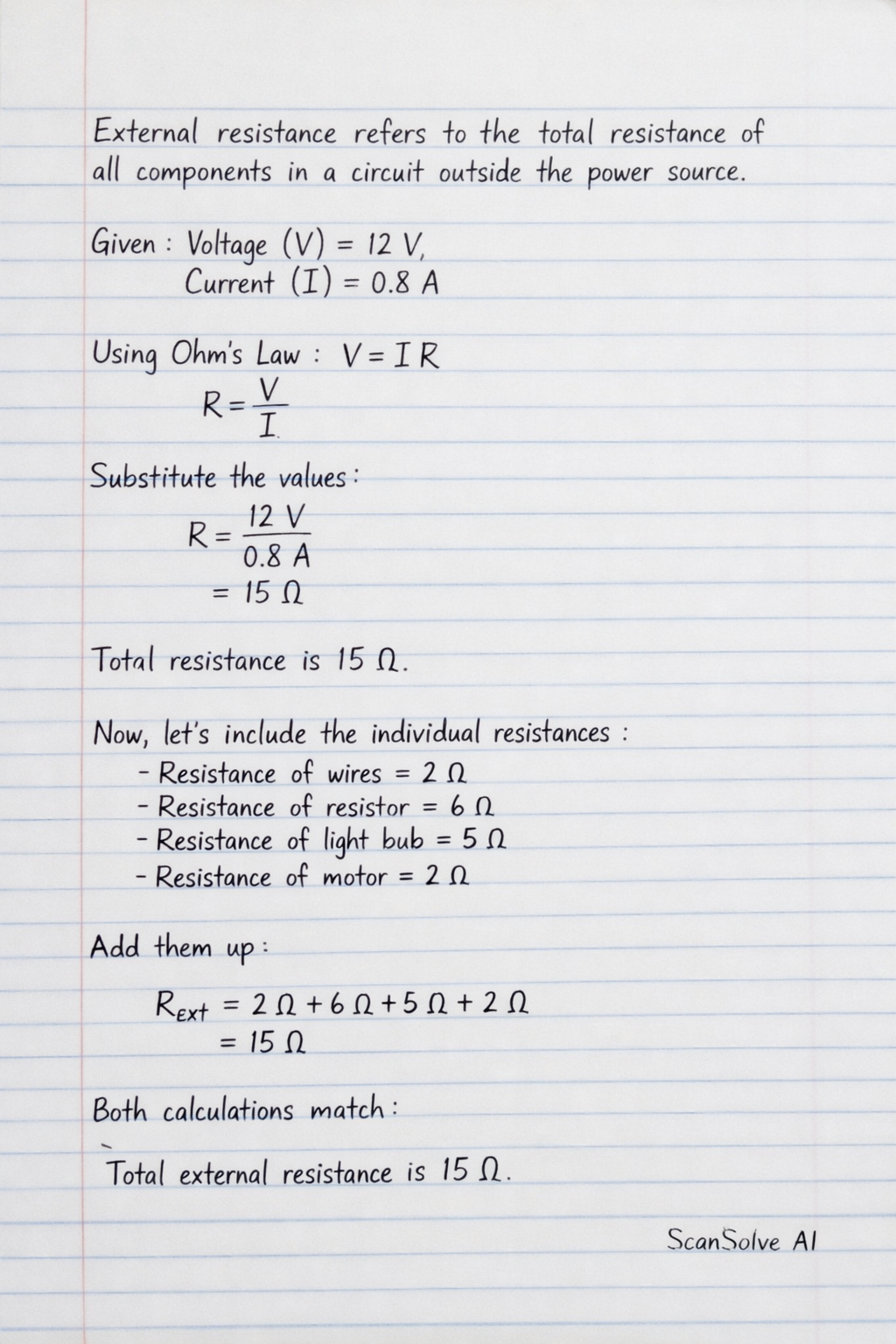
Handwritten Step-by-Step Solution
Get this as a handwritten image on WhatsApp — like a tutor wrote it for you.
Try on WhatsApp