
We read your photo as:
First, we resolve each force into its horizontal (x) and vertical (y) components. We will measure angles counter-clockwise from the positive x-axis.
Physics
ScanSolve AI Answer
To solve this problem, we need to find the resultant force from the three given forces and then determine the magnitude and direction of the force required to keep the system in equilibrium. The equilibrium force will have the same magnitude as the resultant force but act in the opposite direction.
First, we resolve each force into its horizontal (x) and vertical (y) components. We will measure angles counter-clockwise from the positive x-axis.
- Force : Magnitude , Angle .
- Force : Magnitude . The diagram shows it from the negative y-axis in the second quadrant. So, its angle from the positive
Was this helpful?
Still stuck on this one?
Ask a follow-up, and the answer starts from this question.
Got a different question?Ask your own question
More Physics Questions
QResolve each force into its x and y components.QA system has three forces acting on it: 3N upwards, 5N to the right, and 6N at 45 degrees upwards…QResolve the following forces into their vertical and horizontal components:QResolve the initial velocity into horizontal and vertical components.QDetermine the unit vectors for each force's direction.
Browse by topic:Mechanics
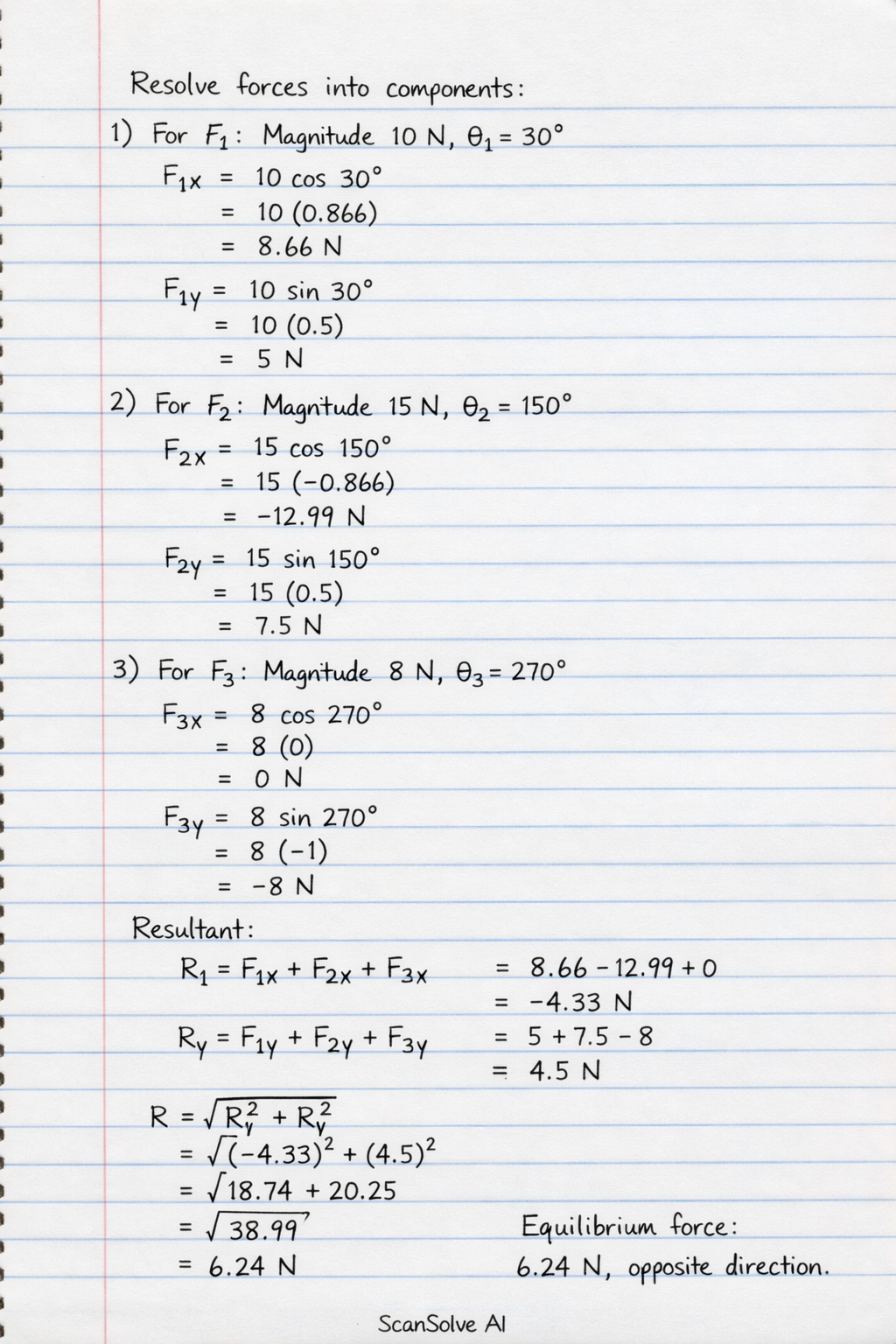
Handwritten Step-by-Step Solution
Get this as a handwritten image on WhatsApp — like a tutor wrote it for you.
Try on WhatsApp