
We read your photo as:
Explain how fish survive in frozen ponds and define pitch of a micrometer screw gauge with calculation of observed reading.
ScanSolve AI Answer
Answer
Step-by-step solution
4 stepsAnswer Question 1.
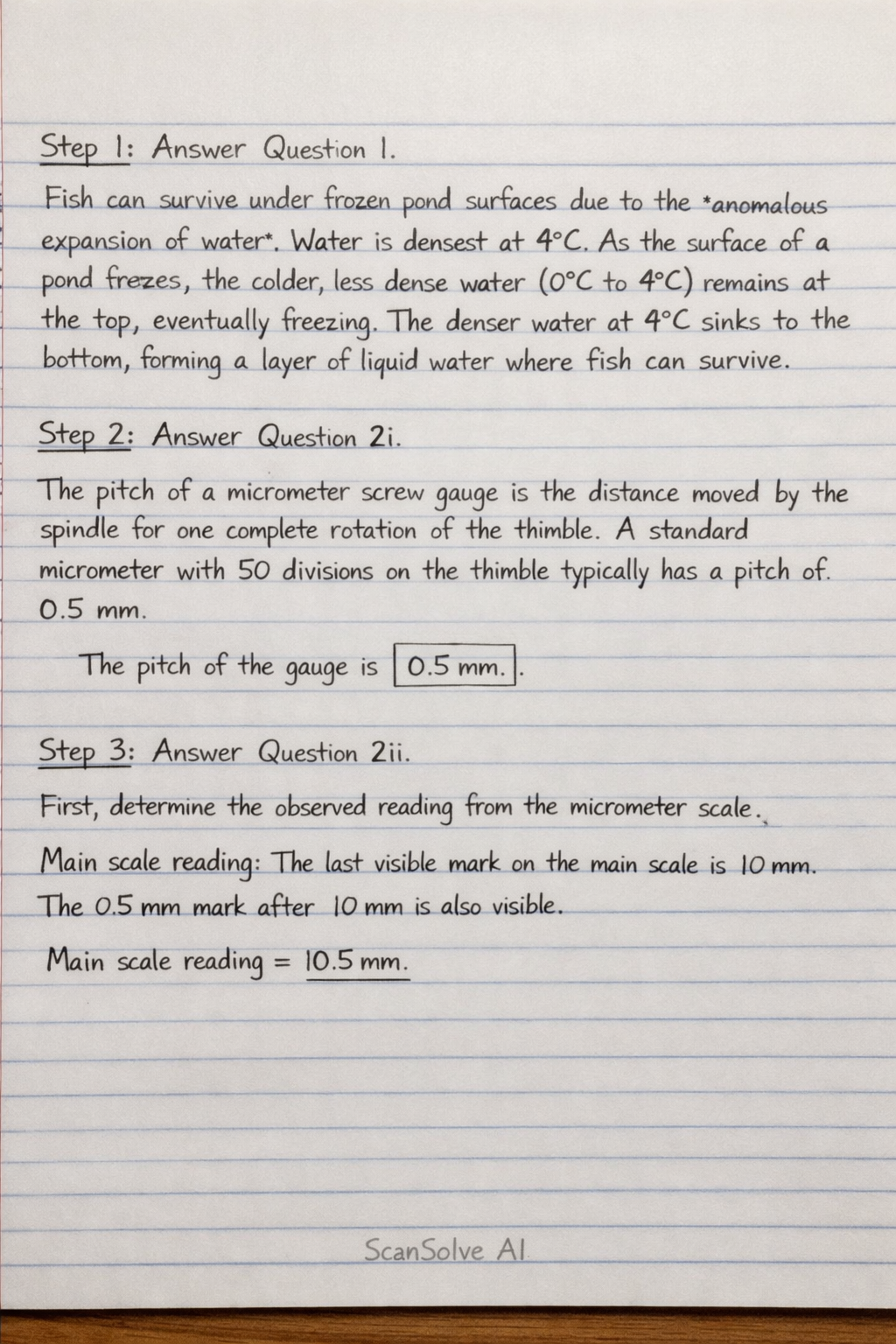
Fish can survive under frozen pond surfaces due to the anomalous expansion of water. Water is densest at . As the surface of a pond freezes, the colder, less dense water ( to ) remains at the top, eventually freezing. The denser water at sinks to the bottom, forming a layer of liquid water where fish can survive.
Answer Question 2i.
The pitch of a micrometer screw gauge is the distance moved by the spindle for one complete rotation of the thimble. A standard micrometer with 50 divisions on the thimble typically has a pitch of .
The pitch of the gauge is .
Answer Question 2ii.
First, determine the observed reading from the micrometer scale.
Main scale reading: The last visible mark on the main scale is . The mark after is also visible.
Main scale reading .Thimble scale reading: The line on the main scale aligns with the division on the thimble scale.
Thimble scale reading .Least count of the micrometer:
Observed reading:
Given positive error:
Correct reading:
Converting to centimeters:
The correct reading on the scale is .
Answer Question 3.
When liquid soap is introduced into the water drop, the surface tension of the water decreases. Surface tension is responsible for holding the water drop in a spherical shape. With reduced surface tension, the cohesive forces within the drop become weaker, causing the drop to spread out and become flatter on the surface.
Try one yourself
A new problem that tests the same skill.
Still stuck on this one?
Ask a follow-up, and the answer starts from this question.
More Physics Questions
Handwritten Step-by-Step Solution
Get this as a handwritten image on WhatsApp — like a tutor wrote it for you.
Try on WhatsApp