
We read your photo as:
Solve the following multiple-choice questions: 1. A frequency of 2 MHz has time period of? 2. The 120 Volts r.m.s. has peak value of? 3. If the capacitance is doubled the capacitive reactance is? 4. T
ScanSolve AI Answer
Here are the solutions to the multiple-choice questions:
1. A frequency of has time period of
- The relationship between frequency () and time period () is .
- Given .
- Answer: a)
2. The has peak value of
- For a sine wave, the peak voltage () is related to the RMS voltage () by .
- Given .
- This is approximately .
- Answer: b)
3. If the capacitance is doubled the capacitive reactance is
- Capacitive reactance () is given by the formula .
- If capacitance is doubled to , the new capacitive reactance will be:
- Therefore, the capacitive reactance is halved.
- Answer: a)
4. Two inductive reactance are in parallel have an equivalent reactance of
- For two parallel reactances and , the equivalent reactance is given by:
- Given and .
- Answer: a)
5. In a sine wave ac circuit the voltage across a capacitance
- In a purely capacitive AC circuit, the current leads the voltage by . Conversely, the voltage across the capacitance lags the current by .
- Answer: a)
6. Alternating current can induce voltage because alternating current has a
- According to Faraday's Law of Induction, a voltage is induced when there is a change in magnetic flux. Alternating current continuously changes its magnitude and direction, which produces a continuously varying magnetic flux.
- Answer: b)
7. An iron core transformer with a step up ratio has applied across the primary. The voltage across the secondary equals
- For an ideal transformer, the ratio of secondary voltage () to primary voltage () is equal to the ratio of secondary turns () to primary turns ():
- Given turns ratio , so .
- Given primary voltage .
- Answer: d)
8. When capacitance is increased the resonant frequency of the LC circuit
- The resonant frequency () of an LC circuit is given by the formula:
- From the formula, is inversely proportional to the square root of the capacitance (). If increases, will decrease.
- Answer: b)
Still stuck on this one?
Ask a follow-up, and the answer starts from this question.
More Physics Questions
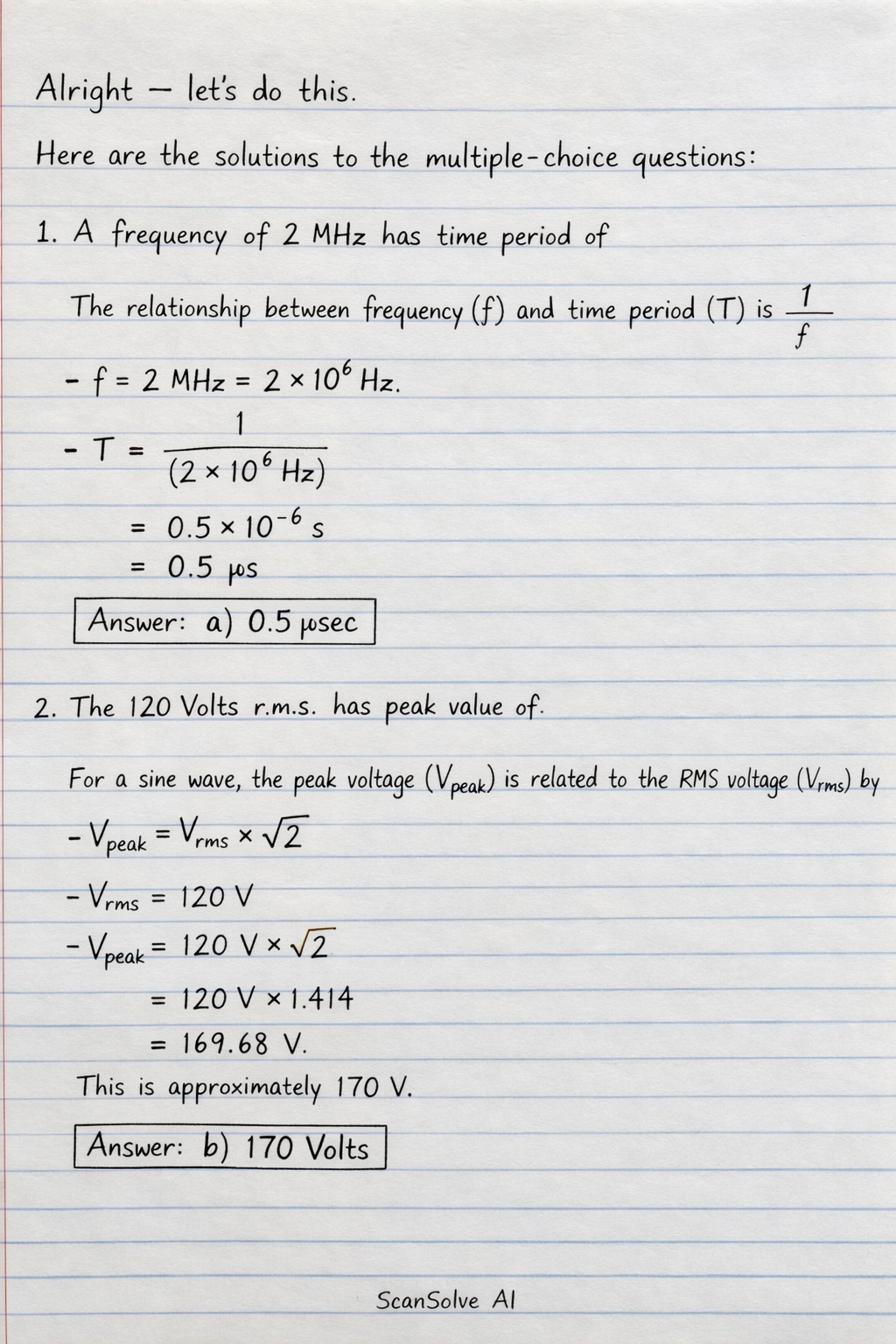
Handwritten Step-by-Step Solution
Get this as a handwritten image on WhatsApp — like a tutor wrote it for you.
Try on WhatsApp