
We read your photo as:
Define the following terms: i. Thermodynamics ii. Thermodynamic state iii. Boundary iv. Surrounding v. Universe. Make a neat sketch of thermodynamic system. List the types of thermodynamic systems and explain any two with examples of each.
Physics
ScanSolve AI Answer
Step-by-step solution
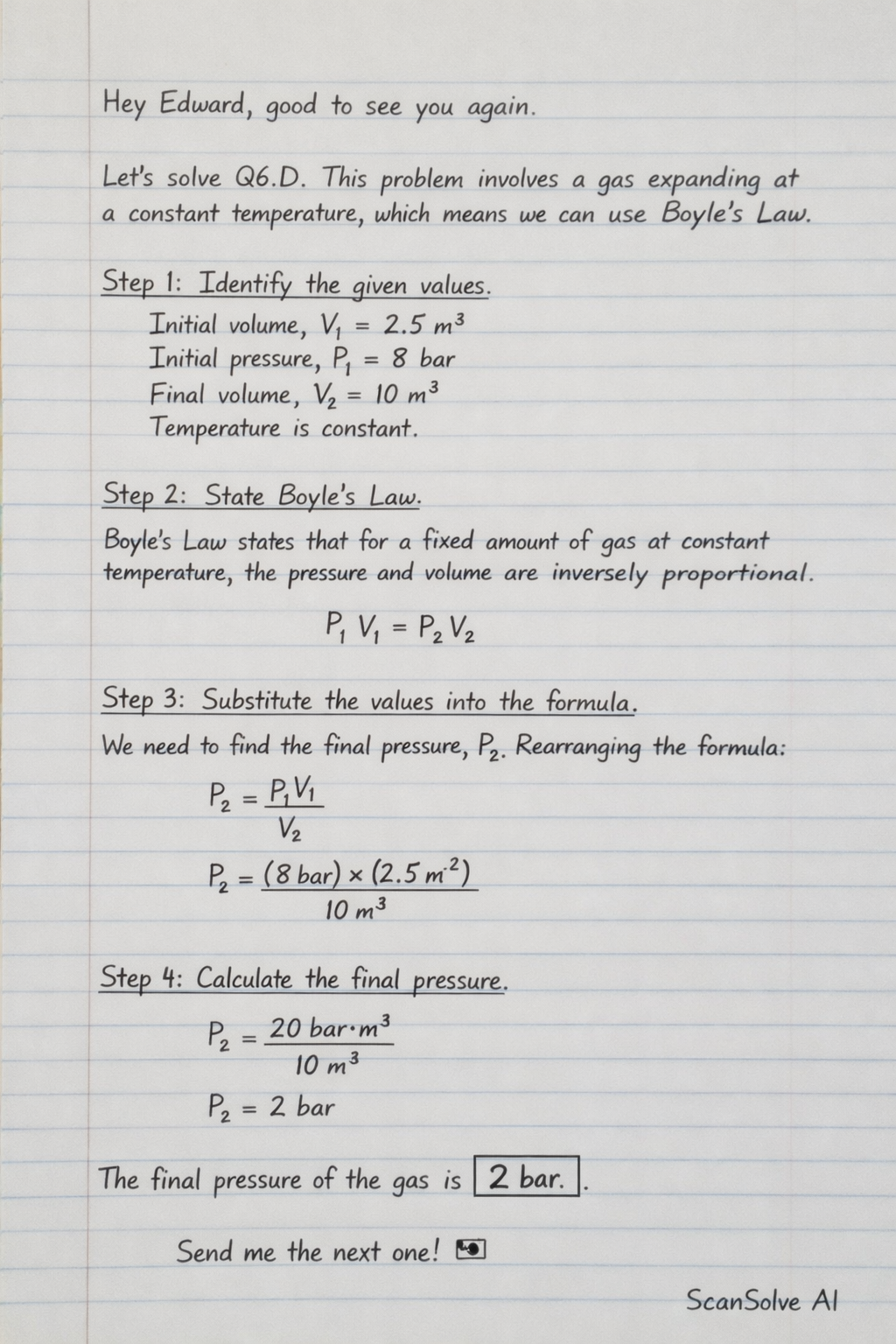
4 stepsLet's solve Q6.D. This problem involves a gas expanding at a constant temperature, which means we can use Boyle's Law.
Identify the given values.
Initial volume,
Initial pressure,
Final volume,
Temperature is constant.State Boyle's Law.
Boyle's Law states that for a fixed amount of gas at constant temperature, the pressure and volume are inversely proportional.
Substitute the values into the formula.
We need to find the final pressure, . Rearranging the formula:
Calculate the final pressure.
The final pressure of the gas is .
Was this helpful?
Still stuck on this one?
Ask a follow-up, and the answer starts from this question.
Got a different question?Ask your own question
More Physics Questions
QQ2a.) Define the following in relation to a thermodynamic system. I. Adiabatic ii. Homogeneous iii…QQ5a.) State the first law of Thermodynamics and represent it with an Equation. b.) Give two(2)…QDefine the following terms and give one example of each. (i) system; (ii) tissue. (b) State three…QDefine and explain the following heat related terms: i. Sensible Heat ii. Latent Heat iii. Latent…
Handwritten Step-by-Step Solution
Get this as a handwritten image on WhatsApp — like a tutor wrote it for you.
Try on WhatsApp