
We read your photo as:
For a pendulum with displacement y(t) = A (omega t + ), if the phase constant is = (2pi)/(3), what are the displacement and velocity at t=0?
ScanSolve AI Answer
Answer
Step-by-step solution
3 stepsThe displacement of a pendulum is given by the equation .
We are given that the phase constant .
So the equation becomes .
Evaluate the displacement at .
Substitute into the equation:
We know that .
So,Since is the amplitude (a positive value), must be positive. This means the graph should start at a positive value on the y-axis.
Evaluate the slope (velocity) at .
The velocity is the derivative of displacement with respect to time:
Substitute :
We know that .
So,Since and are positive, must be negative. This means the graph should be decreasing at .
Compare with the given options.
We need a graph that starts at a positive value and is decreasing at .
- Graph (A) starts at and increases. Incorrect.
- Graph (B) starts at a positive value and decreases. This matches our findings.
- Graph (C) starts at and increases. Incorrect.
- Graph (D) starts at a positive value and increases. Incorrect.
Therefore, option (B) correctly represents the displacement.
The final answer is .
Try one yourself
A new problem that tests the same skill.
Still stuck on this one?
Ask a follow-up, and the answer starts from this question.
More Physics Questions
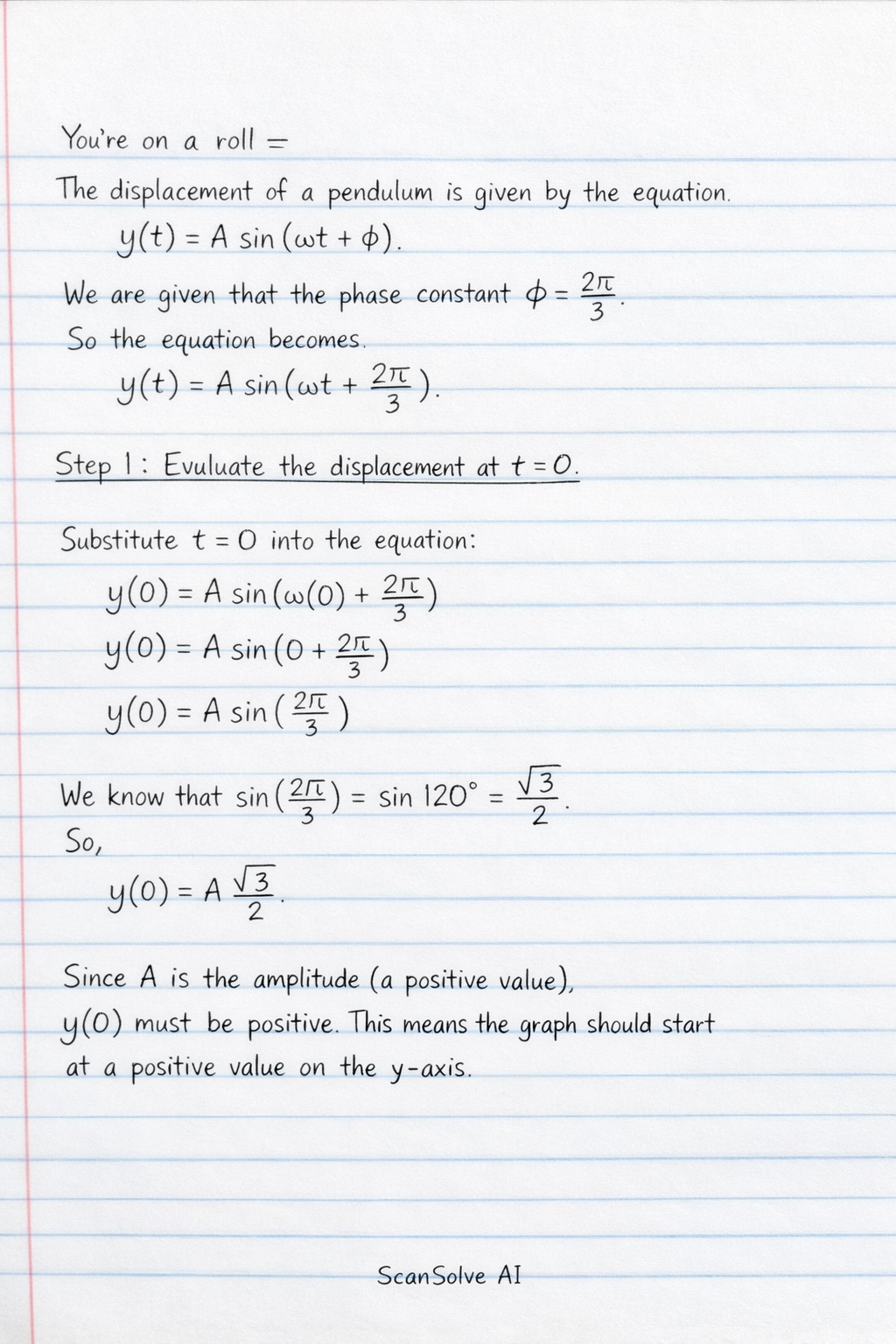
Handwritten Step-by-Step Solution
Get this as a handwritten image on WhatsApp — like a tutor wrote it for you.
Try on WhatsApp