

This physics problem tests your understanding of fundamental physical laws and their applications. The step-by-step solution below breaks down the problem using relevant equations and physical reasoning.
ScanSolve AI Answer
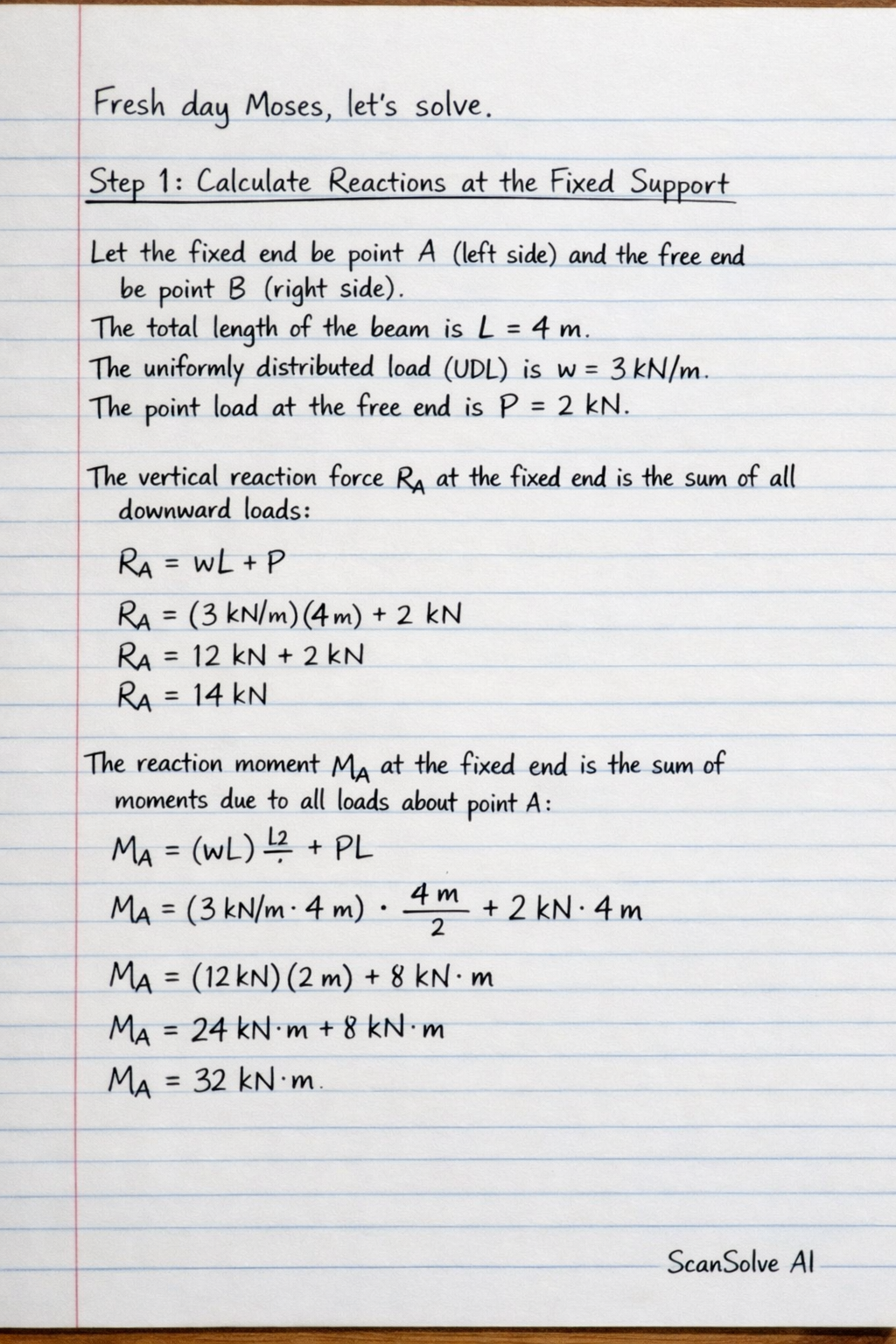
Step 1: Calculate Reactions at the Fixed Support Let the fixed end be point A (left side) and the free end be point B (right side). The total length of the beam is L = 4 \, m. The uniformly distributed load (UDL) is w = 3 \, kN/m. The point load at the free end is P = 2 \, kN. The vertical reaction force R_A at the fixed end is the sum of all downward loads: R_A = wL + P R_A = (3 \, kN/m)(4 \, m) + 2 \, kN R_A = 12 \, kN + 2 \, kN R_A = 14 \, kN The reaction moment M_A at the fixed end is the sum of moments due to all loads about point A: M_A = (wL)(L)/(2) + PL M_A = (3 \, kN/m · 4 \, m) · 4 \, m2 + 2 \, kN · 4 \, m M_A = (12 \, kN) · (2 \, m) + 8 \, kN · m M_A = 24 \, kN · m + 8 \, kN · m M_A = 32 \, kN · m Step 2: Shear Force Calculations Consider a section at a distance x from the fixed end (left side). Using the standard sign convention (upward forces positive for shear force when looking at the left part of the section): V(x) = R_A - wx V(x) = 14 \, kN - (3 \, kN/m)x At the fixed end (x=0): V(0) = 14 - 3(0) = 14 \, kN At the free end (x=4 \, m): V(4) = 14 - 3(4) = 14 - 12 = 2 \, kN Step 3: Bending Moment Calculations Consider a section at a distance x from the fixed end (left side). Using the standard sign convention (hogging moments are negative): M(x) = -M_A + R_A x - (wx)(x)/(2) M(x) = -32 \, kN · m + (14 \, kN)x - (3 \, kN/m)x^22 M(x) = -32 + 14x - 1.5x^2 At the fixed end (x=0): M(0) = -32 + 14(0) - 1.5(0)^2 = -32 \, kN · m At the free end (x=4 \, m): M(4) = -32 + 14(4) - 1.5(4)^2 M(4) = -32 + 56 - 1.5(16) M(4) = -32 + 56 - 24 M(4) = 0 \, kN · m Step 4: Shear Force Diagram (SFD) The shear force diagram starts at a positive value of 14 \, kN at the fixed end (x=0). It decreases linearly along the beam due to the uniformly distributed load. At the free end (x=4 \, m), the shear force is 2 \, kN. The entire diagram is above the zero line, indicating positive shear force throughout the beam. The equation for the SFD is V(x) = 14 - 3x \, kN. Step 5: Bending Moment Diagram (BMD) The bending moment diagram starts at a negative value of -32 \, kN · m at the fixed end (x=0), which is the maximum (in magnitude) bending moment. It then increases parabolically (becomes less negative) along the beam. At the free end (x=4 \, m), the bending moment is 0 \, kN · m. The entire diagram is below the zero line, indicating negative bending moment (hogging) throughout the beam. The equation for the BMD is M(x) = -32 + 14x - 1.5x^2 \, kN · m. Send me the next one 📸