We read your photo as:

For Question 1: A light of wavelength 610 nm produces a first maximum at an angle of 30 degrees. What is the slit separation? For Question 2: 3rd minimum is observed at 30 degrees for a slit separatio

Physics

ScanSolve AI Answer

Step-by-step solution

6 steps
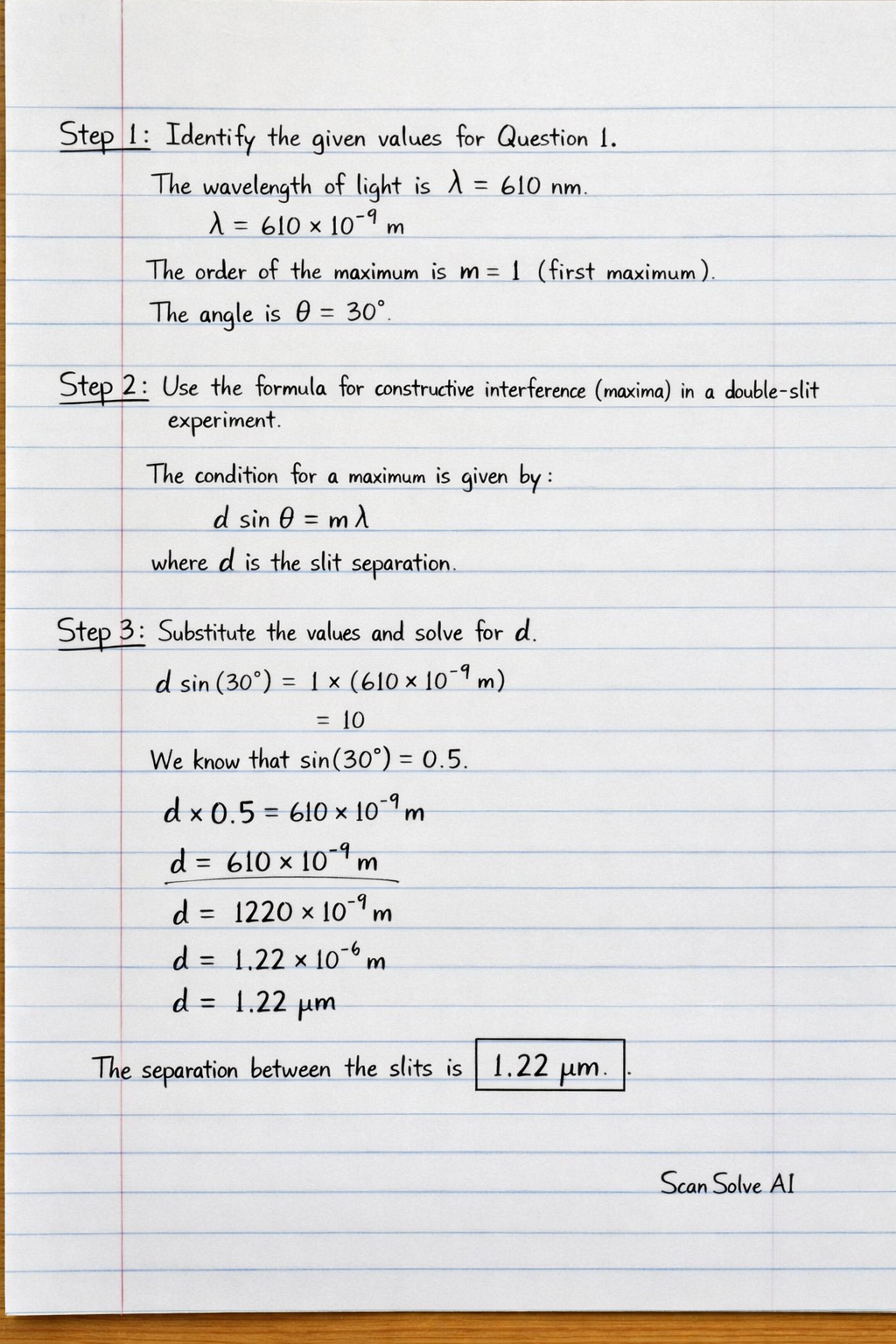
  1. Identify the given values for Question 1.

    The wavelength of light is λ=610 nm\lambda = 610 \text{ nm}.

    λ=610×10−9 m\lambda = 610 \times 10^{-9} \text{ m}

    The order of the maximum is m=1m = 1 (first maximum).
    The angle is θ=30∘\theta = 30^\circ.

  2. Use the formula for constructive interference (maxima) in a double-slit experiment.

    The condition for a maximum is given by:

    dsin⁡θ=mλd \sin \theta = m \lambda

    where dd is the slit separation.

  3. Substitute the values and solve for dd.

    dsin⁡(30∘)=1×(610×10−9 m)d \sin(30^\circ) = 1 \times (610 \times 10^{-9} \text{ m})

    We know that sin⁡(30∘)=0.5\sin(30^\circ) = 0.5.

    d×0.5=610×10−9 md \times 0.5 = 610 \times 10^{-9} \text{ m} d=610×10−9 m0.5d = \frac{610 \times 10^{-9} \text{ m}}{0.5} d=1220×10−9 md = 1220 \times 10^{-9} \text{ m} d=1.22×10⁻⁶ md = 1.22 \times 10^{-6} \text{ m}

    This can also be expressed as 1.22 µm1.22 \text{ µm}.

    The separation between the slits is 1.22  \textmum\boxed{\text{1.22 \text{ \textmu}m}}.


  4. Identify the given values for Question 2.

    The order of the minimum is m=3m = 3 (3rd minimum).
    The angle is θ=30∘\theta = 30^\circ.
    The slit separation is d=3 cmd = 3 \text{ cm}.

    d=3×10⁻² md = 3 \times 10^{-2} \text{ m}
  5. Use the formula for destructive interference (minima) in a double-slit experiment.

    The condition for a minimum is given by:

    dsin⁡θ=(m−12)λd \sin \theta = \left(m - \frac{1}{2}\right) \lambda

    where λ\lambda is the wavelength of light.

  6. Substitute the values and solve for λ\lambda.

    (3×10⁻² m)sin⁡(30∘)=(3−12)λ(3 \times 10^{-2} \text{ m}) \sin(30^\circ) = \left(3 - \frac{1}{2}\right) \lambda

    We know that sin⁡(30∘)=0.5\sin(30^\circ) = 0.5.

    (3×10⁻² m)×0.5=(52)λ(3 \times 10^{-2} \text{ m}) \times 0.5 = \left(\frac{5}{2}\right) \lambda 1.5×10⁻² m=2.5λ1.5 \times 10^{-2} \text{ m} = 2.5 \lambda λ=1.5×10⁻² m2.5\lambda = \frac{1.5 \times 10^{-2} \text{ m}}{2.5} λ=0.6×10⁻² m\lambda = 0.6 \times 10^{-2} \text{ m} λ=6×10⁻³ m\lambda = 6 \times 10^{-3} \text{ m}

    This wavelength is very large for visible light. Let's recheck the calculation.

    λ=0.006 m\lambda = 0.006 \text{ m}

    This is 6 mm6 \text{ mm}. This is an unusually large wavelength for light. However, based on the given values and formula, this is the calculated result.

    The wavelength of light is 6  mm\boxed{\text{6 \text{ mm}}}.

Was this helpful?

Still stuck on this one?

Ask a follow-up, and the answer starts from this question.

Got a different question?Ask your own question
Handwritten step-by-step solution preview

Handwritten Step-by-Step Solution

Get this as a handwritten image on WhatsApp — like a tutor wrote it for you.

Try on WhatsApp