

This physics problem tests your understanding of fundamental physical laws and their applications. The step-by-step solution below breaks down the problem using relevant equations and physical reasoning.
ScanSolve AI Answer
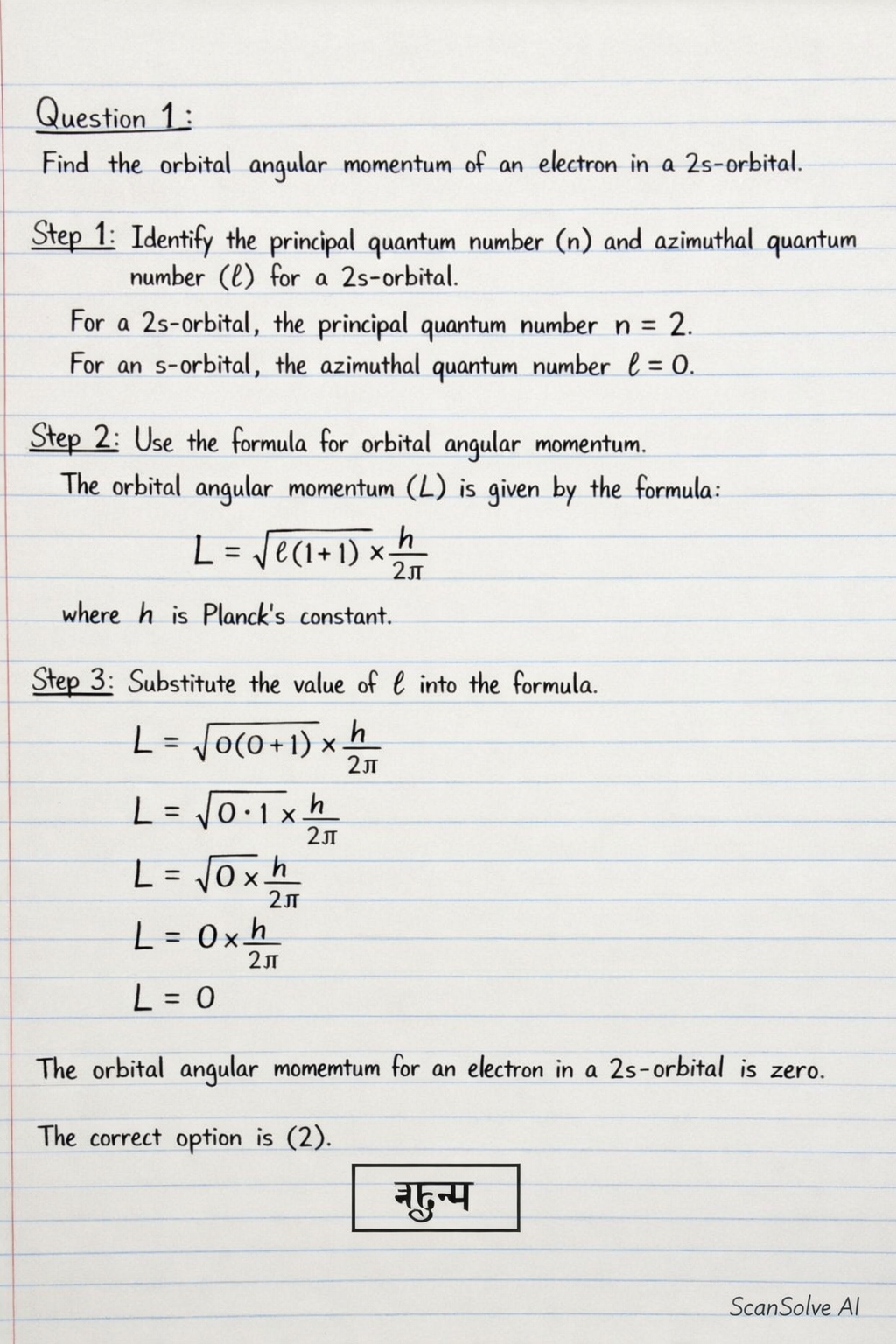
Question 1: The question asks for the orbital angular momentum of an electron in a 2s-orbital. Step 1: Identify the principal quantum number (n) and azimuthal quantum number (l) for a 2s-orbital. For a 2s-orbital, the principal quantum number n=2. For an s-orbital, the azimuthal quantum number l=0. Step 2: Use the formula for orbital angular momentum. The orbital angular momentum (L) is given by the formula: L = sqrt(l(l+1)) (h)/(2) where h is Planck's constant. Step 3: Substitute the value of l into the formula. Substitute l=0 into the formula: L = sqrt(0(0+1)) (h)/(2) L = sqrt(0 · 1) (h)/(2) L = sqrt(0) (h)/(2) L = 0 · (h)/(2) L = 0 The orbital angular momentum for an electron in a 2s-orbital is zero. The correct option is (2). शून्य --- Question 2: The question asks to identify the valid set of quantum numbers among the given options. The rules for valid quantum numbers are: • n must be a positive integer (n 1). • l can range from 0 to n-1. • m can range from -l to +l, including 0. • s can be +(1)/(2) or -(1)/(2). Let's check each option: a) (1) n=3, l=2, m=-2, s=+(1)/(2) • n=3: Valid (positive integer). • l=2: Valid, as 0 l n-1 0 2 3-1 0 2 2. • m=-2: Valid, as -l m +l -2 -2 +2. • s=+(1)/(2): Valid. This set of quantum numbers is valid. b) (2) n=3, l=2, m=-1, s=0 • n=3: Valid. • l=2: Valid. • m=-1: Valid. • s=0: Invalid. The spin quantum number s must be either +(1)/(2) or -(1)/(2). c) (3) n=2, l=2, m=+1, s=-(1)/(2) • n=2: Valid. • l=2: Invalid. For n=2, l can only be 0 or 1 (0 l n-1 0 l 2-1 0 l 1). d) (4) n=2, l=2, m=+1, s=-(1)/(2) This option is identical to option (3). • n=2: Valid. • l=2: Invalid. For n=2, l can only be 0 or 1. Only option (1) represents a valid set of quantum numbers. The correct option is (1). n=3, l=2, m=-2, s=+(1)/(2) Send me the next one 📸