

This physics problem tests your understanding of fundamental physical laws and their applications. The step-by-step solution below breaks down the problem using relevant equations and physical reasoning.
ScanSolve AI Answer
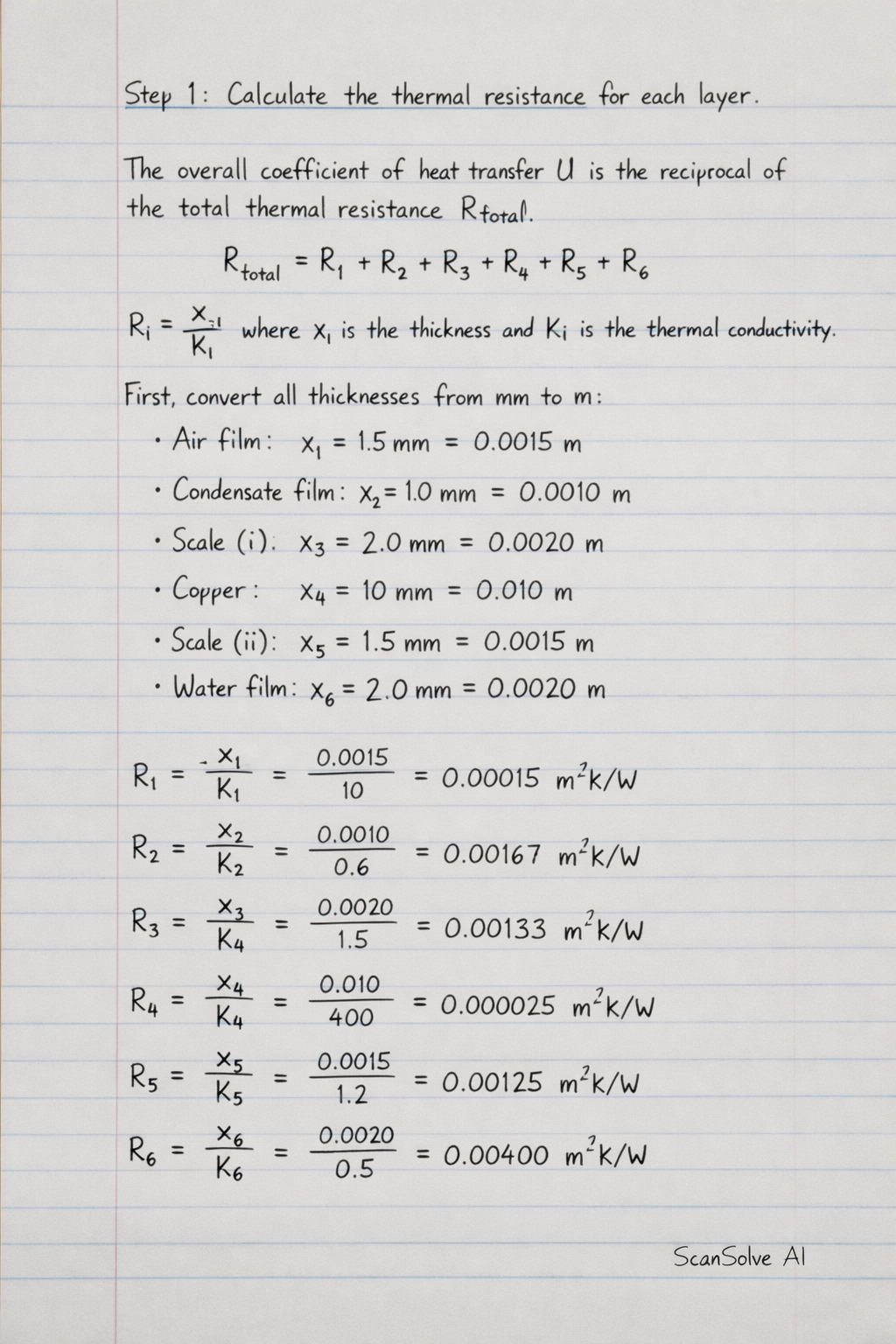
Step 1: Calculate the thermal resistance for each layer. The overall coefficient of heat transfer U is the reciprocal of the total thermal resistance R_total. The total thermal resistance is the sum of individual thermal resistances for each layer, given by R_i = (x_i)/(K_i), where x_i is the thickness and K_i is the thermal conductivity. First, convert all thicknesses from mm to m: • Air film: x_1 = 1.5 mm = 0.0015 m • Condensate film: x_2 = 1.0 mm = 0.0010 m • Scale (i): x_3 = 2.0 mm = 0.0020 m • Copper: x_4 = 10 mm = 0.010 m • Scale (ii): x_5 = 1.5 mm = 0.0015 m • Water film: x_6 = 2.0 mm = 0.0020 m Now, calculate the thermal resistance for each layer: R_1 = 0.0015 m0.03 W/mK = 0.05 m^2K/W R_2 = 0.0010 m0.60 W/mK ≈ 0.001667 m^2K/W R_3 = 0.0020 m0.40 W/mK = 0.005 m^2K/W R_4 = 0.010 m379 W/mK ≈ 0.000026 m^2K/W R_5 = 0.0015 m0.40 W/mK = 0.00375 m^2K/W R_6 = 0.0020 m0.60 W/mK ≈ 0.003333 m^2K/W Step 2: Calculate the total thermal resistance R_total. R_total = R_1 + R_2 + R_3 + R_4 + R_5 + R_6 R_total = 0.05 + 0.001667 + 0.005 + 0.000026 + 0.00375 + 0.003333 R_total ≈ 0.063776 m^2K/W Step 3: Calculate the overall coefficient of heat transfer U. U = (1)/(R_total) = (1)/(0.063776 m)^2K/W U ≈ 15.68 W/m^2K The overall coefficient of heat transfer is 15.68 W/m^2K. b) What happens to the value of the overall coefficient of heat transfer if: i) Copper is to be changed with Steel (lower 'K' value)? If copper is replaced by steel, which has a lower thermal conductivity (K), the thermal resistance of that layer (R = x/K) will increase. Since the overall heat transfer coefficient U = 1/R_total, an increase in R_total will lead to a decrease in the overall heat transfer coefficient U. ii) The values of first and second scales were to be reduced to half? If the thicknesses of Scale (i) and Scale (ii) are reduced to half, their individual thermal resistances (R = x/K) will decrease. This reduction in individual resistances will decrease the total thermal resistance R_total. Consequently, the overall heat transfer coefficient U = 1/R_total will increase. 3 done, 2 left today. You're making progress.