
We read your photo as:
State the formula for the power of a lens.
ScanSolve AI Answer
Answers
5 partsStep-by-step solution
6 stepsHere are the solutions to the questions:
Part 17· 3 steps
State the formula for the power of a lens.
The power of a lens is the reciprocal of its focal length in meters. For a converging lens, the focal length is positive.
Convert the focal length to meters.
Given .
Calculate the power of the lens.
Since it is a converging lens, the power is positive.
The final answer is .
Part 18
State the relationship between the focal length and radius of curvature for a spherical mirror.
The focal length of a spherical mirror is half its radius of curvature . For a convex mirror, the focal length is negative.
Substitute the given radius of curvature.
Given .
Apply the sign convention for a convex mirror.
For a convex mirror, the focal length is negative.
The final answer is .
Part 19
Ohm's law states that the voltage () across a conductor is directly proportional to the current () flowing through it, with the constant of proportionality being the resistance ().
The final answer is .
Part 20
The resistance of a wire is given by the formula:
where is the resistivity, is the length, and is the cross-sectional area.
From this formula, resistance is directly proportional to length. Therefore, an increase in length will increase the resistance of the wire.
The final answer is .
Part 21
The unit of electric current is the ampere.
The final answer is .
Try one yourself
A new problem that tests the same skill.
Still stuck on this one?
Ask a follow-up, and the answer starts from this question.
More Physics Questions
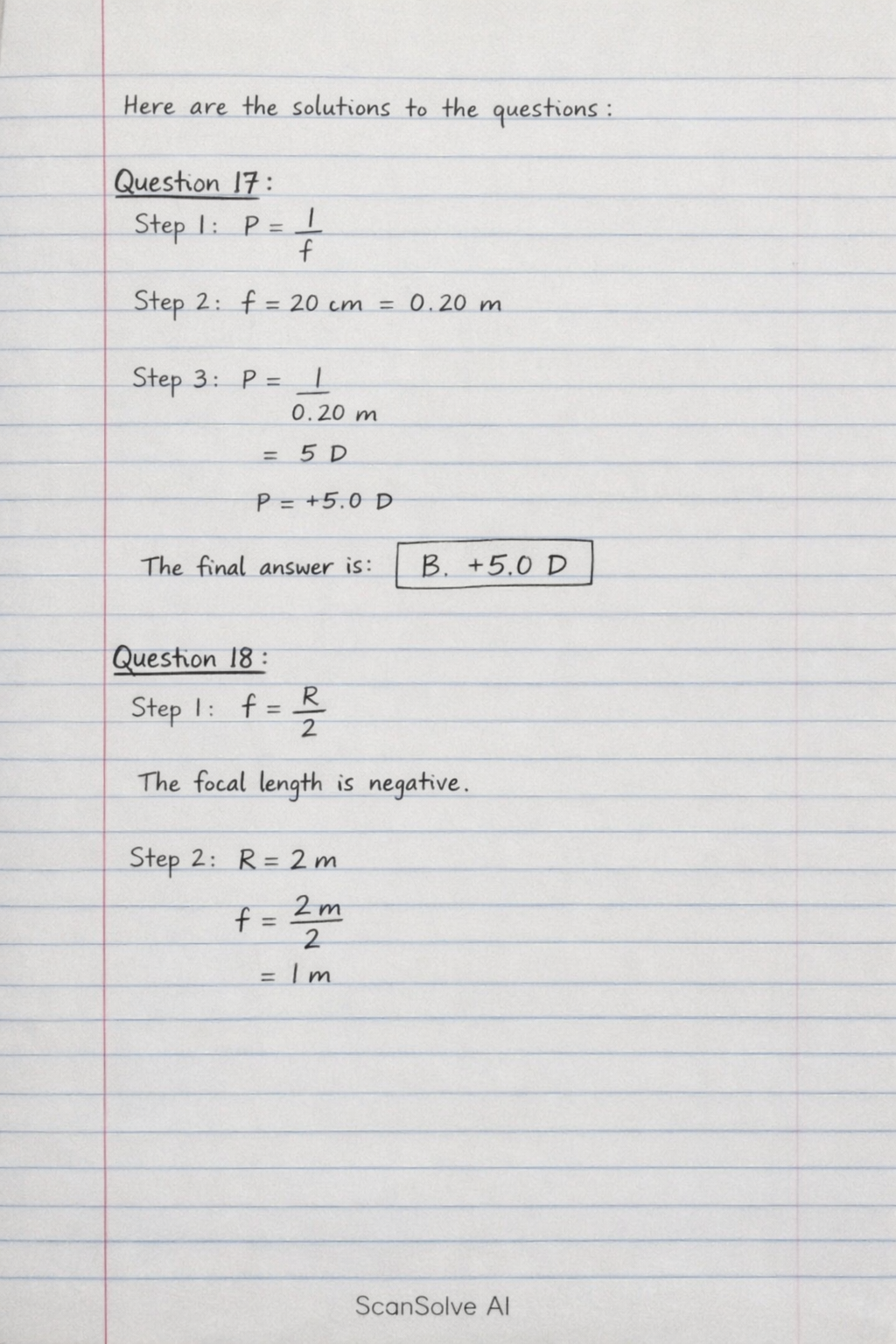
Handwritten Step-by-Step Solution
Get this as a handwritten image on WhatsApp — like a tutor wrote it for you.
Try on WhatsApp